The Brightened Night Sky Nobody Actually Wanted
I have spent a good part of my life pointing telescopes upward and trying to persuade people to look up too. It is a pursuit rooted in wonder, patience, and a deep respect for the darkness that makes it all possible. So it takes something fairly extraordinary to make me genuinely uneasy about what is coming for the night sky. A new paper in Astrophysical Journal Letters does exactly that — and the numbers it contains deserve far wider attention than they have yet received.
Sunlight on Demand: The Reflect Orbital Proposal
A Californian company called Reflect Orbital wants to place giant mirrors in orbit and beam concentrated sunlight down to Earth after dark. Their pilot satellite, named Eärendil-1 — a reference to the Tolkien character who sailed the heavens bearing a silmaril as a beacon of hope — carries an 18 by 18 metre reflective panel at roughly 600 kilometres altitude. It is designed to project a focused patch of artificial daylight approximately 2.5 kilometres in diameter onto any chosen location on the ground, at a customer's request. The stated applications are not without a certain humanitarian appeal: solar farms that could generate power through the night, disaster zones illuminated for search-and-rescue crews operating after sunset, agricultural areas extended beyond the limits of natural seasons.
But Eärendil-1 is explicitly a test article, not an endpoint. The company's roadmap calls for a constellation of approximately 50,000 satellites, with the production versions scaling up to a formidable 54 by 54 metres per reflector. To put that in context, each production mirror would have a surface area exceeding 2,900 square metres — larger than half a football pitch, suspended in low Earth orbit and perpetually chasing the terminator between night and day.
What the Physics Actually Says
The new paper, just accepted for publication in Astrophysical Journal Letters and led by a team including the Princeton astronomer Gáspár Bakos, does the atmospheric physics with commendable rigour. Rather than simply estimating the brightness of the mirror itself, the researchers modelled the full radiative transfer problem — how concentrated reflected sunlight would scatter through Earth's atmosphere, accounting for both Rayleigh scattering (the molecular-level scattering responsible for the blue sky) and aerosol scattering from particulates and water droplets. The distinction matters enormously, because it is atmospheric scattering that transforms a point source of light into a diffuse glow contaminating the entire sky dome.
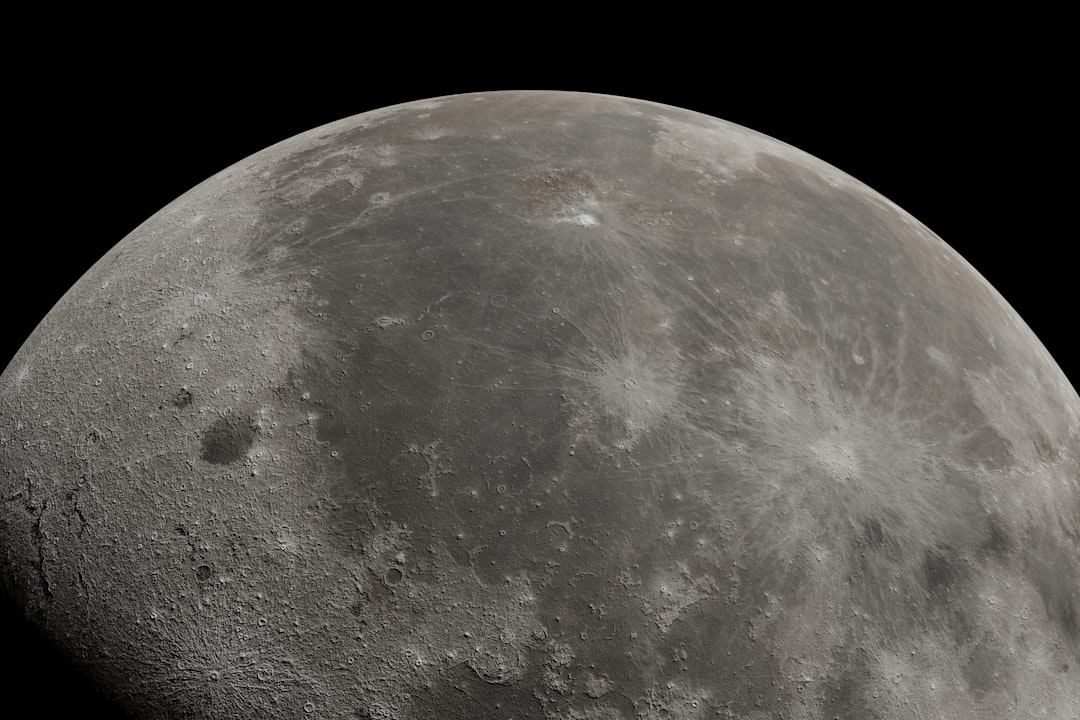
The results are stark. A single production-scale 54-metre mirror would appear as a point of light at approximately magnitude −16.7 to an observer standing within the illuminated beam on the ground. For reference, the full Moon sits at around magnitude −12.7, meaning one of these production satellites would be roughly four stellar magnitudes brighter — a factor of approximately 40 times more luminous than the full Moon as seen from Earth's surface. The NASA Lunar Reconnaissance Orbiter's detailed photographic mosaic of the full Moon served as the researchers' photometric benchmark, a choice that makes the comparison viscerally easy to appreciate.
A single production satellite would outshine the full Moon by roughly four stellar magnitudes — approximately 40 times brighter — and its scattered atmospheric glow would resemble the sky shortly after sunset across a region spanning tens of kilometres.
The picture outside the direct beam is equally troubling. At a distance of 14 kilometres from the illuminated footprint, the scattered atmospheric glow alone — the diffuse halo of light radiating outward through the air — would exceed the brightness of full moonlight across most of the observable sky hemisphere. At 34 kilometres, the effect remains perceptible as brighter than natural moonlight. The resulting sky background has been described by the authors as resembling civil twilight — the period roughly 20 to 30 minutes after sunset when the sky is bright enough to read by but the sun has dipped below the horizon. In that condition, all but the very brightest stars simply vanish.
Scale the operation up to 400 mirrors simultaneously illuminating the same region — a scenario consistent with the company's long-term commercial ambitions — and the glow becomes clearly detectable from 80 kilometres away, affecting not just the target area but an enormous surrounding region whose residents have no say in the matter and no commercial relationship with the company providing the service.
The Regulatory Vacuum at the Heart of the Problem
Eärendil-1 received clearance from the US Federal Communications Commission (FCC) in July 2024, despite more than 1,800 formal public comments and organised objections from the American Astronomical Society (AAS) and numerous dark-sky advocacy organisations. The FCC's reasoning was, in a sense, technically correct and substantively alarming in equal measure: light pollution and interference with astronomical observation simply fall outside the agency's regulatory mandate, which focuses on radio frequency spectrum management and communications infrastructure. The commission is not equipped, nor legally empowered, to weigh the photometric impact on the night sky when evaluating satellite licences.
What makes this regulatory gap so consequential is that no other body has yet claimed jurisdiction over it. The International Telecommunication Union (ITU), which coordinates global satellite orbital slot allocations, similarly has no framework for assessing optical brightness or sky glow. The International Astronomical Union (IAU) has issued increasingly urgent statements about satellite constellations and optical interference, but its resolutions carry no binding authority. The result is a commons — the night sky viewed by every person on Earth — being reshaped by commercial decisions made in a single jurisdiction, with no international mechanism for objection, mitigation, or redress.
This is not entirely a new problem. The launch of SpaceX Starlink satellites beginning in 2019 triggered an intense and ongoing debate within the astronomy community about the cumulative optical impact of large satellite constellations, with researchers documenting measurable contamination of wide-field survey images at facilities including the Vera C. Rubin Observatory. But Starlink satellites, however numerous, are passive reflectors catching sunlight incidentally. Reflect Orbital's proposal is categorically different: these are active optical sources, designed from first principles to maximise the delivery of concentrated sunlight to the ground. The brightness comparison is not even close.
Who Bears the Cost?
Light pollution already represents one of the most pervasive and least-discussed forms of environmental degradation on Earth. Studies published in Science Advances have documented that more than 80 percent of the world's population, and 99 percent of Europeans and North Americans, now live under light-polluted skies. The Milky Way is invisible to more than one-third of humanity. The consequences extend well beyond the frustrations of amateur astronomers.
- Ecological disruption: Dozens of studies have documented the impact of artificial night lighting on nocturnal wildlife, including migratory birds that navigate by starlight, sea turtle hatchlings disoriented by coastal light sources, and insect populations whose breeding cycles are calibrated to darkness.
- Human health: Epidemiological research has linked chronic exposure to artificial light at night with disrupted circadian rhythms, suppressed melatonin production, and elevated risks of certain cancers, metabolic disorders, and cardiovascular disease.
- Cultural heritage: For the entirety of human history until the twentieth century, a dark night sky was a universal human experience — one that shaped mythology, navigation, agriculture, and our understanding of our place in the cosmos. Its disappearance is a form of cultural impoverishment with no obvious remedy.
- Professional astronomy: Ground-based observatories representing billions of dollars of public and private investment are increasingly constrained in their ability to conduct sensitive observations as sky backgrounds brighten. Entire classes of research — faint object spectroscopy, transient detection, debris disk imaging — become progressively harder as artificial sky brightness increases.
A 54-metre orbital mirror, operated commercially on behalf of a paying customer, would impose all of these costs simultaneously on a region spanning thousands of square kilometres, without any mechanism for compensation or consent.
A Preview of What Is Coming
I think about the people who will never get a say in this. The amateur astronomer assembling a telescope in a suburban garden for the first time, hoping for a clean view of Saturn's rings hanging impossibly in the eyepiece. The migrating birds crossing continents on ancient routes calibrated over millions of years to the rhythm of dark nights. The nocturnal animals whose entire ecological niche depends on a darkness we are now systematically eliminating. The people who moved to rural locations partly for the peace and partly, yes, for the dark night-time environment — a choice that may soon require considerably more than a house move to honour. The handful of designated dark sky reserves remaining in Britain, the Galloway Forest Park, the Brecon Beacons, and the Exmoor National Park among them, that people drive for hours to reach precisely because the sky there still behaves as skies are supposed to behave.
A single test satellite is not the end of the night sky. Eärendil-1 alone, at 18 by 18 metres, is substantially less alarming than the production fleet that follows it. But it is a proof of concept, a legal precedent, and a fairly unambiguous preview of what "sunlight on demand" actually costs everyone who is not buying it. The paper in Astrophysical Journal Letters has now put hard numbers on that cost. The question is whether anyone with actual regulatory authority is paying attention.
The night sky is a commons. It belongs to no company, no government, and no generation. Once brightened at scale, it cannot simply be switched off again.
Further Reading and Sources
- Astrophysical Journal Letters — Original research publication venue for the Bakos et al. study on atmospheric light pollution from Reflect Orbital space mirrors
- American Astronomical Society — Formal statement of opposition to the Reflect Orbital FCC application
- NASA Lunar Reconnaissance Orbiter — Source of the photometric full Moon mosaic used as the study's brightness benchmark
- International Astronomical Union — Statements on satellite constellation impacts on astronomy
- International Dark-Sky Association — Resources on light pollution science, policy, and dark sky preservation