In the cosmic hierarchy of black holes, a mysterious population remains frustratingly elusive. While astronomers have successfully identified stellar-mass black holes formed from collapsing stars and the supermassive black holes lurking at galactic centers, the theorized middle children of this family—intermediate-mass black holes (IMBHs)—continue to evade definitive detection. Now, groundbreaking research suggests that an unexpected cosmic phenomenon might finally reveal these hidden giants: the gravitational microlensing of Fast Radio Bursts.
A team of astrophysicists led by Huan Zhou from Yangtze University in China has proposed an innovative detection method that could solve one of astronomy's most persistent puzzles. By analyzing patterns in CHIME's extensive catalog of Fast Radio Bursts, the researchers have identified two potential signatures of IMBHs with masses ranging from approximately 539 to 2,571 solar masses. Their findings, published in a preprint on arxiv.org, represent a promising new avenue for confirming the existence of these theoretical objects that have remained in the shadows of observational astronomy for decades.
The implications extend far beyond simply filling a gap in our understanding of black hole populations. These intermediate-mass objects could provide crucial insights into strong-field gravity—regions where spacetime experiences extreme warping—and may even constitute a significant fraction of the universe's enigmatic dark matter. If confirmed, this discovery would represent a major breakthrough in both black hole physics and our understanding of the cosmos's fundamental structure.
The Missing Link in Black Hole Evolution
The black hole mass spectrum presents a curious puzzle. At the lower end, stellar-mass black holes typically range from about 5 to 100 solar masses, formed through the gravitational collapse of massive stars at the end of their lives. At the opposite extreme, supermassive black holes contain millions to billions of solar masses, dominating the centers of galaxies including our own Milky Way, where Sagittarius A* resides with approximately 4 million solar masses.
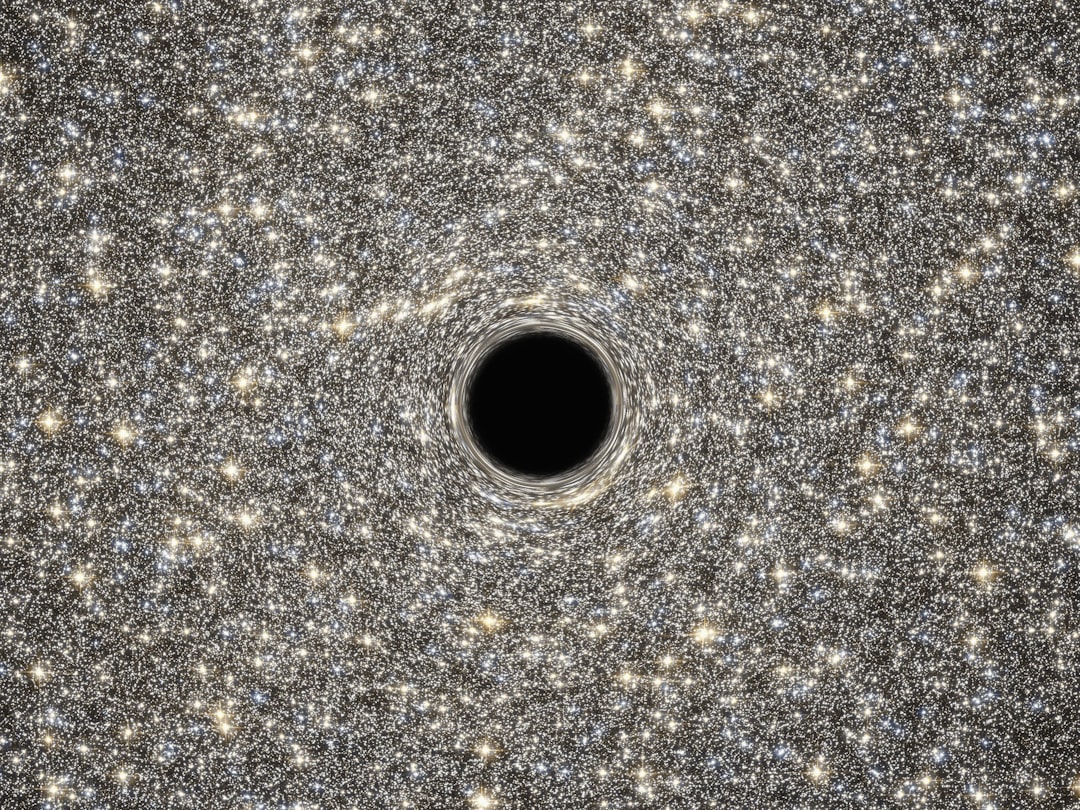
Between these two well-established populations should exist intermediate-mass black holes, with masses between 10² and 10⁵ solar masses. Theoretical models of galaxy formation and black hole evolution strongly suggest these objects should be relatively common, potentially forming through several mechanisms including the merger of stellar-mass black holes in dense star clusters or the direct collapse of massive gas clouds in the early universe.
Yet observational confirmation has proven extraordinarily challenging. The most compelling candidate emerged in 2008 from observations of Omega Centauri, the Milky Way's largest globular cluster. Data from the Hubble Space Telescope and the Gemini Observatory suggested a black hole of approximately 40,000 solar masses lurked in the cluster's core. However, subsequent analyses disputed these findings, leaving the question unresolved and highlighting the difficulty of definitively identifying IMBHs through traditional observational methods.
Fast Radio Bursts: Cosmic Lighthouses for Black Hole Detection
Fast Radio Bursts (FRBs) rank among the most enigmatic phenomena in modern astrophysics. These intense pulses of radio waves last anywhere from a fraction of a microsecond to approximately three seconds, releasing as much energy in milliseconds as the Sun emits in several days. First discovered in 2007, FRBs originate from distant galaxies billions of light-years away, yet their exact physical mechanism remains one of astronomy's most intriguing unsolved mysteries.
The Canadian Hydrogen Intensity Mapping Experiment (CHIME), a revolutionary radio telescope located in British Columbia, has dramatically accelerated FRB research by detecting hundreds of these events. CHIME's unique design—four 100-meter-long cylindrical reflectors monitoring a large swath of sky simultaneously—makes it exceptionally suited for capturing these fleeting cosmic signals.
"The microlensing effect of fast radio bursts can serve as a clean and powerful method to probe IMBHs," the researchers explain in their paper. "Among FRBs, the most likely to contain lensing signals are those with clear multipeak structures."
When an FRB's light passes near a massive object like a black hole, gravitational microlensing occurs—the black hole's gravity bends the light, creating multiple images or an echo effect. This phenomenon, predicted by Einstein's theory of general relativity, provides a unique signature that can reveal both the presence and mass of the lensing object. Unlike direct observation methods that require detecting light from material falling into the black hole, microlensing works even for completely isolated black holes with no surrounding matter to illuminate them.
Decoding the Microlensing Signatures
Zhou's team systematically analyzed CHIME's FRB catalog, focusing on bursts exhibiting distinct multipeak structures—the telltale sign of potential gravitational lensing. Their sophisticated analysis revealed two compelling candidates that displayed characteristics consistent with microlensing by intermediate-mass black holes.
The first signature indicates a lensing mass of approximately 539-609 solar masses, while the second suggests a substantially more massive object weighing in at 1,544-2,571 solar masses. Both fall squarely within the theoretical mass range for IMBHs, making them prime candidates for this elusive population. The precision of these mass estimates, derived from detailed modeling of the lensing effect on the FRB light curves, represents a significant achievement in observational technique.
The research methodology involved careful consideration of multiple factors that could produce similar signatures. The team had to distinguish genuine gravitational lensing from intrinsic properties of the FRB source itself, as some emission mechanisms might naturally produce multipeak structures. This required sophisticated statistical analysis and modeling to assess the probability that these signatures genuinely represent lensing events rather than source-intrinsic phenomena.
Implications for Dark Matter
Perhaps the most tantalizing aspect of these findings relates to the nature of dark matter, the invisible substance comprising approximately 85% of the universe's matter. If the detected IMBHs are primordial black holes—formed in the extreme conditions of the early universe rather than from stellar collapse—they could represent a significant component of dark matter itself.
The researchers' analysis suggests several possibilities:
- Primordial Origin Scenario: If these IMBHs are primordial and representative of a larger population, black holes in these mass ranges could constitute approximately 4% of all dark matter in the universe
- Upper Limit Constraints: Even if these candidates prove to be false positives, the analysis constrains the abundance of primordial black holes with masses exceeding 300 solar masses to no more than 13% of dark matter at 95% confidence level
- Isolated Population: The lack of obvious intervening structures like galaxies or galaxy clusters along the line of sight suggests these objects may indeed be isolated primordial black holes rather than IMBHs formed within galactic environments
This connection to dark matter makes the findings particularly significant. Dark matter remains one of physics' greatest mysteries, and any observational constraints on its nature represent valuable progress toward understanding the universe's fundamental composition.
Challenges and Future Verification
Despite the promising nature of these detections, significant challenges remain before astronomers can confidently claim discovery of IMBHs through this method. The primary uncertainty revolves around our incomplete understanding of FRB emission mechanisms. Without knowing precisely how these bursts are generated, distinguishing between lensing-induced multipeak structures and intrinsic source properties remains difficult.
Several avenues exist for strengthening these results and the general methodology:
- Enhanced FRB Characterization: More detailed observations of FRB host galaxies and environments would help determine whether apparent lensing signatures could be produced by source-intrinsic mechanisms
- Statistical Validation: As CHIME and other facilities like ASKAP in Australia detect more FRBs, statistical analysis of lensing rates can test whether the observed frequency matches theoretical predictions
- Multi-wavelength Follow-up: Coordinated observations across different wavelengths during FRB events could provide additional constraints on lensing versus intrinsic explanations
- Improved Theoretical Models: Better understanding of strong-field gravity effects and FRB physics will sharpen the ability to interpret potential lensing signatures
The authors emphasize that establishing microlensing of FRBs as a reliable tool for detecting IMBHs will require "more comprehensive observational information for FRBs, together with a deeper understanding of whether the intrinsic emission mechanisms of FRBs can produce lensing-like signals."
A New Window on Cosmic Evolution
The potential confirmation of IMBHs through FRB microlensing would have profound implications extending across multiple areas of astrophysics. These objects represent crucial laboratories for testing general relativity in extreme conditions, where spacetime curvature reaches levels impossible to replicate in terrestrial experiments. Observations of matter and light behavior near IMBHs could reveal whether Einstein's theory holds in these extreme regimes or whether modifications are necessary.
Furthermore, understanding the IMBH population addresses fundamental questions about supermassive black hole formation. How did the universe's first galaxies develop billion-solar-mass black holes within a few hundred million years of the Big Bang? IMBHs could serve as the seeds that grew into these supermassive giants through accretion and mergers, making their detection crucial for reconstructing the cosmic history of black hole growth.
The technique also showcases the power of using transient cosmic events as probes of otherwise invisible phenomena. Just as gravitational wave detectors like LIGO revolutionized black hole astronomy by detecting mergers, FRB microlensing could open a complementary window on isolated black holes that would otherwise remain completely undetectable.
As next-generation radio telescopes come online and our catalog of well-characterized FRBs grows, this method may finally solve the mystery of intermediate-mass black holes and illuminate the hidden architecture of the universe's dark matter. The cosmic hierarchy of black holes may soon be complete, revealing the full spectrum of these extraordinary objects that shape the evolution of galaxies and the structure of spacetime itself.