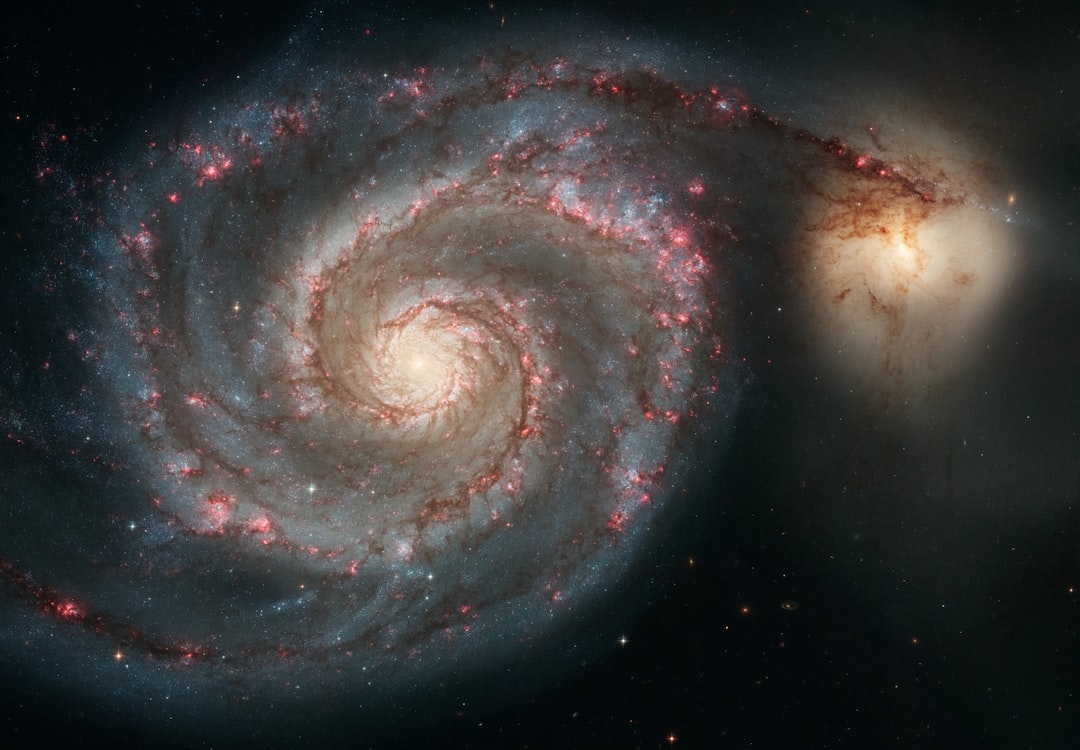
In the vast expanse of the cosmos, where distances span hundreds of thousands of light-years and events unfold over hundreds of millions of years, one of the universe's most majestic phenomena is occurring right before our eyes. Two magnificent spiral galaxies, designated IC 2163 and NGC 2207, are engaged in a cosmic dance that began millions of years ago when they first brushed past each other at velocities exceeding hundreds of kilometers per second. Captured in stunning detail by NASA's Chandra X-ray Observatory and other space telescopes, this galactic encounter provides astronomers with a remarkable window into one of the universe's most transformative processes.
What makes this celestial spectacle so captivating is the paradoxical nature of galactic collisions. Despite the violent-sounding terminology, these encounters proceed with an almost balletic grace. From our terrestrial vantage point, approximately 80 million light-years away in the constellation Canis Major, these two galaxies appear frozen in an eternal embrace, their graceful spiral arms extending toward one another like cosmic dancers suspended in time. Yet this apparent stillness belies the tremendous forces at work and the dramatic transformations unfolding within these galactic systems.
The composite imagery released by NASA represents a technological tour de force, combining observations from multiple wavelengths to reveal different aspects of this galactic interaction. Visible light data from the Hubble Space Telescope captures the overall structure and distribution of stars, while infrared observations penetrate dust clouds to reveal hidden star-forming regions, and X-ray data from Chandra highlights the most energetic phenomena occurring within the collision zone.
The Surprising Gentleness of Cosmic Catastrophes
When most people imagine galaxies colliding, they envision catastrophic impacts with stars smashing into each other like billiard balls on a cosmic scale. However, the reality of galactic mergers defies these intuitive expectations. Despite each galaxy containing hundreds of billions of stars, actual stellar collisions during these encounters are extraordinarily rare events. This counterintuitive outcome stems from a fundamental property of galaxies that often surprises non-astronomers: galaxies are mostly empty space.
To truly grasp this concept, consider a thought experiment that brings these cosmic scales down to human dimensions. If we were to shrink our Sun to the size of a single grain of sand, the nearest star, Proxima Centauri, would be located approximately four kilometers away. This vast emptiness means that when two galaxies interpenetrate during a merger, their constituent stars pass through each other's territories like ghosts, rarely if ever coming close enough to interact gravitationally in any significant way. According to research published in the Astrophysical Journal, computational simulations suggest that even in the densest regions of merging galaxies, the probability of direct stellar collisions remains vanishingly small.
This doesn't mean that individual stars remain unaffected by the merger. While direct collisions are rare, the collective gravitational field of hundreds of billions of stars profoundly influences stellar orbits. Stars that once followed orderly, circular paths around their galactic centers find themselves pulled in new directions, their trajectories bent and twisted by the competing gravitational influences of two massive galactic systems.
Where Gas Clouds Collide: The Spectacular Birth of Stars
While stars pass through each other like ships in the night, the story is dramatically different for the vast reservoirs of gas that permeate both galaxies. Each spiral galaxy contains enormous quantities of interstellar gas, primarily hydrogen and helium, distributed throughout the space between stars. When these diffuse clouds slam together at velocities of hundreds of kilometers per second, the results are nothing short of spectacular.
The collision compresses these gas clouds violently, increasing their density by orders of magnitude. This compression has a profound consequence: it triggers gravitational collapse in regions where the gas becomes dense enough to overcome its own internal pressure. The result is an explosive burst of star formation, often called a "starburst" event, that can produce stars at rates hundreds of times faster than in isolated, undisturbed galaxies.
"When we observe merging galaxies like IC 2163 and NGC 2207, we're witnessing star formation on steroids. The collision compresses gas clouds so efficiently that entire stellar nurseries spring to life simultaneously, creating some of the most luminous and energetic regions in the nearby universe," explains Dr. Michelle Thaller, astronomer at NASA's Goddard Space Flight Center.
The composite image of IC 2163 and NGC 2207 beautifully illustrates this phenomenon. The blue and red specks scattered throughout both galaxies mark regions where newborn stars are blazing to life. The most massive of these infant stars burn with such intensity that they heat surrounding gas to temperatures of millions of degrees, generating powerful X-rays that appear as ethereal blue highlights in Chandra's observations. These young, massive stars live fast and die young, often exploding as supernovae within just a few million years of their birth, further enriching the interstellar medium with heavy elements forged in their nuclear furnaces.
The Role of Shock Waves in Stellar Genesis
The physics of gas cloud collisions in merging galaxies involves complex hydrodynamic processes that researchers at institutions like the Space Telescope Science Institute continue to study intensively. When two gas clouds collide at supersonic speeds, they generate powerful shock waves that propagate through the medium. These shocks compress the gas even further, creating ideal conditions for gravitational collapse. Additionally, the turbulence generated by these collisions can fragment large gas clouds into smaller clumps, each of which may independently collapse to form a star or stellar system.
Gravitational Choreography: Tidal Forces and Galactic Reshaping
Beyond the immediate effects of gas cloud collisions, gravitational tidal forces play a crucial role in reshaping both galaxies during their merger. These are the same fundamental forces that cause Earth's oceans to bulge toward the Moon, but operating on incomparably larger scales. As IC 2163 and NGC 2207 orbit around their common center of mass, the gravitational pull varies across each galaxy, being stronger on the side facing the companion and weaker on the far side.
This differential gravitational force, known as a tidal force, literally pulls stars out of both galaxies, creating long streamers called tidal tails that can stretch for hundreds of thousands of light-years into intergalactic space. These spectacular structures, visible in deep images of many merging systems, represent some of the most visually striking features of galactic collisions. The famous Antennae Galaxies, for instance, display dramatic tidal tails that extend far beyond the main galactic bodies.
In the case of IC 2163 and NGC 2207, observers can already detect pronounced distortions where the spiral arms of both galaxies overlap. The normally graceful, logarithmic spirals characteristic of undisturbed spiral galaxies show unnatural curves and bends as they respond to their neighbor's gravitational influence. Over successive passes through each other's gravitational wells, these distortions will become increasingly severe until the original spiral structure is completely obliterated.
The Ultimate Fate: From Spirals to Ellipticals
The long-term destiny of IC 2163 and NGC 2207 is already written in the laws of physics. Over the next several billion years, these two galaxies will complete multiple passes through each other, each encounter sapping orbital energy through a process called dynamical friction. With each passage, the galaxies will draw closer together, their mutual gravitational attraction inexorably pulling them toward an ultimate merger.
Eventually, perhaps three to five billion years from now, IC 2163 and NGC 2207 will coalesce into a single, larger galaxy. But this remnant will look nothing like its spiral progenitors. The ordered rotation that characterizes spiral galaxies, with stars following neat circular or elliptical orbits in a thin disk, will be replaced by a more chaotic distribution. Stars will orbit in random directions, creating a smooth, roughly spherical or ellipsoidal distribution characteristic of elliptical galaxies.
This transformation from spiral to elliptical represents one of the fundamental pathways of galactic evolution. Astronomers have long recognized that elliptical galaxies, particularly the most massive examples, are likely the products of major mergers between spiral galaxies. The violence of the merger scrambles stellar orbits, erasing the delicate disk structure and creating the pressure-supported, randomly orbiting stellar populations we observe in ellipticals today.
Our Own Cosmic Future: The Milky Way-Andromeda Collision
The merger of IC 2163 and NGC 2207 isn't just a distant curiosity—it's a preview of our own galaxy's future. In approximately four billion years, the Milky Way will begin its own collision with the Andromeda Galaxy (M31), our nearest large galactic neighbor located roughly 2.5 million light-years away. Observations using the Hubble Space Telescope have precisely measured Andromeda's motion through space, confirming that it is indeed on a collision course with our galaxy.
This future merger has captured public imagination and generated numerous questions about Earth's fate. The good news is that the collision poses no direct threat to our planet or solar system. Given the vast distances between stars, the probability of our Sun experiencing a close encounter with another star during the merger is negligibly small. Instead, our Sun will simply find itself reassigned to a new galaxy—the product of the Milky Way-Andromeda merger, sometimes whimsically called "Milkomeda" or "Milkdromeda" by astronomers.
However, the night sky visible from Earth will be transformed beyond recognition. As the galaxies approach, Andromeda will grow larger and larger in our sky, eventually spanning a region many times the apparent size of the full Moon. During the closest passages, the sky will be ablaze with newly formed stars as gas clouds collide and compress. Tidal forces may trigger bursts of star formation in our own galactic neighborhood, potentially creating brilliant stellar nurseries visible to the naked eye.
Timeline of the Milky Way-Andromeda Merger
- 4 billion years from now: First close passage between the Milky Way and Andromeda, with dramatic tidal distortions beginning to reshape both galaxies and triggering intense bursts of star formation in collision zones
- 5-6 billion years: Multiple passages through each other, with increasingly severe gravitational interactions and the formation of spectacular tidal tails stretching across millions of light-years
- 7 billion years: Final coalescence into a single elliptical galaxy, with the original spiral structures of both galaxies completely erased and replaced by a chaotic distribution of stars
- Long-term future: The merged galaxy settles into a stable elliptical configuration, possibly eventually accreting additional smaller galaxies from the Local Group
Scientific Significance and Future Research Directions
Studies of merging galaxies like IC 2163 and NGC 2207 provide crucial insights into galaxy evolution across cosmic time. In the early universe, when galaxies were closer together and collisions more frequent, mergers played an even more important role in building up the massive galaxies we observe today. By studying nearby merging systems in exquisite detail, astronomers can test theoretical models of galaxy formation and evolution, refining our understanding of how structure emerged from the nearly uniform conditions of the early universe.
Future observations with next-generation facilities promise to reveal even more about these cosmic collisions. The James Webb Space Telescope, with its unprecedented infrared sensitivity, can peer through dust clouds to reveal star formation in the most obscured regions of merging galaxies. Ground-based facilities like the upcoming Extremely Large Telescope will provide the spatial resolution needed to study individual star-forming regions and stellar populations within merger remnants.
Additionally, sophisticated computer simulations continue to improve, incorporating ever more realistic physics to model the complex interplay of gravity, gas dynamics, star formation, and stellar feedback during galactic mergers. These simulations help astronomers interpret observations and predict what IC 2163 and NGC 2207—and eventually the Milky Way and Andromeda—will look like at various stages of their merger process.
As we gaze upon the frozen waltz of IC 2163 and NGC 2207, we're witnessing not just a beautiful cosmic spectacle, but a fundamental process that has shaped the universe's structure throughout its 13.8-billion-year history. These colliding galaxies remind us that even on the largest scales, the cosmos remains dynamic and ever-changing, with transformations unfolding over timescales that dwarf human history but remain accessible to patient scientific observation and analysis.