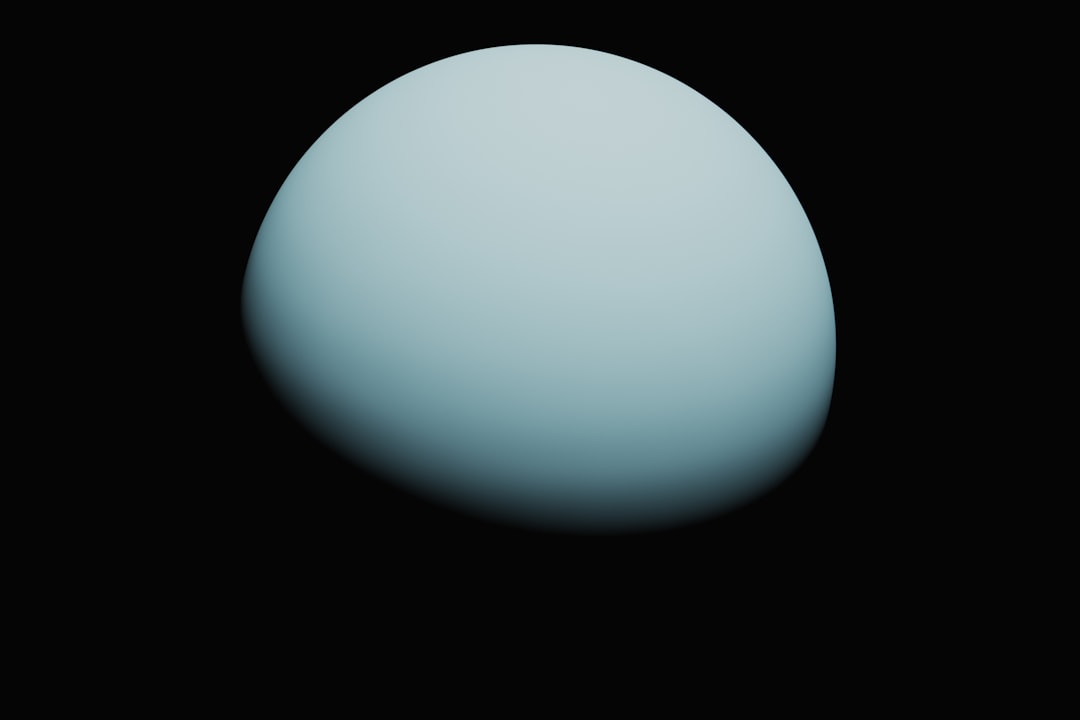
The seventh planet from our Sun, Uranus, stands as one of the solar system's most enigmatic worlds—a pale blue-green sphere tipped on its side, encircled by delicate rings, and accompanied by a retinue of mysterious moons. Despite its captivating characteristics, this ice giant remains largely unexplored, visited only once by humanity's robotic emissaries nearly four decades ago. Now, an innovative mission concept promises to finally unlock the secrets of this distant world and revolutionize our understanding of planetary formation across the cosmos.
Dr. Hadi Madanian, a Research Scientist and founder of Earth and Planetary Exploration Sciences LLC (Epex Scientific), has unveiled an ambitious proposal called CASMIUS (Coupled AtmosphereS and Magnetosphere Interactions of the Uranus System) at the 57th Lunar and Planetary Science Conference. This groundbreaking mission concept represents a comprehensive approach to studying Uranus, targeting everything from its peculiar magnetic field configuration to the chemical composition of its rings and the geological history of its diverse moon system. The proposal arrives at a critical juncture in planetary science, as the international community increasingly recognizes the urgent need to explore the ice giants before optimal launch windows close in the coming decade.
What makes CASMIUS particularly innovative is its proposed dual-spacecraft architecture, designed to provide simultaneous observations from multiple vantage points. This approach would enable scientists to capture dynamic processes in Uranus's atmosphere and magnetosphere that a single spacecraft might miss, offering unprecedented insights into how this tilted world interacts with the solar wind and generates its asymmetric magnetic field. According to research from NASA's planetary science division, such comprehensive exploration could answer fundamental questions about planetary evolution that have implications far beyond our solar system.
The Urgency of Ice Giant Exploration
Uranus and its sibling Neptune represent a class of planets that dominate the galaxy—ice giants are believed to be the most common type of planet orbiting distant stars, yet they remain the least understood worlds in our own cosmic neighborhood. The National Academies' Planetary Science Decadal Survey recently identified a Uranus mission as the highest priority for the next generation of flagship-class planetary exploration, emphasizing the scientific imperative to study these worlds before another generation passes.
The scientific community's interest in Uranus extends beyond mere curiosity about a distant planet. Understanding Uranus's interior structure, atmospheric dynamics, and magnetic field generation provides crucial data for interpreting observations of exoplanets—planets orbiting other stars. Astronomers have discovered thousands of Neptune and Uranus-sized worlds in other solar systems, but without detailed knowledge of our own ice giants, characterizing these distant worlds remains largely speculative. The CASMIUS mission concept addresses this knowledge gap by proposing comprehensive measurements that would serve as a Rosetta Stone for interpreting ice giant observations across the universe.
Mission Architecture and Timeline Considerations
The CASMIUS study presents a sophisticated analysis of potential mission trajectories and launch opportunities, recognizing that the enormous distance to Uranus—approximately 1.8 billion miles from Earth—presents significant engineering challenges. Dr. Madanian's research outlines several viable launch windows, each optimized for different mission parameters and scientific objectives. The proposal includes detailed delta-V calculations (the change in velocity required for spacecraft maneuvers) that demonstrate the feasibility of reaching Uranus within a reasonable timeframe.
According to the study, a mid-2033 launch would require approximately 9-10 years of cruise time to reach the Uranian system, utilizing gravitational assists from Jupiter to reduce fuel requirements and accelerate the spacecraft. Alternative launch windows in 2034 and 2035 offer similar transit times of 8-10 years, while a 2036 departure would extend the journey to approximately 10 years. These carefully calculated trajectories take advantage of planetary alignments that occur infrequently, making the next decade a critical window for launching ice giant missions. Mission planners at NASA's Jet Propulsion Laboratory have long emphasized that missing these optimal launch opportunities could delay Uranus exploration by another decade or more.
Dual-Spacecraft Synergy
The cornerstone of the CASMIUS concept lies in its proposed use of two complementary spacecraft, each carrying specialized instruments designed to work in concert. This innovative approach draws inspiration from successful multi-spacecraft missions like NASA's THEMIS (Time History of Events and Macroscale Interactions during Substorms) and ESA's Cluster mission, which revolutionized our understanding of Earth's magnetosphere through simultaneous multi-point measurements. By deploying two spacecraft at Uranus, CASMIUS would enable scientists to distinguish between spatial and temporal variations in the planet's dynamic environment—a capability impossible with a single probe.
The first spacecraft could focus on atmospheric characterization, carrying advanced spectrometers to analyze the composition of Uranus's clouds, measure wind speeds at different altitudes, and search for evidence of internal heat sources. Meanwhile, the second spacecraft might concentrate on magnetospheric studies, using particle detectors and magnetometers to map the complex magnetic field and investigate how it channels charged particles from the solar wind into the planet's atmosphere, potentially creating auroras at unexpected latitudes due to Uranus's tilted magnetic axis.
Scientific Objectives and Breakthrough Potential
The CASMIUS mission concept targets several fundamental mysteries that have puzzled planetary scientists since Voyager 2's brief encounter in 1986. One of the most perplexing questions concerns Uranus's extreme axial tilt—the planet rotates on its side, with its axis tilted 98 degrees relative to its orbital plane. This unusual orientation suggests a catastrophic collision early in the solar system's history, but the details of such an impact and its consequences for the planet's internal structure remain speculative. CASMIUS's precision gravity measurements could reveal asymmetries in Uranus's interior that preserve evidence of this ancient collision.
"Understanding the complexities of the Uranus system opens a new window to understanding the solar system formation, planetary dynamo, and exoplanet research. It also furthers our knowledge of our home planet in critical areas such as geomagnetism and dynamo and can provide insights into extreme events such as the magnetic dipole reversal."
The mission's focus on magnetospheric interactions addresses another profound mystery: Uranus's magnetic field is not only tilted 59 degrees from its rotational axis but also offset from the planet's center. This bizarre configuration, unique among the planets we've studied, challenges our understanding of how planetary magnetic fields are generated. Research published in the Journal of Geophysical Research suggests that Uranus's magnetic field might be generated in a thin shell of conducting material rather than deep in the planet's core, as occurs on Earth. CASMIUS's detailed magnetic field mapping could confirm or refute this hypothesis, with implications for understanding magnetic field generation in ice giants throughout the galaxy.
Rings and Moons: A Complex System
Beyond the planet itself, CASMIUS would investigate Uranus's intricate ring system and its family of 27 known moons, each potentially harboring unique geological histories. The rings, composed primarily of dark particles possibly rich in organic compounds, may preserve a record of ancient collisions and dynamical evolution. Several of Uranus's largest moons—including Miranda, Ariel, Umbriel, Titania, and Oberon—show evidence of past geological activity, with Miranda displaying some of the most dramatic terrain in the solar system, including towering cliffs and jumbled surface features that suggest a violent past.
Recent theoretical work suggests that some of Uranus's moons might harbor subsurface oceans beneath their icy crusts, similar to Jupiter's Europa and Saturn's Enceladus. If confirmed, these hidden oceans would dramatically expand the number of potentially habitable environments in our solar system. CASMIUS's observations of the moons' surfaces, combined with measurements of their gravitational fields and any potential plume activity, could identify which moons warrant future dedicated exploration missions.
The Broader Context: A Global Push to the Ice Giants
CASMIUS joins an increasingly crowded field of proposed ice giant missions, reflecting the international scientific community's recognition that exploring these distant worlds can no longer be postponed. NASA's Uranus Orbiter and Probe (UOP) mission currently leads the pack as the designated flagship mission recommended by the Decadal Survey, with a projected launch in the early 2030s. This ambitious mission would include both an orbiter for long-term observations and an atmospheric probe to directly sample Uranus's atmosphere, providing ground truth for remote sensing measurements.
International competitors are also eyeing the ice giants. China's Tianwen-4 mission, announced as part of that nation's expanding deep space exploration program, plans a dual mission that would orbit Jupiter while conducting a flyby of Uranus, demonstrating China's growing capabilities in outer solar system exploration. Meanwhile, the European Space Agency has studied its own MUSE (Mission to Uranus for Science and Exploration) concept, which mirrors NASA's approach with an orbiter and atmospheric probe combination, potentially opening opportunities for international collaboration that could enhance the scientific return while sharing costs.
Technical Challenges and Innovation Requirements
Mounting a successful mission to Uranus requires overcoming formidable technical challenges that push the boundaries of current spacecraft engineering. The extreme distance from the Sun means that solar panels become impractical, necessitating radioisotope thermoelectric generators (RTGs) to provide power—a technology that relies on limited supplies of plutonium-238. The communication delay of approximately 2.5 to 3 hours (one-way) means that spacecraft must operate with substantial autonomy, making critical decisions without real-time guidance from Earth.
The cold environment, with temperatures dropping below -220°C (-364°F), requires specialized materials and thermal control systems to keep instruments functioning. Additionally, the spacecraft must be designed to operate for at least a decade during the cruise phase, followed by an extended mission in orbit around Uranus. These requirements demand innovations in autonomous navigation, fault protection systems, and long-lived instruments that can maintain calibration over extended periods.
Implications for Planetary Science and Beyond
The scientific payoff from a successful Uranus mission extends far beyond cataloging the features of a single planet. Understanding how Uranus formed, evolved, and maintains its unusual characteristics provides essential data for planetary formation models that scientists use to interpret observations of distant solar systems. With ice giants being the most common type of planet discovered around other stars, detailed knowledge of Uranus serves as a critical reference point for characterizing thousands of exoplanets detected by missions like NASA's TESS and the upcoming Nancy Grace Roman Space Telescope.
Furthermore, studying Uranus's magnetic field generation mechanism could shed light on Earth's own geomagnetic dynamo and the processes that occasionally cause magnetic pole reversals. While Earth's magnetic field is generated deep in its liquid iron core, the different conditions in Uranus's interior—where the magnetic field may arise from convection in a layer of superionic water—provide a natural laboratory for testing dynamo theories under extreme conditions. These insights could improve our ability to predict long-term changes in Earth's magnetic field, which shields our planet from harmful solar radiation.
The Path Forward: From Concept to Reality
While CASMIUS remains a concept study rather than an approved mission, its detailed analysis of scientific objectives, mission architecture, and trajectory options contributes valuable information to the ongoing discussion about how best to explore Uranus. The mission concept demonstrates that innovative approaches using multiple spacecraft could achieve comprehensive scientific objectives while potentially reducing risk through redundancy. As NASA and international partners continue refining plans for ice giant exploration, concepts like CASMIUS help define the realm of possibilities and inspire new approaches to planetary exploration.
The next few years will be critical for ice giant exploration as space agencies move from concept studies to mission selection and development. With optimal launch windows opening in the early 2030s, decisions made in the current decade will determine whether humanity finally returns to Uranus after a half-century absence or whether these enigmatic worlds remain mysterious for another generation. The scientific community's enthusiasm, demonstrated by multiple mission concepts like CASMIUS, NASA's UOP, and ESA's MUSE, suggests that the ice giants' time has finally come.
As Dr. Madanian's work on CASMIUS demonstrates, individual researchers and small organizations can make significant contributions to mission planning, bringing fresh perspectives and innovative ideas to the challenge of exploring the outer solar system. Whether CASMIUS itself flies or its concepts are incorporated into other missions, this type of creative thinking will be essential for overcoming the formidable challenges of ice giant exploration and finally revealing the secrets of these distant, tilted worlds that have captivated astronomers since their discovery centuries ago.