Planets Don't Just Disappear — But They Can Wobble Out of Sight if Their Neighbour is Close Enough
NASA's Transiting Exoplanet Survey Satellite (TESS) has been one of the most productive planet-hunting missions in the history of astronomy. As of mid-2026, the mission has identified more than 8,100 candidate exoplanets, with just over 1,000 confirmed by follow-up observations. Still actively scanning the sky, TESS continues to surprise astronomers — not only through new detections, but through its rich archival data, which researchers are increasingly mining using advanced machine learning techniques to uncover hidden worlds.
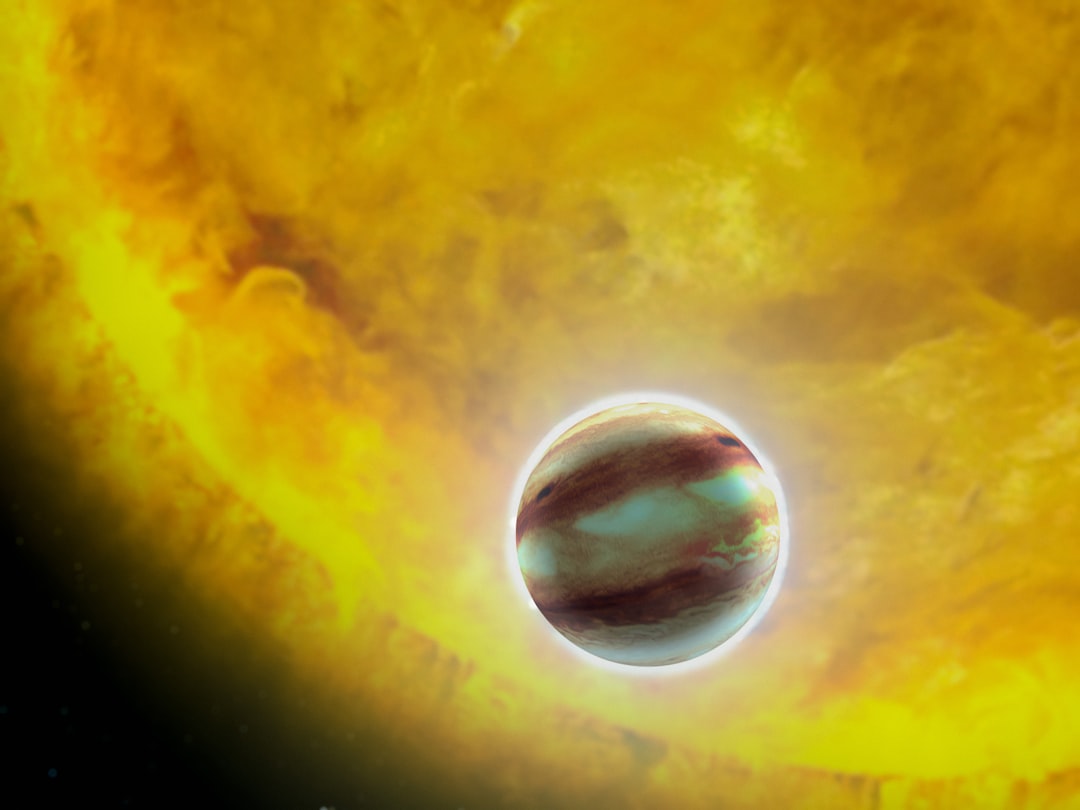
TESS was primarily engineered to detect smaller worlds — super-Earths and sub-Neptunes — orbiting nearby, bright stars. Yet in its sweeping sky surveys, it also captured numerous hot Jupiters: colossal gas giants that orbit perilously close to their host stars, completing full orbits in just days. These objects remain among the most scientifically fascinating and theoretically challenging planets known to science, defying early models of planetary formation that never anticipated such massive worlds forming so close to stellar heat. One particular hot Jupiter — designated TOI-2535b, located approximately 1,000 light-years from Earth — has now become the subject of an extraordinary study after exhibiting behavior that left astronomers momentarily baffled: it appeared to simply vanish.
A Planet That Seemed to Disappear
TESS observed multiple transits of TOI-2535b across seven years of observations. Then, as new data came in, the planet's signature faded — and ultimately disappeared from view entirely. For scientists who rely on the transit method to detect and characterize exoplanets, this was an unsettling anomaly. The transit method works by detecting the minute dimming of a star's light as a planet passes in front of it from our perspective. It is an elegant, powerful technique, but it demands a very specific geometric arrangement: the planet's orbit must be aligned almost perfectly with our line of sight.
New research published in The Astrophysical Journal Letters now offers a compelling natural explanation for this apparent vanishing act. The paper, titled "A TESS Disappearing Act: The Vanishing Transits of TOI-2535 b," is led by Samuel Yee, a postdoctoral fellow at UCLA, and represents a landmark discovery in exoplanetary science.
"Planetary transits require a fortuitous alignment between a planet's orbit and our line of sight, but dynamical interactions can render this geometric coincidence only temporary. We report the discovery of the hot Jupiter TOI-2535b, the first confirmed planet orbiting a single star whose transits have been directly observed to disappear."
— Samuel Yee et al., The Astrophysical Journal Letters, 2026
The Transit Method: Precision Dependent on Perfect Alignment
To fully appreciate why TOI-2535b's disappearance is so remarkable, it helps to understand the geometry of the transit method. When astronomers speak of a planet "transiting" its star, they mean that the planet crosses the stellar disk as seen from Earth. This phenomenon creates a characteristic, repeating dip in the star's light curve. But this arrangement only works if the planet's orbital plane is oriented edge-on relative to us — a condition called transit geometry.
The sensitivity of this method to orbital inclination is extreme. As the TOI-2535b team explains, a planet is only observable in transit when its orbit normal — the direction perpendicular to the orbital plane — lies within a few degrees of the sky plane. Even slight changes in a planet's orbital inclination, the tilt of its orbit relative to our line of sight, can produce measurable changes in the shape and duration of a transit. For sufficiently large inclination changes, a planet might only occupy the correct geometric window for a fraction of its total orbital evolution.
"If the variation is fast enough and we are lucky to catch the planet in the right phase of its inclination evolution, we may see its transits appear or disappear."
— Yee et al., 2026
This kind of orbital precession — the slow wobbling or tilting of an orbit over time — is well-understood in physics. It occurs in our own Solar System: Earth's axial tilt and orbital orientation drift over long timescales due to gravitational nudges from the Moon, Jupiter, and other bodies. But for such precession to be dramatic enough to cause a planet to vanish from transit observations on a timescale of years — that is extraordinary.
Watching the Orbit Change in Real Time
Crucially, TOI-2535b did not disappear suddenly. Astronomers watching the system over several years saw its transit signal evolve gradually. Both the timing and the shape of the transits changed in a systematic, measurable way before the signal vanished altogether. This gradual evolution is key evidence supporting the orbital precession hypothesis, distinguishing it from instrumental artifacts or astrophysical phenomena such as stellar variability or transit depth dilution.
The research team analyzed what are known as Transit Duration Variations (TDVs) — small, periodic changes in the length of time a planet takes to cross its star. These are exquisitely sensitive tracers of orbital geometry. TOI-2535b's TDVs are among the most extreme ever recorded, and they are accompanied by correspondingly dramatic changes in orbital inclination.
The system also exhibits some of the largest Transit Timing Variations (TTVs) ever measured — fluctuations in the precise moment when a transit occurs, which reveal the gravitational influence of other bodies in the system. TOI-2535b's TTVs are definitively the largest ever detected for a hot Jupiter, providing unmistakable evidence that something massive is perturbing its orbit from nearby.
- Largest TDVs ever recorded for a planet orbiting a single star
- Largest TTVs ever detected for any hot Jupiter
- A measured orbital precession period of decades — shorter than any other known system of this type
- Direct, real-time observation of transit disappearance — a first in exoplanetary science
"We think of the universe as resembling clockwork, where everything is regular, but that's not true. If there are multiple planets in a system, they can affect each other's orbits. We know of a few systems that are like this. This is the most extreme example we've seen because the two planets are interacting so strongly. The planet's orbit is tilting so quickly that its transit disappeared while we were watching."
— Samuel Yee, UCLA
The Culprit: A Hidden Giant Companion
So what is tilting TOI-2535b's orbit so dramatically? The research team's dynamical modeling points firmly to the existence of a second, hidden planet in the system — a companion with a mass of at least Saturn's mass, and possibly greater. This perturber is likely locked in a mean-motion resonance with TOI-2535b, meaning the two planets complete their orbits in a whole-number ratio of periods, reinforcing their gravitational interactions with each repetition.
Mean-motion resonances are well-documented in planetary science. Jupiter and Saturn are near a 5:2 resonance. Several of Jupiter's moons — Io, Europa, and Ganymede — are locked in a precise 1:2:4 resonance that drives tidal heating deep within their interiors. But a resonant pair of short-period giant planets orbiting so close to their star is something that existing planet formation models struggle to explain.
Phenomena like this are more commonly associated with circumbinary planets — worlds orbiting a binary star system — where the complex gravitational environment of two host stars can rapidly alter a planet's transit parameters. Around single stars, inclination variations of this magnitude are considered exceptionally rare. TOI-2535b's behavior therefore represents a dramatic outlier, and a scientifically precious one.
Challenging What We Know About Hot Jupiter Formation
The existence of a close companion to TOI-2535b is itself deeply puzzling. Hot Jupiters are, by conventional theory, expected to be lonely worlds. The leading explanation for how they arrive so close to their stars — high-eccentricity migration — involves a dramatic gravitational scattering event that hurls the planet onto a highly elliptical orbit, after which tidal forces from the host star gradually circularize and shrink the orbit, leaving the planet stranded in a close, hot orbit. This violent process would likely eject or destroy any nearby companions.
The TOI-2535 system's architecture directly contradicts that narrative. The research team explicitly rules out high-eccentricity migration as an explanation. Instead, they outline two alternative formation scenarios:
- Eccentric interaction followed by tidal capture: A powerful gravitational interaction — perhaps a near-encounter with another massive body — sends the planet into an elliptical orbit, after which the host star's gravitational tides gradually draw it inward to reside as a hot Jupiter. This can allow companions to survive if the interaction was not catastrophically violent.
- Disk migration: The planet gradually spirals inward through the protoplanetary disk while other planets do the same, arriving at its current location without violent disruption. This scenario preserves neighboring planets but struggles to explain the nonzero orbital inclinations observed — since the disk environment would tend to flatten and align all orbital planes. Some later gravitational excitation would be required to tilt the orbits to their current configuration.
Yee himself favors a version of the disk migration scenario. "Because TOI-2535b has a close neighbor, it probably migrated by slowly spiraling in instead of getting flung in," he said. "We may be seeing a formation channel that doesn't happen very often but is very interesting." A complete picture of the system's orbital architecture — the precise masses, periods, and inclinations of all components — will be essential to discriminating between these possibilities. That full picture is not yet available.
Why This Discovery Matters for Planetary Science
TOI-2535b is now only one of a small handful of hot Jupiters known to have a close planetary companion. What makes it even more remarkable is that the companion is likely another giant planet — not the sub-Neptune or super-Earth companions that have been found around the rare hot Jupiters that do have neighbors. A gravitationally resonant pair of short-period giants is a configuration that pushes the boundaries of current planet formation theory and demands a fresh look at the processes that shape solar systems.
Beyond its implications for formation models, the TOI-2535 system offers something that is almost unheard of in astronomy: the ability to watch planetary orbital evolution unfold on human timescales. The dynamical interactions between these two giant planets are reshaping their orbits over decades, not millions of years. For scientists who study planetary system dynamics, this is an observational goldmine.
Phenomena like precessing orbits, TTVs, and TDVs are typically inferred from long-baseline statistical analyses or modeled theoretically. Here, they can be directly measured in near real time, providing a unique empirical laboratory for testing dynamical models. Future observations — particularly with instruments like the James Webb Space Telescope (JWST) and ground-based high-resolution spectrographs capable of radial velocity measurements — could soon provide the detailed orbital constraints needed to fully characterize the companion planet and settle the question of the system's formation history.
Key Takeaways
- TOI-2535b is the first confirmed exoplanet around a single star whose transits have been directly observed to disappear.
- The disappearance is caused by orbital precession driven by gravitational interactions with a hidden companion planet.
- The companion is likely a Saturn-mass or larger giant planet in mean-motion resonance with TOI-2535b.
- This makes TOI-2535 one of the rarest known multi-giant, short-period planetary systems.
- The system's formation cannot be explained by standard high-eccentricity migration models, challenging prevailing theories of hot Jupiter origin.
- The orbital evolution is occurring on human timescales, providing an unprecedented opportunity to study planet–planet interactions in action.
The TOI-2535 system is a reminder that planetary systems are not the static, clockwork arrangements they might appear to be. They are dynamic, evolving structures, shaped by gravitational forces that play out across vast stretches of time — but, in rare and precious cases like this one, compressed into windows that we can actually witness. As NASA's Exoplanet Exploration Program continues to push the frontiers of discovery, systems like TOI-2535 will serve as crucial benchmarks, challenging theorists and observers alike to refine our understanding of how planets are born, how they migrate, and how they interact across the full sweep of cosmic time.
The full study, "A TESS Disappearing Act: The Vanishing Transits of TOI-2535 b," is published in The Astrophysical Journal Letters and is authored by Samuel W. Yee and collaborators.