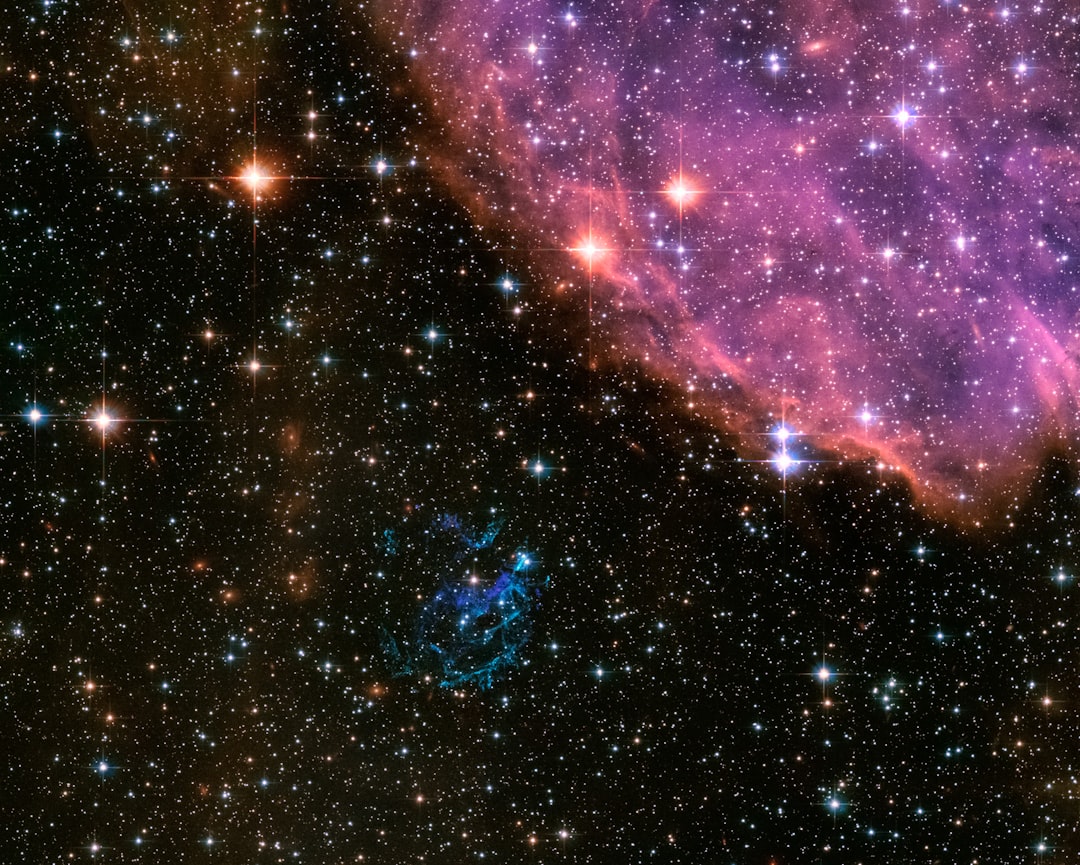
In the frigid darkness between the stars, billions of years before our Sun first ignited, the raw materials of our Solar System drifted silently through space. These interstellar molecular clouds—sprawling cosmic nurseries of ice, gas, and microscopic dust particles—contained within them the chemical blueprint for everything that would eventually emerge: terrestrial worlds like Earth, massive gas giants, and potentially the very building blocks of life itself. Yet despite decades of astronomical observation and theoretical modeling, scientists have struggled to fully understand the precise chemical pathways that transformed these primordial ingredients into the diverse planetary systems we observe today.
A groundbreaking new facility at the Southwest Research Institute aims to illuminate this fundamental mystery of cosmic evolution. The Nebular Origins of the Universe Research (NOUR) Laboratory, under the direction of Senior Research Scientist Dr. Danna Qasim, represents a sophisticated attempt to recreate the extreme environments that existed in the pre-solar nebula. By simulating conditions that haven't existed in our corner of the galaxy for over 4.6 billion years, researchers hope to trace the chemical genealogy of planets from their most ancient origins.
This cutting-edge laboratory arrives at a critical juncture in planetary science, addressing priorities identified in the 2022 National Academies Decadal Survey for understanding Solar System formation, planetary evolution, and the emergence of habitable environments. The facility's research will directly support multiple NASA missions, from lunar exploration initiatives to the ambitious goal of sending humans to Mars, by providing essential data about the distribution and chemistry of water, organic compounds, and other materials across our planetary neighborhood.
Recreating the Cosmic Chemistry Laboratory
The NOUR Laboratory's experimental approach centers on high-fidelity simulation of the chemical environments that existed during the earliest stages of planetary system formation. The facility houses two specialized vacuum chambers, each designed to replicate distinct phases in the transformation of interstellar matter into planetary materials.
The first chamber recreates conditions within dense molecular clouds—the stellar nurseries where stars and planets are born. These regions of space are extraordinarily cold, with temperatures plummeting to just 10-20 Kelvin (approximately -440°F or -263°C), barely above absolute zero. In this extreme environment, gases freeze onto the surfaces of microscopic dust grains, creating icy mantles where complex organic chemistry unfolds. Scientists have long theorized that these ice-coated grains serve as miniature chemical factories, facilitating reactions that would be impossible in the gas phase alone.
The second chamber simulates what happens when these pristine ices encounter the harsh radiation environment surrounding newly forming stars. Young stars emit intense ultraviolet radiation that penetrates the surrounding nebula, energizing molecules and driving photochemical reactions. This radiation can break molecular bonds and create highly reactive chemical species, leading to the formation of increasingly complex organic molecules. Research from facilities like the ESA's Herschel Space Observatory has detected dozens of complex organic molecules in star-forming regions, including compounds containing carbon-nitrogen bonds that are fundamental to biological chemistry.
The Chemical Journey from Cloud to Planet
Understanding the chemical evolution of planetary materials requires tracing their journey through multiple distinct environments, each with its own characteristic temperature, pressure, and radiation conditions. The process begins in the diffuse interstellar medium, where simple molecules like carbon monoxide, water, and ammonia exist primarily in gas form. As gravity draws material together into denser clouds, these molecules freeze onto dust grains, initiating a cascade of surface chemistry.
"We are examining the chemistry of ice, gas and dust that have existed since before our Solar System formed, connecting the dots to determine how materials in those clouds ultimately evolve into planets. By simulating the physico-chemical conditions of these pre-planetary environments, we can fill key data gaps, providing insights that future NASA missions need to accomplish their goals," explains Dr. Danna Qasim, director of the NOUR Laboratory.
As the cloud collapses to form a protoplanetary disk around a young star, materials experience dramatic changes in temperature and pressure. The inner regions of the disk, where rocky planets like Earth eventually form, become hot enough to vaporize most ices, while the outer regions remain cold enough to preserve volatile compounds. This temperature gradient creates distinct chemical zones within the disk, influencing which materials are available to form planets at different orbital distances. The NOUR Laboratory's experiments will help scientists understand how molecules survive—or transform—during this turbulent period.
Focus on Life's Essential Elements
The laboratory's initial research program will concentrate on sulfur and phosphorus chemistry—two elements that are absolutely essential for life as we understand it, yet whose incorporation into planetary materials remains poorly understood. Sulfur plays crucial roles in protein structure and metabolism, while phosphorus is a fundamental component of DNA, RNA, and the energy-carrying molecule ATP that powers all known cellular life.
Despite their biological importance, the chemical pathways by which these elements were incorporated into the building blocks of planets remain unclear. Observations from missions like ESA's Rosetta spacecraft, which studied comet 67P/Churyumov-Gerasimenko, have revealed unexpected chemical compositions that challenge our understanding of how these elements behave in space environments. The NOUR Laboratory will systematically investigate how sulfur and phosphorus compounds form and evolve under pre-planetary conditions, providing crucial data to interpret observations from current and future space missions.
Bridging Laboratory Science and Space Exploration
One of the NOUR Laboratory's most powerful capabilities lies in its ability to directly compare laboratory-synthesized materials with actual samples returned from space. The facility is equipped with a liquid chromatography-mass spectrometer—a sophisticated analytical instrument capable of identifying and quantifying complex organic molecules at extremely low concentrations. This technology will allow researchers to analyze samples from the Moon, asteroids, comets, and eventually Mars, comparing their chemistry to materials created in the laboratory's simulation chambers.
This comparative approach addresses a fundamental challenge in planetary science: distinguishing between processes that occurred in the pre-solar nebula and those that happened later on planetary surfaces. By creating a comprehensive catalog of molecules that can form under different pre-planetary conditions, scientists can work backward from the chemistry observed in returned samples to reconstruct the environmental history of those materials.
Supporting NASA's Exploration Architecture
The laboratory's research directly supports NASA's Moon to Mars exploration strategy, which envisions sustained human presence on the lunar surface as a stepping stone to crewed missions to the Red Planet. Understanding the distribution and chemistry of water ice and organic compounds on these worlds is critical for mission planning, both for scientific investigation and for potential resource utilization.
Recent discoveries, including the detection of water ice in permanently shadowed lunar craters and the identification of complex organic molecules in Martian rocks by the Perseverance rover, have raised fundamental questions about the origins of these materials. Did they form locally on these planetary surfaces, or were they delivered by comets and asteroids that inherited their chemistry from the pre-solar nebula? The NOUR Laboratory's experiments will help answer these questions by establishing the chemical signatures characteristic of different formation pathways.
Implications for Astrobiology and the Search for Life
Perhaps the most profound implications of the NOUR Laboratory's research lie in the field of astrobiology—the study of life's origins, evolution, and distribution in the universe. One of the greatest challenges in searching for life beyond Earth is distinguishing between organic molecules produced by biological processes and those created through abiotic chemistry. Many organic compounds found in meteorites and comets are structurally identical to molecules used by living organisms, yet they formed through purely chemical processes in space.
By systematically cataloging the prebiotic chemical inventory that existed before life emerged on Earth, researchers can establish baseline expectations for what organic chemistry should look like on lifeless worlds. Any significant deviations from these patterns in samples from Mars, ocean worlds like Europa or Enceladus, or exoplanet atmospheres might indicate biological activity. This approach represents a crucial complement to more direct searches for life, providing context for interpreting ambiguous chemical signatures.
Key Research Objectives and Expected Outcomes
The NOUR Laboratory's research program encompasses several interconnected objectives that will advance our understanding of planetary origins:
- Molecular Formation Pathways: Identifying which complex organic molecules can form spontaneously under pre-planetary conditions, including amino acids, nucleobases, and lipid precursors that are fundamental to biochemistry
- Chemical Inheritance: Determining which molecules from interstellar clouds survive the violent process of planetary system formation and are incorporated into planets and moons
- Isotopic Signatures: Characterizing the isotopic compositions of laboratory-synthesized materials to create diagnostic tools for identifying materials' origins in returned samples
- Radiation Processing Effects: Understanding how ultraviolet light and cosmic rays modify organic chemistry, both destroying simple molecules and creating more complex ones
- Surface Chemistry on Ices: Investigating how chemical reactions proceed on ice surfaces under space conditions, including the role of surface catalysis in forming complex molecules
A New Chapter in Planetary Science
The establishment of the NOUR Laboratory represents a significant investment in understanding the most fundamental questions about our cosmic origins. By recreating conditions that existed before our Solar System formed, researchers are essentially conducting experimental archaeology on a cosmic scale—following chemical breadcrumbs back through billions of years to understand how the materials around us came to be.
This work has implications that extend far beyond our own planetary system. As astronomers discover thousands of exoplanets orbiting other stars, understanding the chemical processes that govern planetary formation helps us interpret observations of these distant worlds. The James Webb Space Telescope is already detecting molecules in the atmospheres of exoplanets and in protoplanetary disks around young stars. The NOUR Laboratory's research will provide the fundamental chemical data needed to interpret these observations and understand how common Earth-like chemistry might be throughout the galaxy.
As Dr. Qasim and her team begin their experimental program, they are opening a new window into the deep past—a time before planets, before the Sun, when the materials that would eventually become our world drifted through the darkness between stars. By understanding this primordial chemistry, we gain insight not only into where we came from, but also into the potential for life to emerge elsewhere in the universe. In this sense, the NOUR Laboratory is not just studying the origins of planets—it's investigating the origins of possibility itself.