New Solar System Models Show Earth Is No Fluke
Over the past three decades, computer models of forming planetary systems have undergone a remarkable transformation — evolving from fairly crude replications of known conditions into extraordinarily sophisticated simulations capable of exploring thousands of different initial starting configurations. Now, a groundbreaking new approach is challenging long-held assumptions about how our solar system came to be, and what it means for the likelihood of life elsewhere in the universe.
A paper presented at the recent Origins 2026 conference in Paris details innovative simulations of how our own solar system might have formed — this time, by making no assumptions about the planetary architecture we have come to know so well. The research represents a fundamental philosophical shift in how scientists approach one of astronomy's most enduring questions: Is Earth a cosmic accident, or an inevitable outcome of the physics of planet formation?
Rethinking Planet Formation From Scratch
Nader Haghighipour, a planetary scientist at the University of Hawaii at Mānoa, argues in his paper that his models, unlike their predecessors, incorporate many completely random starting points and let physics — rather than preconceived notions — drive the ultimate evolution of each simulated system. The result is a far more complete and unbiased picture of how planetary systems emerge from the chaos of a nascent stellar environment.
"After about thirty years of doing terrestrial planet formation in one specific way, we have reached a point where we realized that the modeling we have done in the past has many limitations and can't be pushed any further." — Nader Haghighipour, University of Hawaii at Mānoa
This acknowledgment reflects a broader maturation within the field of planetary science. Early models of solar system formation, developed in the 1980s and 1990s, were necessarily constrained by the limited computing power of the era and by the fact that Earth's own solar system was the only known reference point. Scientists essentially worked backward from the architecture they could observe, tuning their models to reproduce known outcomes. While this approach yielded valuable insights, it inherently carried a bias that may have obscured the true range of possibilities.
The Protoplanetary Disk: A Non-Uniform Birthplace
At the heart of Haghighipour's new framework is the concept of the protoplanetary disk — the swirling cloud of gas, dust, and rocky material that surrounds a young star and serves as the raw material for planet formation. In his Origins conference paper, Haghighipour writes:
"The most viable environment for the formation of habitable planets, one that emerges organically from the evolution of a stellar nebula and is free from any specific assumption, is a protoplanetary disk with a non-uniform distribution of solid material."
This is a crucial distinction. Previous models often assumed relatively smooth, uniform distributions of material within the protoplanetary disk — a simplification that made computations more tractable but arguably less realistic. In nature, planetesimals (the building blocks of planets) and planetary embryos are distributed unevenly, shaped by turbulent gas dynamics, gravitational instabilities, and the complex interplay of radiation and magnetic fields from the young star. By embracing this inherent messiness, Haghighipour's simulations may far better capture the true conditions of planetary nurseries across the galaxy.
To explore this parameter space comprehensively, Haghighipour and his colleagues conducted more than 1,000 simulations of the late stage of terrestrial planet formation, varying the distributions of planetesimals and planetary embryos across a wide range of configurations. This ensemble approach — running a vast suite of simulations rather than a single canonical model — is increasingly recognized as the gold standard in computational planetary science, mirroring techniques used in climate modeling and cosmological simulations. Learn more about protoplanetary disk research at NASA's Planetary Science Division.
A Random Start Yields a Familiar Outcome
Perhaps the most striking finding of this work is just how naturally Earth-like conditions emerge from the chaos of random initial conditions.
"We had to go back to the beginning and start from scratch; letting the physics of planet formation take over and take us forward — without accommodating what we already know about our solar system." — Nader Haghighipour
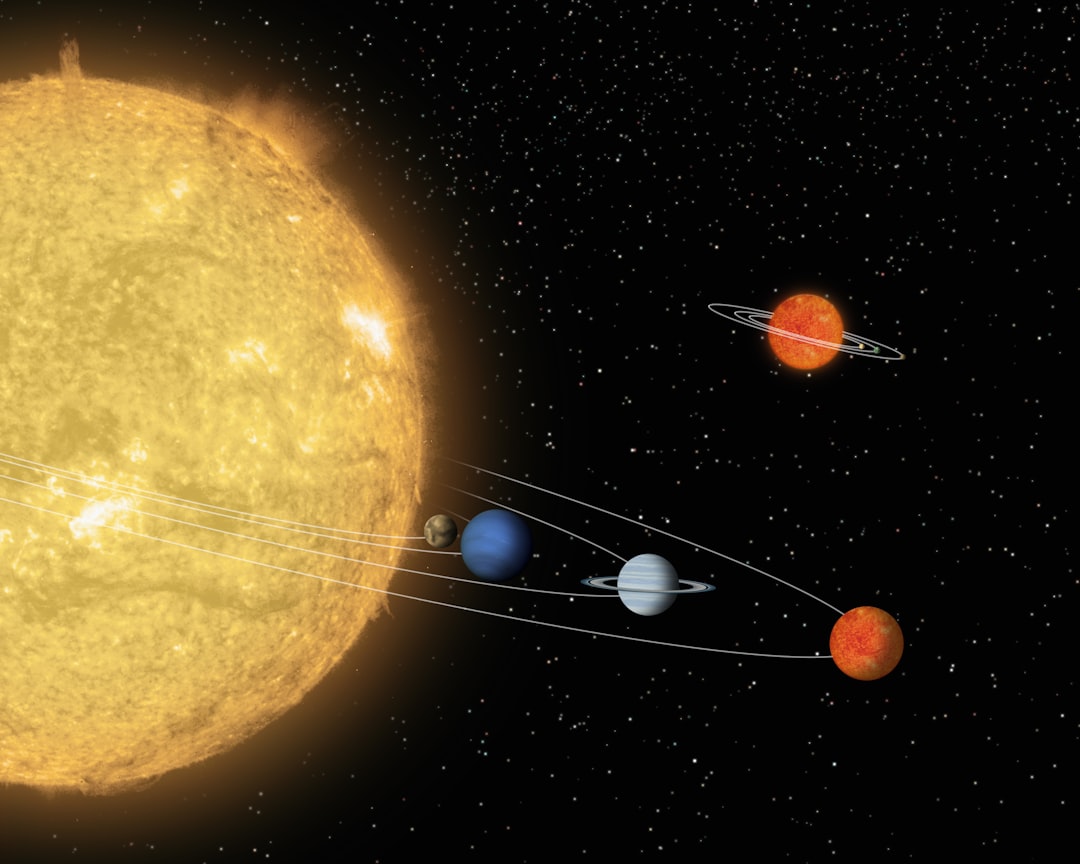
Critically, Haghighipour and colleagues found that the formation of a planet at one astronomical unit (AU) — Earth's distance from the Sun — is a natural outcome of the evolution of our solar system's conditions, not a lucky exception. This is a profoundly significant result. The habitable zone of a Sun-like star, sometimes called the "Goldilocks Zone," represents the range of orbital distances at which liquid water can exist on a planetary surface. The fact that physics, given sufficiently random starting conditions, tends to place a rocky planet in this sweet spot suggests that habitable worlds may be far more common than pessimistic estimates have allowed.
The simulations also reproduced analogs of other familiar solar system bodies:
- Venus analogs appeared in approximately 28 percent of simulations, often maintaining stable orbits — sometimes within the habitable zone of their host star, sometimes slightly outside it.
- Mars analogs appeared multiple times as small, low-mass objects in the vicinity of Mars's current orbital distance, consistent with the real Mars's status as a planetary embryo that never fully grew.
- Earth-mass planets at roughly 1 AU emerged repeatedly across the simulation ensemble, suggesting the architecture of our inner solar system is a common, physically motivated outcome rather than a statistical outlier.
These results align with — and lend theoretical weight to — the growing observational database from missions such as NASA's Kepler Space Telescope and its successor, NASA's TESS mission, which have revealed that Earth-sized planets are extraordinarily common throughout the Milky Way. Kepler data alone suggested that potentially billions of Earth-sized worlds reside in the habitable zones of Sun-like stars across the galaxy.
Computational Advances Accelerate Discovery
Beyond the scientific results themselves, Haghighipour's work highlights a remarkable leap in computational capability. Simulations of this complexity that once required six to eight months of dedicated supercomputer time can now be completed in six to eight weeks on modern laptop computers. This democratization of computational power means that planetary scientists can iterate more rapidly, explore wider parameter spaces, and refine their models with unprecedented efficiency — a trend that promises to accelerate discoveries across all of astrophysics.
Yet even with all this computational power, the simulations reveal something humbling: the exquisite sensitivity of planetary systems to their initial conditions.
"Even a small variation in initial conditions can have a great impact on the final product of a given solar system." — Nader Haghighipour
This sensitivity — reminiscent of the butterfly effect in chaos theory — means that while Earth-like outcomes are common in a statistical sense across many simulations, the precise configuration of any given planetary system remains deeply dependent on the particular conditions of its formation. It is a reminder that science can speak in probabilities across cosmic populations while still acknowledging the uniqueness of individual worlds.
The Origin of Life: An Eternal Puzzle
Haghighipour's work intersects with one of biology's deepest and most enduring mysteries: the origin of life itself. While his models can illuminate the physical conditions that make a planet habitable, the leap from chemistry to biology remains stubbornly elusive.
"After life originated — we don't know how and will never know — life developed branches and bifurcated so that it could find a way to stay in sync with Earth's evolution." — Nader Haghighipour
This humbling admission underscores an important distinction: habitability and inhabited are not synonymous. A planet may possess liquid water, a stable orbit, and a protective atmosphere — all conditions that Haghighipour's simulations suggest are naturally achievable — and still never give rise to life. The question of how inanimate chemistry crossed the threshold into self-replicating biology remains one of the great unsolved problems of science, explored by researchers at institutions such as the NASA Astrobiology Institute and through international collaborations like the ESA Astrobiology initiative.
Implications for the Search for Extrasolar Earths
Perhaps the most exciting implication of Haghighipour's research lies in what it suggests about life's prevalence across the cosmos. Given the growing evidence for the commonality of Earth-sized planets — including small super-Earths — in the habitable zones of solar-type stars, the logical conclusion is increasingly difficult to dismiss.
"Given the commonality of Earth-sized planets in the habitable zones of solar-type stars, it would be completely logical to consider that Earthly life is common." — Nader Haghighipour
Whether that life could be detected remains a towering technological challenge. Current and near-future observatories — including the James Webb Space Telescope — are beginning to probe the atmospheres of exoplanets for potential biosignatures: chemical fingerprints such as oxygen, methane, or ozone that might betray the presence of biology. But the detection of unambiguous signs of life on even the nearest exoplanets remains, for now, beyond our reach.
"Finding life on other planets is a very complicated thing; our technology is not at that level. But this type of study will enable us to understand the characteristics of a planet like Earth and the physical processes that went into its formation and how it became habitable." — Nader Haghighipour
In this sense, Haghighipour's simulations serve a dual purpose: they refine our theoretical understanding of how habitable worlds form, while simultaneously informing the observational strategies we might use to find them. By identifying which physical processes most reliably produce Earth-like planets, researchers can prioritize the most promising stellar systems for future biosignature searches — a critical consideration as the next generation of space- and ground-based telescopes comes online.
The Bottom Line: Earth Is Not a Fluke
After more than 1,000 simulations, countless random starting configurations, and decades of accumulated insight into the physics of planet formation, the conclusion is both scientifically robust and philosophically stirring.
"There is no reason to believe that our Earth is a fluke." — Nader Haghighipour, University of Hawaii at Mānoa
This finding does not diminish Earth's wonder or the astonishing improbability of human consciousness arising within it. Rather, it places our world within a grander cosmic context: one in which the laws of physics, operating across billions of stellar nurseries throughout the galaxy, naturally and repeatedly tend to produce worlds like ours. The universe, it seems, may be far more hospitable — and far more inhabited — than our lonely vantage point might otherwise suggest.
As computational power continues to grow, as observational surveys catalogue ever more distant worlds, and as astrobiology deepens our understanding of life's requirements and resilience, the question may gradually shift from whether Earth-like worlds are common to which ones we should visit first.
Key Takeaways
- New simulations using over 1,000 random initial conditions show that Earth-like planets at 1 AU form naturally from basic physics, without assuming our solar system's known architecture.
- Venus analogs appear in ~28% of simulations; Mars analogs and Earth-mass planets emerge consistently across the ensemble.
- Simulation run times have dropped from 6–8 months to 6–8 weeks, dramatically accelerating research capabilities.
- The results strongly suggest that Earth-like habitable worlds are a common outcome of planetary system evolution, not a statistical fluke.
- The origin of life itself remains unknown, but the physical preconditions for habitability appear to be widespread across the galaxy.
- Future telescopes, including JWST, may begin to probe the atmospheres of these worlds for signs of biology.