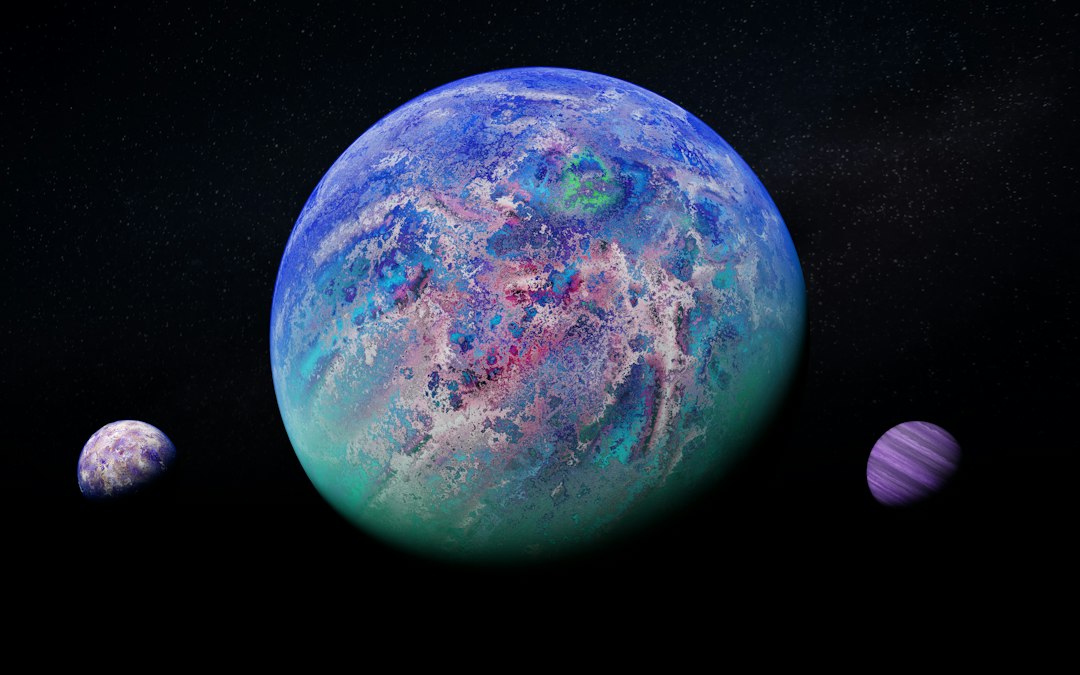
New Model Suggests an Earth-Class Planet Lurks Beyond Pluto
The longstanding hypothesis that a hidden "Planet Nine" exists in the far, frozen reaches of our solar system has captivated — and divided — the planetary science community for decades. A compelling new wave of research, grounded in sophisticated computer modeling, is now adding significant weight to this idea. Drawing on formation and evolution models of the outer solar system beyond 50 astronomical units (AU) — considered the outer boundary of the main Kuiper Belt — scientists are building a case for the existence of a large, undiscovered planetary body lurking in the solar system's distant shadows. For context, Neptune, the most distant recognized planet, orbits at approximately 30 AU, while the dwarf planet Pluto traces its elliptical path at around 39.5 AU from the Sun.
A recent study published in the Monthly Notices of the Royal Astronomical Society now offers fresh and provocative insights into this enduring mystery. The research focuses on a well-documented anomaly: several Kuiper Belt Objects (KBOs) follow orbits that defy conventional gravitational explanations, clustering in ways that strongly suggest the gravitational influence of a large, unseen body. These peculiar orbital signatures have been a source of intense scientific debate, and the new study represents one of the most rigorous computational attempts yet to explain them.
An International Team Takes on the Outer Solar System
To investigate the source of these orbital anomalies, a collaborative trio of researchers from Japan, the United States, and Australia employed a series of high-resolution computer simulations to model planetary formation in the early solar system, approximately 4.5 billion years ago. While the simulations encompassed the entire solar system, the team's primary focus was on the formation and evolution of trans-Neptunian objects (TNOs) — bodies that orbit the Sun beyond Neptune — within a range extending from 100 AU to beyond 200 AU. This vast, poorly characterized region represents one of the last true frontiers of solar system exploration.
The researchers tested two competing hypotheses to account for the unusual orbital configurations observed among distant Kuiper Belt objects:
- The presence of several Earth- or Mars-sized planetary embryos — the building blocks of planets that never fully coalesced — scattered throughout the outer solar system.
- The existence of a fully formed planet with approximately 1–2 Earth masses, which the team designates as "Planet X2", orbiting at extreme distances from the Sun.
After running extensive simulations, the results pointed decisively in one direction: the Planet X2 scenario most accurately reproduced the orbital architecture of present-day Kuiper Belt objects. The scattered planetary embryo model, by contrast, failed to replicate the observed patterns with comparable fidelity. The models further constrained Planet X2's probable mass at approximately 2 Earth masses, with an orbital distance estimated between 300 and 550 AU — a staggeringly remote region of space where sunlight is roughly 100,000 times dimmer than it is on Earth.
What Planet X2 Could Mean for Solar System Science
The implications of such a discovery would be profound. A planet of this size and location would not merely be an astronomical curiosity; it would fundamentally reshape our understanding of how the solar system formed and evolved over billions of years. Current planetary formation models struggle to explain how a full-sized planet could exist so far from the Sun, where the primordial disk of gas and dust was thin and slow to coalesce. Its presence would suggest either an in-situ formation under extraordinary conditions, a dramatic gravitational ejection from the inner solar system during its turbulent early history, or even a captured rogue planet — a world that once drifted freely between the stars before being ensnared by our Sun's gravity.
"Imagine discovering, after decades of mapping our Solar System, that another planet has been hiding from us all this time. If this planet exists, it could change how we understand the history of our Solar System and how its most distant objects came to follow such unusual orbits." — Dr. Patryk Sofia Lykawka, Adjunct Associate Professor, Centre for Astrophysics, University of Southern Queensland, and lead author of the study.
Dr. Lykawka's team is careful to frame their findings within appropriate scientific caution. Computer models, however sophisticated, are only as reliable as the assumptions and input data that underpin them. The researchers are explicit that further observational evidence is essential before any definitive conclusions can be drawn. Nevertheless, the internal consistency and predictive power of the Planet X2 scenario provide a compelling roadmap for future observational campaigns.
The Vera C. Rubin Observatory: A Game-Changer on the Horizon
The observational tool best positioned to validate — or refute — these findings is the Vera C. Rubin Observatory in Chile, which began full science operations in June 2026. Its flagship survey program, the Legacy Survey of Space and Time (LSST), is designed to image the entire visible sky every few nights over a decade, generating an unprecedented catalog of solar system objects. The sheer depth and cadence of the LSST survey makes it ideally suited to detecting faint, slow-moving bodies in the outer solar system — precisely the kind of object that Planet X2 would appear to be from Earth.
The Rubin Observatory has already demonstrated its extraordinary capability: in October 2026, it confirmed the existence of its first trans-Neptunian dwarf planet candidate, designated 2026 ED138. This newly identified world is estimated to have a diameter of approximately 600–1,530 kilometers (373–950 miles) and orbits the Sun at roughly 43 AU — placing it squarely within the classical Kuiper Belt. Its discovery underscores the transformative potential of the LSST survey in unveiling the hidden population of the outer solar system.
Beyond the Rubin Observatory, future space-based missions and next-generation ground telescopes, including the Extremely Large Telescope (ELT) currently under construction in the Atacama Desert, will further sharpen our ability to detect and characterize distant solar system bodies. The convergence of these powerful new instruments with increasingly refined theoretical models creates a uniquely promising moment in the search for undiscovered planets.
A Brief History of the Planet Nine Hypothesis
The search for a planet beyond the known boundaries of the solar system has roots stretching back nearly a century. The modern quest arguably began with the discovery of Pluto in 1930 by astronomer Clyde Tombaugh at Lowell Observatory — itself the result of a systematic search for a hypothetical "Planet X" thought to be perturbing the orbit of Neptune. While Pluto proved far too small to be the culprit, the idea of an undiscovered outer planet never fully faded from scientific discourse.
Interest intensified between the 1990s and 2006, as improved telescope technology enabled astronomers to discover dozens of icy bodies in the Kuiper Belt, revealing it as a rich, structured population rather than a sparse scattering of debris. This era culminated in the landmark discovery of the dwarf planet Eris in 2005, a body comparable in size to Pluto and orbiting even farther from the Sun. The recognition that Eris was just one of many Pluto-like objects led directly to the reclassification of Pluto as a dwarf planet by the International Astronomical Union (IAU) in 2006 — a decision that remains culturally resonant to this day.
The modern Planet Nine hypothesis took its current form in 2016, when astronomers Konstantin Batygin and Mike Brown of the California Institute of Technology published a landmark paper arguing that the clustered orbits of a handful of extreme trans-Neptunian objects could best be explained by the gravitational influence of an unseen planet — estimated at 5–10 Earth masses and orbiting at distances of 400–800 AU. This proposal ignited a global wave of observational and theoretical research that continues to this day. You can read more about the original hypothesis via NASA's Planet Nine overview.
In the years since, the evidence has evolved considerably. Crucially, the probable orbital position of Planet Nine has been narrowed by approximately 78 percent through a combination of observational constraints and refined dynamical modeling — a remarkable convergence that has transformed the hypothesis from speculative to increasingly plausible. The new Planet X2 study adds yet another independent line of evidence, derived from an entirely different modeling approach, that points toward a substantial undiscovered planet in the outer solar system.
Key Facts: Planet X2 at a Glance
- Estimated Mass: Approximately 1–2 Earth masses
- Orbital Distance: Between 300 and 550 AU from the Sun
- Evidence Basis: Gravitational influence on anomalous Kuiper Belt Object orbits
- Detection Method: Computational solar system formation simulations
- Best Chance of Confirmation: Legacy Survey of Space and Time (LSST) at the Vera C. Rubin Observatory
- Distinct From Planet Nine: Lower estimated mass; different orbital constraints derived from an independent modeling framework
Looking Ahead: A New Era of Outer Solar System Exploration
What makes this moment particularly exciting is the rare alignment of theoretical momentum and observational capability. For the first time, astronomers have both sophisticated computational models pointing toward an undiscovered planet and a world-class survey telescope — the Rubin Observatory — actively scanning the sky with the sensitivity required to find it. If Planet X2 exists within the predicted orbital range, the LSST survey has a realistic chance of detecting it within the next several years.
Such a discovery would rank among the most significant in the history of planetary science, comparable in impact to the discovery of Uranus in 1781 or the confirmation of Neptune's existence in 1846 through its predicted gravitational influence on Uranus — a historical parallel that planetary scientists are keenly aware of. Just as Neptune's existence was deduced mathematically before it was ever seen through a telescope, Planet X2 may be on the verge of transitioning from mathematical prediction to observed reality.
The outer solar system remains one of the most sparsely explored regions of our cosmic neighborhood. Each new discovery — whether a distant dwarf planet, an exotic trans-Neptunian object, or potentially a true planet — adds a new chapter to the story of how our solar system came to be. For further reading on the structure of the outer solar system and ongoing research, visit the NASA Solar System Exploration: Kuiper Belt overview.
The coming decade promises to be transformative. With the Rubin Observatory now operational, the ELT approaching completion, and a new generation of planetary scientists armed with ever more powerful simulation tools, the question of whether Planet X2 — or Planet Nine, or some other undiscovered world — inhabits the solar system's dark outer frontier may finally receive a definitive answer. In the grand tradition of astronomy, patience and precision will ultimately prevail over the void.