In the grand cosmic narrative, few substances have been as underappreciated and misunderstood as interstellar dust. These microscopic grains, scattered throughout the vast expanses of space, turn out to be the unsung architects of everything we see in the universe—including ourselves. Far from being mere cosmic debris, dust particles serve as the essential catalysts for star formation, the building blocks for planetary systems, and the delivery vehicles for the complex molecules that make life possible.
This revelation represents a fundamental shift in our understanding of cosmic evolution. Research from institutions like NASA's Spitzer Space Telescope and the European Southern Observatory's Very Large Telescope has demonstrated that without these tiny grains—each typically less than a micrometer in diameter—the universe as we know it simply could not exist. The stars overhead, the planets beneath our feet, and the biological molecules that constitute every living thing all owe their existence to processes that begin with dust.
The Thermal Regulation Crisis in Star Formation
The birth of stars presents one of astronomy's most elegant paradoxes. When a giant molecular cloud begins to collapse under its own gravity—a process involving masses equivalent to hundreds of thousands of suns—it encounters a fundamental physical barrier. As the gas compresses, gravitational potential energy converts into thermal energy, heating the collapsing material. This heat generates pressure that pushes outward, directly opposing the gravitational force trying to compress the cloud further.
Pure hydrogen and helium, which constitute approximately 98% of the primordial gas in these clouds, are remarkably inefficient at radiating away this accumulated heat. At the relatively low temperatures of collapsing clouds—typically between 10 and 100 Kelvin—these simple atoms lack the complex electronic transitions necessary for efficient radiative cooling. Without an effective cooling mechanism, the cloud reaches a state of hydrostatic equilibrium, where thermal pressure exactly balances gravity, and the collapse simply stalls indefinitely.
"Dust grains act as cosmic refrigerators, providing the critical thermal regulation that allows star formation to proceed. Without them, molecular clouds would remain as diffuse, hot structures incapable of fragmenting into stellar nurseries," explains Dr. Barbara Whitney, astrophysicist at the Space Science Institute.
This is where interstellar dust becomes indispensable. Dust grains, composed primarily of silicates and carbonaceous materials with typical sizes of 0.1 micrometers, possess a remarkable property: they are extraordinarily efficient at absorbing thermal energy from gas collisions and re-emitting it as infrared radiation. Studies using the James Webb Space Telescope have revealed intricate details of this process, showing how dust grains can radiate away excess heat at rates up to 1000 times more efficient than pure gas at equivalent temperatures.
The Protective Shield Against Photodissociation
Beyond thermal regulation, dust performs a second critical function in stellar nurseries. The densest regions of molecular clouds—where star formation actually occurs—exist in environments flooded with ultraviolet radiation from nearby massive stars. This high-energy light carries enough energy to break apart molecular bonds, particularly the hydrogen molecule (H₂) that forms the structural backbone of these clouds.
Dust grains create an effective barrier against this destructive radiation. By absorbing and scattering UV photons, they establish protective zones where molecular chemistry can proceed uninterrupted. Research published in the Astrophysical Journal has shown that without this dust shielding, molecular clouds would dissociate into atomic gas within a few million years—far too quickly for the gravitational collapse and fragmentation necessary for star formation to occur.
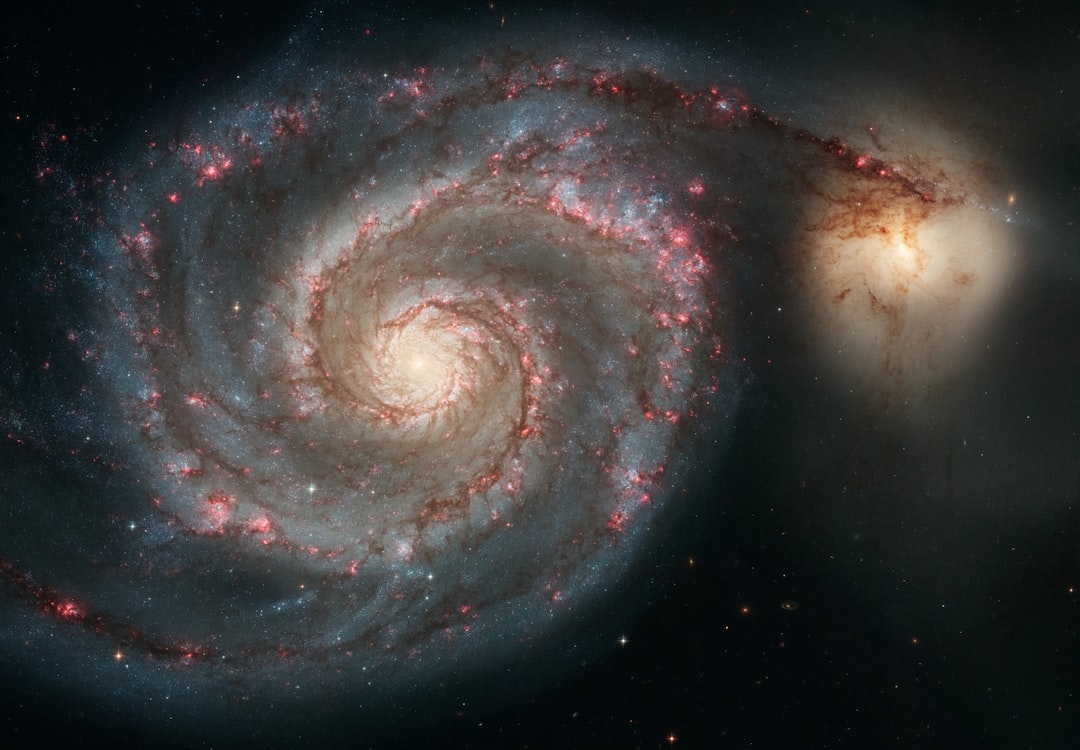
The consequences of a dust-free universe would be profound. Galaxies would still exist as gravitationally bound systems, but they would appear dramatically different: smooth, diffuse structures lacking the distinctive spiral arms, bright stellar clusters, and active star-forming regions that characterize modern galaxies. The universe would be dimmer, older, and fundamentally unable to produce the successive generations of stars necessary for building complex chemistry.
From Microscopic Grains to Rocky Worlds
The story of planet formation begins with the same dust grains that enabled their parent stars to form. Around young stars, remnant material from the stellar birth process settles into a rotating protoplanetary disk—a structure that NASA's Hubble Space Telescope has imaged around thousands of nearby stellar systems. Within these disks, dust grains undergo a remarkable transformation from microscopic particles to planet-sized bodies.
The process begins with differential settling. Dust particles, being denser than the surrounding gas, gradually sink toward the disk's midplane due to the star's gravity and aerodynamic drag forces. This concentration effect increases the local density of solid material by factors of hundreds to thousands, creating conditions favorable for grain aggregation.
The Aggregation Ladder: Building Worlds One Grain at a Time
The pathway from dust to planets proceeds through a series of increasingly complex stages:
- Initial Adhesion (micrometers to millimeters): Electrostatic forces, similar to the static electricity that makes balloons stick to walls, cause dust grains to adhere when they collide. Van der Waals forces—weak molecular attractions—help maintain these initial bonds. Laboratory experiments simulating protoplanetary disk conditions have confirmed that grains can stick together even at collision velocities of several meters per second.
- Pebble Formation (millimeters to centimeters): As aggregates grow, they sweep up additional grains from their surroundings. The resulting "pebbles" become the fundamental building blocks for larger objects. Recent models suggest this stage occurs remarkably quickly, within just a few thousand years in the inner disk regions.
- Planetesimal Assembly (kilometers): Once objects reach roughly kilometer sizes, their own gravity becomes significant enough to attract nearby material. This gravitational focusing dramatically accelerates growth, allowing these planetesimals to clear out their orbital zones and compete for dominance.
- Planetary Embryos and Final Assembly (planetary masses): The largest planetesimals, now termed planetary embryos, undergo violent collisions and mergers. In the inner solar system, these collisions produced the rocky terrestrial planets. In the outer regions, embryos grew large enough to gravitationally capture surrounding hydrogen and helium, forming gas giants.
Remove the first rung of this ladder—the initial dust grain adhesion—and the entire sequence collapses. Without solid particles to initiate aggregation, the gas disk would simply dissipate over a few million years, leaving behind a solitary star with no planetary companions. No rocky worlds. No gas giant cores. No moons, asteroids, or comets. The universe would be populated exclusively by isolated stars.
Cosmic Chemistry and the Seeds of Life
Perhaps dust's most profound contribution lies in its role as a cosmic chemistry laboratory. The surfaces of dust grains provide unique environments where atoms and molecules can meet, react, and form increasingly complex structures. In the frigid conditions of interstellar space—where temperatures hover just a few degrees above absolute zero—gas-phase chemical reactions proceed impossibly slowly. But on grain surfaces, atoms can stick, accumulate, and interact over extended periods.
This surface chemistry has produced an astonishing inventory of molecules in space. Astronomers have identified over 200 distinct molecular species in interstellar clouds, including organic compounds like formaldehyde, methanol, ethanol, and even amino acids—the building blocks of proteins. Many of these molecules form exclusively or primarily on dust grain surfaces, where the grain acts as a catalyst bringing reactants together and stabilizing intermediate products.
"Dust grains are the universe's chemistry sets. They provide the surfaces, the protection, and the conditions necessary for building the complex organic molecules that eventually seed planetary systems with the raw materials for life," notes Dr. Ewine van Dishoek, astrochemist at Leiden University.
These molecular-laden dust grains don't remain stationary. Stellar winds, supernova shockwaves, and radiation pressure drive them across vast interstellar distances, distributing their chemical cargo throughout galaxies. When new stellar systems form, they incorporate this pre-enriched material. Comets and asteroids—themselves aggregates of primordial dust—deliver these molecules to planetary surfaces during the violent early epochs of planetary system evolution.
Ancient Stardust in Your Home
The connection between cosmic dust and our daily lives extends beyond abstract astrophysical processes. Earth continuously accretes approximately 40,000 tons of extraterrestrial material annually, mostly in the form of micrometeorites—dust particles so small they drift through the atmosphere without burning up. These cosmic visitors settle everywhere: on rooftops, in rain gutters, on that dusty bookshelf in your home.
Among the countless dust grains in any household sample, a small fraction originated beyond our planet. Some traveled from the asteroid belt, others from cometary debris streams. And remarkably, some grains predate our entire solar system. Researchers analyzing meteorite samples have identified individual presolar grains—dust particles that formed in stellar atmospheres more than 7 billion years ago, before the Sun even existed.
These ancient grains, forged in stellar furnaces that have long since died, carry isotopic signatures that reveal their exotic origins. Some formed in the expanding envelopes of red giant stars, others in the explosive deaths of supernovae. Each grain is a time capsule, preserving information about stellar processes that occurred when the universe was less than half its current age. Studies at facilities like the Lunar and Planetary Institute continue to extract remarkable insights from these microscopic messengers.
A Profound Realization
The implications of dust's cosmic importance force us to reconsider our place in the universe's grand scheme. Every star in the night sky owes its existence to dust's cooling abilities. Every planet, including Earth, formed through dust aggregation. The organic molecules that assembled into the first living cells likely formed on dust grain surfaces and arrived via dust-rich comets and meteorites.
Without interstellar dust, the universe would be a vastly simpler, emptier place. Galaxies would exist as diffuse clouds of hot gas, unable to cool and fragment into stars. No stellar generations would enrich the cosmos with heavy elements. No planets would form to provide stable environments for chemistry and biology. The universe would remain locked in a primitive state, incapable of generating the complexity necessary for life.
This perspective transforms our relationship with these microscopic particles. Far from being cosmic nuisances that obscure our view of distant objects—the traditional astronomer's complaint—dust grains emerge as the essential enablers of cosmic structure and biological possibility. They are simultaneously the architects of stars, the builders of worlds, and the chemists synthesizing life's precursors.
So the next time you encounter dust settling on a surface, consider its dual nature. Yes, most of it is mundane terrestrial material. But mixed within that collection are grains that crossed interstellar space, particles older than the Sun, fragments that witnessed the birth of our solar system. You're touching material that makes existence itself possible—the literal building blocks of everything we are and everything we see.
In this light, dust deserves not our annoyance, but our profound appreciation. These tiny grains, often invisible to the naked eye, have shaped the universe's evolution from the cosmic dark ages to the present day. They continue their work in stellar nurseries across the galaxy, cooling clouds, building planets, and synthesizing the molecules of life. We are, quite literally, the beneficiaries of dust's cosmic engineering—a humbling realization that connects the mundane act of cleaning a shelf to the grandest processes in the universe.