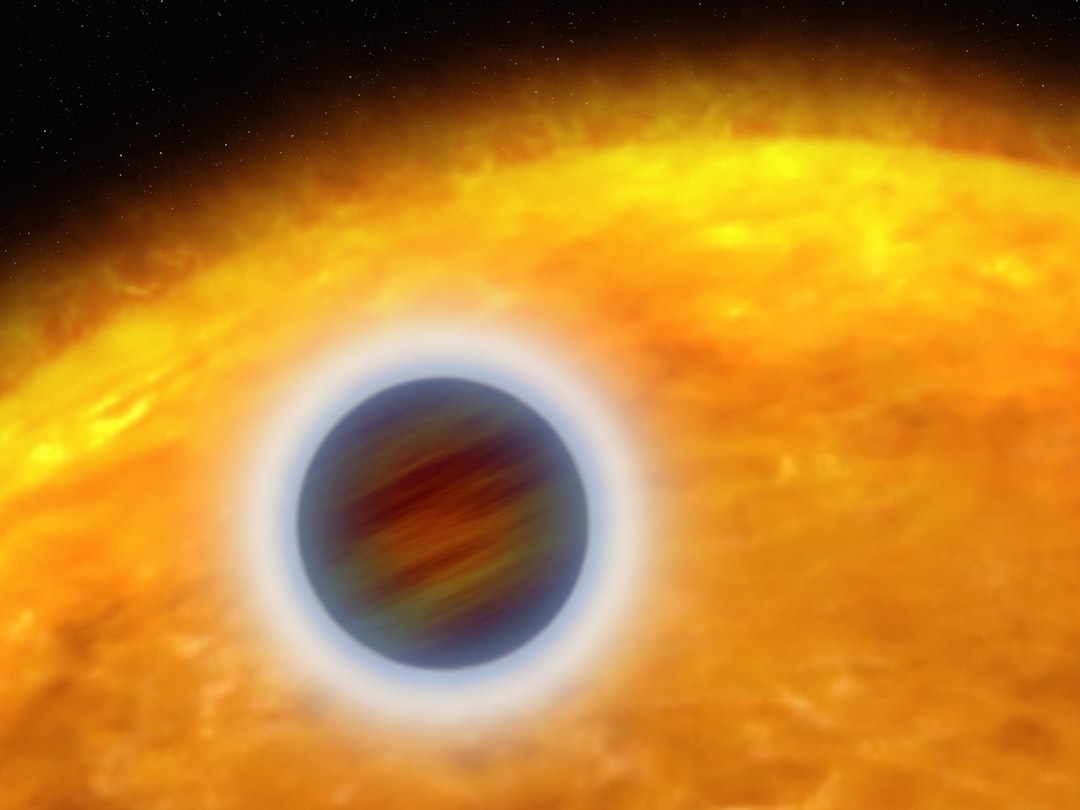
Astronomers have made a groundbreaking observation of continuous atmospheric escape from an unusual exoplanet, revealing unprecedented insights into how planetary atmospheres evolve over time. Using the James Webb Space Telescope, an international research team has detected persistent streams of helium flowing away from WASP-107 b, a so-called "cotton candy" world located 211 light-years from Earth. This remarkable discovery, published in Nature Astronomy, marks a significant advancement in our understanding of atmospheric erosion processes that shape planetary evolution throughout the cosmos.
The findings reveal that WASP-107 b is losing its atmosphere in a dramatic fashion, with helium gas streaming away from the planet before, during, and after it passes in front of its host star. This persistent atmospheric leakage extends tens of planetary radii into space, creating an enormous tail of escaping gas that contains not only helium but also water vapor, ammonia, carbon dioxide, methane, and carbon monoxide. For planetary scientists, this discovery provides a natural laboratory for studying the fundamental processes that determine whether planets can retain their atmospheres over billions of years—a critical factor in understanding planetary habitability and the diversity of worlds beyond our solar system.
The Enigmatic Nature of Super-Puff Exoplanets
WASP-107 b belongs to an extraordinary and puzzling class of exoplanets known as "super-puffs" or "cotton candy planets," which represent some of the most mysterious objects discovered in exoplanetary science. These worlds challenge our fundamental understanding of planet formation because they possess characteristics unlike anything found in our solar system. With a radius nearly matching Jupiter's but a mass less than one-tenth of the gas giant—approximately 30 Earth masses—WASP-107 b exhibits an astonishingly low density of just 0.13 grams per cubic centimeter.
To put this in perspective, WASP-107 b is far less dense than any planet orbiting our Sun. Jupiter, the least dense planet in our solar system, still maintains a density of 1.33 g/cm³—more than ten times denser than WASP-107 b. Even Saturn, famous for being light enough to theoretically float in water, has a density of 0.69 g/cm³, making it more than five times denser than this puffy exoplanet. The ice giants Uranus and Neptune are even more compact, with densities of 1.27 g/cm³ and 1.64 g/cm³ respectively. This extreme lack of density suggests that WASP-107 b's atmosphere is extraordinarily bloated and extended, making it an ideal target for studying atmospheric escape mechanisms.
The population of known super-puff exoplanets remains relatively small but fascinating. Other confirmed members of this exclusive club include HAT-P-67 b, WASP-94 A b, Kepler-79 d and e, HIP 41378 f, and the Kepler-51 system containing three super-puff planets (b, c, and d). These worlds orbit close to their parent stars, with WASP-107 b completing a full orbit in just 5.7 days, subjecting the planet to intense stellar radiation that likely drives the dramatic atmospheric escape observed by researchers.
Advanced Observational Techniques Reveal Atmospheric Dynamics
The research team utilized the Near Infrared Imager and Slitless Spectrograph (NIRISS) aboard the James Webb Space Telescope to conduct detailed observations of multiple transits of WASP-107 b. During a transit, the planet passes directly between Earth and its host star, allowing astronomers to analyze starlight filtering through the planet's atmosphere. Different molecules absorb light at specific wavelengths, creating a unique spectral fingerprint that reveals the atmospheric composition.
What makes this study particularly remarkable is the detection of helium absorption signatures at three distinct phases of the planet's orbit. The researchers observed pre-transit absorption (before the planet crossed in front of the star), transit absorption (during the crossing), and post-transit absorption (after the planet had passed). This unprecedented observation pattern indicates that WASP-107 b is surrounded by an extensive envelope of escaping helium that extends far beyond the planet's visible disk, forming an enormous tail structure that stretches across space.
The James Webb Space Telescope's advanced capabilities in the infrared spectrum proved essential for this discovery. Helium atoms in their excited state absorb light at a specific infrared wavelength (1083 nanometers), which JWST can detect with exceptional sensitivity. Previous observations using ground-based telescopes and the Hubble Space Telescope had detected helium escape from other exoplanets, but JWST's superior resolution and sensitivity enabled this comprehensive three-phase observation, revealing the full extent and continuity of the atmospheric loss process.
Chemical Composition of the Escaping Atmosphere
Beyond helium, the spectroscopic analysis revealed a rich mixture of molecular species within WASP-107 b's escaping atmosphere. The detection of water vapor (H₂O), ammonia (NH₃), carbon dioxide (CO₂), methane (CH₄), and carbon monoxide (CO) provides crucial insights into the planet's atmospheric chemistry and the selective nature of atmospheric escape processes. These molecules represent key tracers of planetary formation conditions and ongoing atmospheric evolution.
The presence of these diverse chemical species suggests that atmospheric escape on WASP-107 b is not simply stripping away the lightest elements but is removing a substantial portion of the planet's atmospheric inventory. This hydrodynamic escape process occurs when intense stellar radiation heats the upper atmosphere to such high temperatures that gas molecules achieve escape velocity and flow away into space. The lighter helium atoms escape most readily, but they can drag heavier molecules along with them in a process known as entrainment.
The detection of carbon-bearing molecules like methane and carbon dioxide is particularly significant for understanding the planet's formation history. These species likely formed in the cooler outer regions of the protoplanetary disk before being incorporated into the growing planet. Their presence in the escaping atmosphere indicates that WASP-107 b may have migrated inward from a more distant orbit, where volatile-rich materials could condense and accumulate.
Implications for Planetary Evolution Across the Universe
The continuous atmospheric escape observed on WASP-107 b has profound implications for understanding how planetary atmospheres evolve over time, particularly for worlds orbiting close to their host stars. This research provides direct observational evidence of the mass loss rates and mechanisms that can fundamentally alter a planet's characteristics over millions and billions of years.
"On Earth, atmospheric escape is too weak to drastically influence our planet," explained Dr. Vincent Bourrier, an assistant professor specializing in exoplanets at the University of Geneva and co-author of the study. "But it would be responsible for the absence of water on our close neighbor, Venus. It is therefore essential to fully understand the mechanisms at work in this phenomenon, which could erode the atmosphere of certain rocky exoplanets."
Dr. Bourrier's statement highlights a critical connection between observations of gas giant atmospheric escape and the potential fate of rocky exoplanets in similar orbital configurations. Venus, despite being similar in size to Earth, lost its water inventory billions of years ago, likely due to a combination of greenhouse heating and atmospheric escape driven by solar radiation. Understanding the efficiency and mechanisms of atmospheric loss on planets like WASP-107 b helps scientists model how rocky planets in close orbits might lose their atmospheres and become uninhabitable.
WASP-107 b joins a growing catalog of exoplanets exhibiting detectable helium atmospheric escape, including WASP-69 b, HAT-P-11 b, GJ 3470 b, HD 209458 b, HD 189733 b, WASP-12 b, and Kepler-63 b. Each of these worlds provides unique insights into how stellar radiation, planetary mass, atmospheric composition, and orbital distance combine to determine atmospheric retention. By studying this diverse population, astronomers can develop comprehensive models of atmospheric evolution applicable to planets throughout the galaxy.
The Role of JWST in Revolutionizing Exoplanet Science
This study exemplifies the transformative impact of the James Webb Space Telescope on exoplanetary research. Since beginning science operations in 2022, JWST has revolutionized our ability to characterize exoplanet atmospheres with unprecedented detail and precision. The telescope's large primary mirror (6.5 meters in diameter) and advanced infrared instruments enable observations that were simply impossible with previous facilities.
JWST's contributions to exoplanet science extend far beyond detecting atmospheric escape. The observatory has successfully:
- Characterized atmospheric temperatures and wind patterns on hot Jupiter exoplanets, revealing complex circulation patterns and temperature variations across planetary hemispheres
- Detected key biosignature molecules including water vapor, methane, and carbon dioxide in the atmospheres of potentially habitable worlds
- Studied Earth-sized rocky exoplanets in the TRAPPIST-1 system, providing the first detailed atmospheric constraints on terrestrial worlds beyond our solar system
- Identified atmospheric chemistry in diverse planetary types, from mini-Neptunes to super-Earths, revealing the incredible diversity of planetary atmospheres
- Measured atmospheric metallicity and cloud properties, helping to constrain planet formation models and migration histories
The NIRISS instrument used in this study represents just one of JWST's powerful scientific capabilities. The telescope also carries the Near Infrared Camera (NIRCam), Near Infrared Spectrograph (NIRSpec), and Mid-Infrared Instrument (MIRI), each optimized for different types of observations. Together, these instruments provide comprehensive coverage of infrared wavelengths where many important atmospheric molecules leave their spectral signatures.
Future Directions in Atmospheric Escape Research
The discovery of continuous helium streaming from WASP-107 b opens numerous avenues for future investigation. Researchers plan to conduct follow-up observations to monitor how the atmospheric mass loss rate varies over time and whether it correlates with stellar activity cycles. Understanding these temporal variations will help refine models of long-term planetary evolution and predict which planets are most vulnerable to complete atmospheric loss.
Comparative studies of multiple super-puff exoplanets will prove essential for understanding why these unusual worlds exist and how they maintain their extraordinarily low densities. Theoretical models suggest that super-puffs might represent a transitional phase in planetary evolution, where young planets with extended atmospheres gradually lose mass over time, potentially transforming into denser sub-Neptune or super-Earth planets. Long-term monitoring programs using space telescopes like CHEOPS and future facilities will test these evolutionary scenarios.
The techniques developed for studying WASP-107 b will also be applied to smaller, potentially habitable planets orbiting M-dwarf stars—the most common type of star in our galaxy. These cool, dim stars are attractive targets for finding habitable worlds, but they also produce intense ultraviolet radiation and frequent flares that could strip away planetary atmospheres. Understanding atmospheric escape processes on larger planets like WASP-107 b provides the foundation for assessing habitability prospects around M-dwarfs.
Advanced computer simulations incorporating the observational constraints from JWST will enable scientists to model the three-dimensional structure of escaping atmospheres with unprecedented accuracy. These models will reveal how planetary magnetic fields, stellar winds, and atmospheric composition interact to shape the geometry and dynamics of atmospheric outflows. Such detailed understanding is crucial for interpreting observations of more distant and fainter exoplanets where direct detection of atmospheric escape remains challenging.
Broader Context: Understanding Planetary Diversity
With the confirmed exoplanet count now exceeding 6,000 worlds, astronomers have discovered that planetary systems exhibit far greater diversity than our solar system alone would suggest. Super-puff planets like WASP-107 b represent one extreme of this diversity—worlds that challenge our theoretical understanding of how planets form and evolve. Their very existence forces scientists to reconsider fundamental assumptions about planet formation processes, core accretion timescales, and atmospheric retention mechanisms.
The study of atmospheric escape connects to fundamental questions about planetary habitability and the distribution of life in the universe. Every planet with a substantial atmosphere must balance atmospheric loss against atmospheric retention over billions of years. Earth maintains its atmosphere because our planet's mass provides sufficient gravity to retain most atmospheric gases, while our magnetic field shields the atmosphere from solar wind erosion. Mars, being smaller and lacking a global magnetic field, lost most of its atmosphere billions of years ago, transforming from a potentially habitable world to the cold, dry planet we observe today.
By studying extreme cases like WASP-107 b, where atmospheric escape occurs at dramatic rates, scientists can calibrate their models and apply them to less extreme but potentially more interesting cases—rocky planets in the habitable zones of their stars where liquid water might exist on the surface. Understanding which planets can maintain their atmospheres over geological timescales directly informs the search for life beyond Earth and helps prioritize targets for future detailed characterization.
As research continues and new observations accumulate, the mystery of super-puff exoplanets and their leaking atmospheres will gradually yield to scientific understanding. Each new discovery, each refined measurement, and each improved theoretical model brings us closer to comprehending the full range of planetary possibilities in our vast and varied universe. The continuous helium streams flowing from WASP-107 b represent not just an isolated curiosity, but a window into the fundamental processes that shape worlds throughout the cosmos—a reminder that the universe continues to surprise us with phenomena beyond our initial imagination.
What new revelations about atmospheric escape and planetary evolution will researchers uncover in the coming years and decades? As JWST continues its mission and future observatories come online, we can anticipate increasingly detailed portraits of exoplanetary atmospheres and their complex behaviors. Only time will tell what additional surprises await discovery in the atmospheres of distant worlds. As always, keep doing science and keep looking up!