As the spring comet season of 2025 reaches its dramatic climax, astronomers and skywatchers worldwide are turning their attention to Comet C/2025 R3 Pan-STARRS, a spectacular celestial visitor that is currently making its closest approach to the Sun. This remarkable icy wanderer, currently shining at an impressive magnitude +4.3, represents one of the brightest comets to grace our skies in recent years, offering both professional researchers and amateur enthusiasts a rare opportunity to witness the dynamic evolution of a pristine object from the outer solar system.
The comet's journey has been nothing short of extraordinary. Discovered on September 8th, 2025, by the prolific Panoramic Survey Telescope and Rapid Response System (Pan-STARRS) in Hawaii, this cosmic traveler has been steadily brightening as it plunges toward its perihelion passage—the point of closest approach to our star. Scientists estimate that Comet R3 Pan-STARRS is on an incredibly elongated orbit lasting approximately 170,000 years, meaning this is likely its first visit to the inner solar system in recorded human history, and it won't return until long after our current civilization has faded into the distant past.
The timing of this celestial spectacle comes with both fortune and frustration. While the comet has been putting on an impressive pre-dawn display for early-rising astrophotographers across the Northern Hemisphere, its trajectory will bring it to within just four degrees of the Sun as seen from Earth on April 25th, making direct observation challenging during its peak brightness. However, modern space-based observatories, particularly NASA and ESA's Solar and Heliospheric Observatory (SOHO), will provide unprecedented views of the comet's perihelion passage, offering scientists invaluable data about cometary behavior in the extreme environment near our star.
The Dawn Spectacle: A Fleeting Window of Visibility
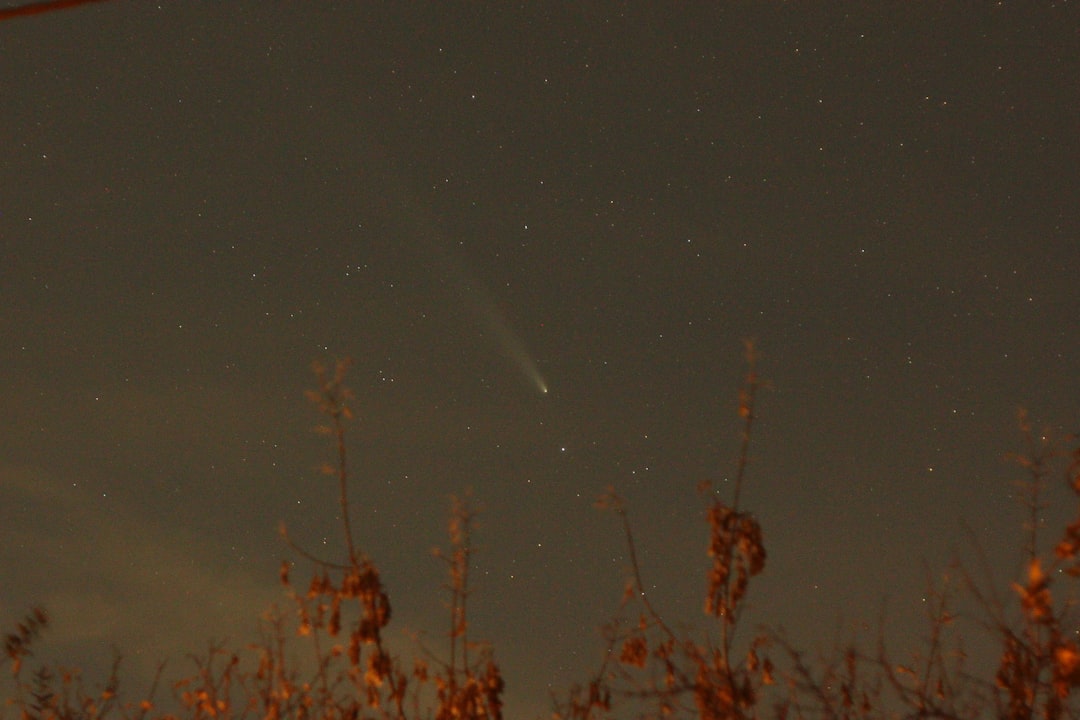
For observers across mid-northern latitudes, the past two weeks have offered a precious viewing opportunity as Comet R3 Pan-STARRS lingered low in the eastern sky approximately one hour before sunrise. The comet has displayed the classic characteristics that make these visitors from the outer solar system so captivating: a brilliant cyanogen-rich coma glowing with an ethereal green hue, accompanied by a remarkably narrow dust tail stretching across the dawn sky like a cosmic needle.
The green coloration observed in the comet's coma is a telltale signature of diatomic carbon (C₂) and cyanogen (CN) molecules being energized by solar ultraviolet radiation. As the comet approaches the Sun, these volatile compounds sublimate from the icy nucleus, creating the characteristic glow that has fascinated observers throughout history. Astrophotographers have captured stunning images revealing the full extent of the comet's tail, with some wide-field mosaics showing structures extending several degrees across the sky—a testament to the enormous scale of these celestial phenomena.
"The needle-thin dust tail and vibrant green coma of Comet R3 Pan-STARRS represent a textbook example of cometary activity as these pristine objects from the outer solar system encounter the intense radiation environment near the Sun. What we're witnessing is essentially a time capsule from the early solar system being vaporized before our eyes," explains Dr. Matthew Knight, a cometary scientist at the U.S. Naval Research Laboratory.
The viewing window for naked-eye observation has been remarkably brief. As the comet races toward perihelion, its angular separation from the Sun has decreased daily, causing it to become lost in the brightening dawn twilight. By mid-April, observers needed clear eastern horizons and dark skies to glimpse this celestial visitor, with binoculars or small telescopes significantly enhancing the view. The comet's trajectory has been particularly favorable for observers in the southwestern United States and similar latitudes, where the ecliptic angle provides slightly better viewing conditions.
Perihelion Passage: Surviving the Solar Furnace
On April 19th, 2025, Comet R3 Pan-STARRS will reach its moment of truth, passing perihelion at a distance of 0.499 Astronomical Units (approximately 75 million kilometers or 46.5 million miles) from the Sun's surface. This distance places the comet's closest approach just beyond the orbit of Mercury, our solar system's innermost planet, and well within what astronomers consider a relatively safe zone for cometary survival.
The survival prospects for Comet R3 Pan-STARRS are considerably better than those of its ill-fated companion, Comet C/2026 A1 MAPS, which disintegrated during its extremely close perihelion passage on April 4th. Sungrazers like A1 MAPS, which pass within a few solar radii of the Sun's surface, face extreme tidal forces and temperatures exceeding 2,000 degrees Celsius—conditions that can literally tear apart all but the most robust cometary nuclei. By contrast, R3 Pan-STARRS's more conservative perihelion distance should allow it to survive intact, though it will undoubtedly lose a significant fraction of its volatile materials to sublimation.
The physics of cometary perihelion passages involves a complex interplay of factors. As a comet approaches the Sun, the increasing solar radiation causes volatile ices—primarily water ice, but also frozen carbon dioxide, carbon monoxide, and methane—to sublimate directly from solid to gas. This process creates the comet's coma and drives the formation of both the dust tail (composed of solid particles released from the nucleus) and the ion tail (consisting of ionized gases swept away by the solar wind). The rate of mass loss can be prodigious, with active comets losing tons of material per second during peak activity.
Space-Based Observations: SOHO and the New Generation
While ground-based observers will lose sight of Comet R3 Pan-STARRS as it merges with the solar glare, space-based coronagraphs will provide continuous coverage of this critical phase. The SOHO spacecraft, stationed at the Sun-Earth Lagrange Point 1 (L1) approximately 1.5 million kilometers from Earth, has been humanity's premier solar observatory since its launch in 1995. Its LASCO C3 coronagraph, which uses an occulting disk to block the Sun's brilliant photosphere, will capture the comet's passage from April 23rd through 25th.
SOHO has an impressive pedigree in cometary discovery and observation, having detected over 5,200 sungrazing comets during its more than quarter-century of operation. These discoveries have revolutionized our understanding of the population of small bodies in the inner solar system and the fate of comets that venture too close to our star. The spacecraft's observations of Comet R3 Pan-STARRS will provide crucial data on the comet's nucleus size, rotation rate, outgassing patterns, and structural integrity as it endures peak solar heating.
A newcomer to the field of space-based comet observation is the CCOR-1 (Compact Coronagraph) instrument aboard NOAA's GOES-19 satellite. Launched as part of the next generation of geostationary weather satellites, CCOR-1 offers a unique perspective from its position in geostationary orbit, approximately 35,786 kilometers above Earth's equator. Unlike SOHO's view from the Sun-Earth L1 point, CCOR-1's vantage point occasionally includes Earth and the Moon in its field of view, providing valuable context and calibration opportunities. This instrument has already captured dramatic images of Comet A1 MAPS's disintegration, demonstrating its capabilities for cometary science.
The Geometry of Cometary Tails: A Celestial Paradox
One of the most counterintuitive aspects of cometary behavior involves the orientation of their tails. Unlike the trail of smoke from a moving object on Earth, a comet's tail doesn't follow behind it—instead, the tail always points away from the Sun, regardless of the comet's direction of motion. This occurs because the dust and ion tails are shaped by solar radiation pressure and the solar wind, respectively, rather than by the comet's velocity through space.
This geometric reality creates a fascinating situation for Comet R3 Pan-STARRS. As it approaches perihelion, the tail streams behind the nucleus as expected. However, after perihelion, as the comet begins its outbound journey, the tail will actually precede the nucleus, pointing ahead along the comet's trajectory away from the Sun. Observers watching the comet's passage through SOHO's field of view will witness this reversal in real-time, a visual demonstration of the powerful influence of solar radiation and the solar wind on these fragile objects.
The comet's orbital geometry also creates an interesting viewing opportunity on April 29th, when Earth crosses the plane of the comet's orbit. During this orbital plane crossing, observers with appropriate equipment may be able to see the comet's dust tail edge-on, appearing as a thin line rather than a broad fan. This perspective can reveal fine structures within the tail and provide information about the size distribution of dust particles ejected from the nucleus.
Post-Perihelion Prospects: The Evening Sky Challenge
Following its close solar encounter, Comet R3 Pan-STARRS will emerge into the evening sky, but observing conditions present significant challenges for Northern Hemisphere skywatchers. The comet's trajectory carries it through the constellations Eridanus, Orion, and past the brilliant star Sirius (the brightest star in Earth's night sky) during May and June. Unfortunately, this path runs nearly parallel to the horizon for mid-northern latitude observers during evening twilight, meaning the comet will remain frustratingly low in the sky and difficult to observe against the bright background.
Southern Hemisphere observers will enjoy significantly better viewing conditions, with the comet appearing higher above the horizon during evening hours. For these fortunate skywatchers, May and June should provide excellent opportunities to observe the comet's evolution as it recedes from the Sun and gradually fades. The comet's brightness will decline as it moves away from perihelion, but it should remain within reach of binoculars and small telescopes for several weeks.
A particularly noteworthy photographic opportunity occurs on May 11th, when Comet R3 Pan-STARRS will pass just two degrees from the magnificent Orion Nebula (Messier 42), one of the most spectacular star-forming regions visible from Earth. This celestial conjunction will allow astrophotographers to capture both objects in a single wide-field frame—a juxtaposition of a transient visitor from the outer solar system with a stellar nursery where new stars are being born. Such alignments are purely coincidental from our Earthly perspective, but they provide stunning visual compositions and help convey the vast scales and diverse phenomena present in our cosmic neighborhood.
Scientific Significance: Pristine Messengers from the Early Solar System
Beyond their aesthetic beauty, long-period comets like R3 Pan-STARRS are of immense scientific value. These objects spent the vast majority of their existence in the frigid depths of the Oort Cloud, a vast spherical shell of icy bodies surrounding our solar system at distances of up to 100,000 AU from the Sun. In this deep-freeze environment, far from the warmth and radiation of our star, cometary nuclei remain essentially unchanged since their formation during the solar system's infancy approximately 4.6 billion years ago.
When gravitational perturbations—often from passing stars or the tidal forces of the Milky Way galaxy itself—nudge these pristine objects toward the inner solar system, they provide scientists with direct samples of the primordial material from which planets formed. The chemical composition of cometary ices and the embedded dust particles can reveal information about conditions in the early solar nebula, the distribution of volatile elements during planet formation, and even the potential role of comets in delivering water and organic compounds to the early Earth.
Spectroscopic observations of comets like R3 Pan-STARRS allow astronomers to identify specific molecules and isotopic ratios in the cometary material. The deuterium-to-hydrogen ratio in cometary water, for example, helps scientists understand whether comets could have been a significant source of Earth's oceans. Similarly, the detection of complex organic molecules in cometary comae provides insights into the chemical processes that may have contributed to the emergence of life on our planet.
The Journey Continues: From Visitor to Interstellar Wanderer
After its brief but spectacular appearance in Earth's skies, Comet R3 Pan-STARRS will continue its outbound journey, spending the remainder of 2025 and into 2026 traversing the constellation Lepus (the Hare) as it climbs back out of the Sun's gravitational well. The comet's hyperbolic trajectory suggests it may be on an unbound orbit, meaning it could potentially be ejected from our solar system entirely, becoming an interstellar comet destined to wander the vast spaces between stars.
If Comet R3 Pan-STARRS does achieve escape velocity from the solar system, it will join a select group of objects that have made the transition from solar system bodies to interstellar travelers. The concept gained prominence with the discoveries of 1I/'Oumuamua in 2017 and 2I/Borisov in 2019—the first confirmed interstellar objects detected passing through our solar system. These discoveries demonstrated that interstellar space is populated by rogue planets, comets, and asteroids ejected from their home systems, and that such objects occasionally pass through our own cosmic neighborhood.
The idea that Comet R3 Pan-STARRS might eventually become another civilization's "interstellar visitor" captures the imagination and highlights the dynamic nature of our galaxy. Billions of years from now, this comet—if it survives its journey through the harsh environment of interstellar space—might pass through another star system, where hypothetical astronomers could detect it and wonder about its origins, just as we have pondered the nature of 'Oumuamua and Borisov.
Observing Tips and Future Outlook
For those hoping to catch a glimpse of Comet R3 Pan-STARRS during its post-perihelion emergence, several strategies can improve your chances of success:
- Location matters: Seek out observing sites with unobstructed western horizons, away from city lights and artificial light pollution. Southern Hemisphere observers will have significantly better viewing conditions than their Northern Hemisphere counterparts.
- Timing is crucial: Begin observing as soon as possible after sunset, when the sky is darkening but the comet is still above the horizon. The viewing window may be limited to 30-60 minutes before the comet sets.
- Optical aids: While the comet may briefly reach naked-eye visibility, binoculars or a small telescope will greatly enhance the view and extend the period during which the comet remains visible as it fades.
- Photography opportunities: Wide-field astrophotography can capture the comet's tail structure and its position relative to bright stars and deep