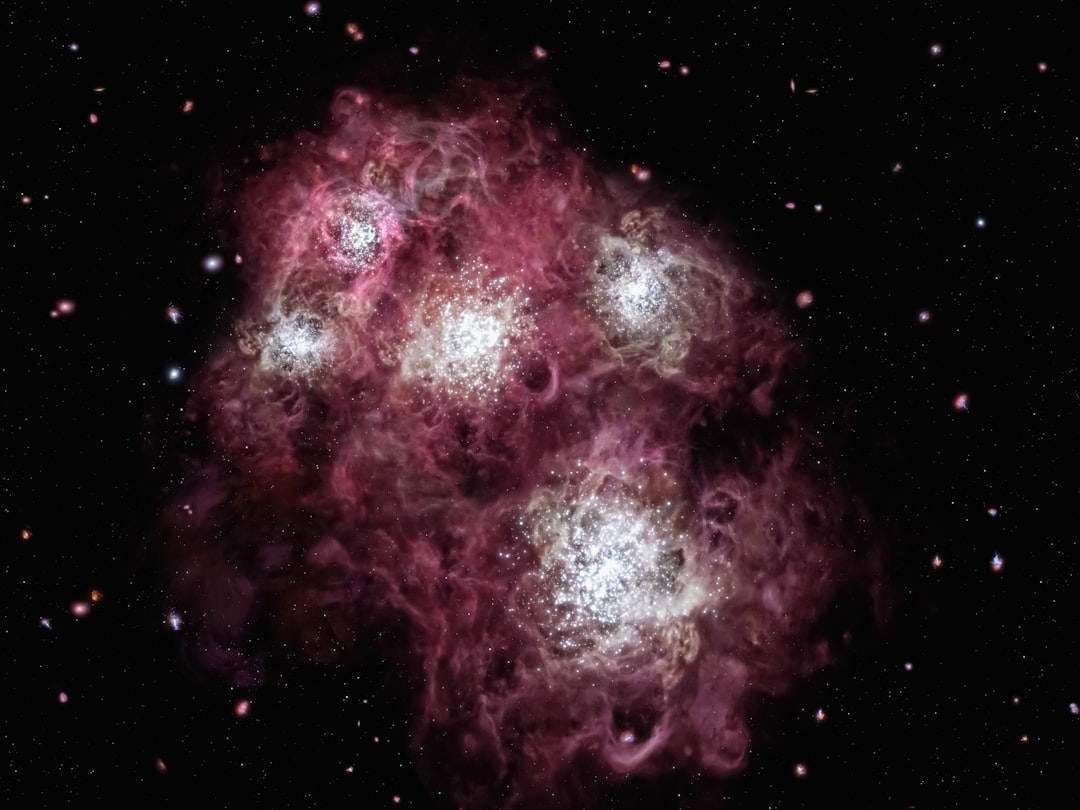
In one of the most ambitious theoretical leaps in modern physics, researchers have proposed a groundbreaking connection between two of cosmology's most perplexing puzzles: the mysterious cosmic inflation that occurred in the universe's first fraction of a second, and the long-sought theory of quantum gravity. This revolutionary framework, published in Physical Review Letters, suggests that a controversial mathematical approach called quadratic quantum gravity might not only solve fundamental problems in theoretical physics but also explain why our universe underwent its dramatic early expansion.
The quest to unify our understanding of the cosmos has challenged physicists for nearly a century. While we possess extraordinarily successful theories describing different aspects of reality—from the behavior of subatomic particles to the motion of galaxies—these frameworks stubbornly refuse to fit together into a single, coherent picture. This new research, led by Ruolin Liu, Jerome Quintin, and Niayesh Afshordi, offers a potential resolution that could reshape our understanding of the universe's earliest moments and provide testable predictions for next-generation gravitational wave observatories like NASA's LISA mission.
The Three Pillars Problem: When Physics Theories Clash
Contemporary cosmology rests upon three foundational theoretical frameworks, each spectacularly validated by experimental evidence yet fundamentally incompatible with the others. Special relativity, Einstein's theory of space and time, describes how these dimensions interweave and how nothing can exceed the speed of light. Newtonian gravity (and its more sophisticated cousin, general relativity) governs the behavior of massive objects—from planets orbiting stars to the warping of spacetime around black holes. Quantum mechanics rules the microscopic realm, describing the probabilistic nature of particles and the forces that bind atoms together.
Each theory excels in its domain. Quantum mechanics accurately predicts the behavior of electrons, photons, and the fundamental forces that govern particle interactions. Gravitational theory, as refined by Einstein into general relativity, has been confirmed by countless observations, from the detection of gravitational waves to the precise tracking of GPS satellites. Special relativity underpins our understanding of how space and time behave at high velocities and forms the backdrop against which all physical processes unfold.
The challenge arises when physicists attempt to combine these theories. Any two can be successfully unified: general relativity emerges from wedding special relativity with gravity, revealing that gravity itself is the curvature of spacetime. Quantum field theory combines quantum mechanics with special relativity, giving us the Standard Model of particle physics. Even quantum mechanics and weak gravitational fields can be reconciled, allowing us to understand how atoms behave on Earth's surface.
The Renormalization Crisis: When Infinities Invade Physics
The real trouble begins when attempting to merge all three frameworks simultaneously. At the heart of this difficulty lies what physicists call the renormalization problem—a mathematical nightmare that has stymied theoretical progress for decades.
In quantum field theory, the vacuum of space isn't truly empty. According to Heisenberg's uncertainty principle, particles can spontaneously pop into existence as "virtual particles," borrowing energy from the quantum vacuum for infinitesimally brief moments before disappearing. When combined with special relativity's famous equation E=mc², these virtual particles carry energy that can theoretically convert into mass and back again.
This creates a cascade effect: the energy of virtual particles spawns more virtual particles, which generate even more, ad infinitum. When physicists attempt to calculate the total energy density of this quantum foam, the mathematics explodes into infinity—a physically meaningless result. Fortunately, a clever mathematical technique called renormalization allows physicists to subtract away these infinities by focusing only on relative energy differences, which are finite and measurable.
However, gravity throws a wrench into this elegant solution. According to general relativity, energy curves spacetime—and that includes the energy of virtual particles. But if spacetime itself is fluctuating due to quantum effects, there's no fixed background against which to perform renormalization. The mathematical machinery breaks down completely. As researchers at Perimeter Institute for Theoretical Physics have noted, this fundamental incompatibility represents one of the deepest problems in modern physics.
Quadratic Quantum Gravity: A Controversial Solution
Among the various approaches to quantum gravity—including string theory, loop quantum gravity, and causal set theory—one framework stands out for its mathematical tractability: quadratic quantum gravity. This approach modifies Einstein's field equations by adding terms proportional to the square of the curvature of spacetime, hence the name "quadratic."
The beauty of this modification is that it makes the theory renormalizable, allowing physicists to use the same mathematical techniques that work so successfully in quantum field theory. The quadratic terms effectively dampen the ultraviolet (high-energy) behavior of the theory, preventing the runaway infinities that plague other quantum gravity approaches.
But there's a catch—and it's a significant one. The quadratic terms introduce a new quantum field that manifests as "ghost particles"—exotic entities with bizarre properties that violate some of our fundamental assumptions about how particles should behave. These ghosts have never been detected in any particle physics experiment, from the massive detectors at CERN's Large Hadron Collider to precision measurements of atomic spectra.
"The ghost particles predicted by quadratic quantum gravity could simply be too massive to produce in current accelerators, but this very feature made the theory seem untestable and therefore unfalsifiable—a serious problem for any scientific theory," explains Dr. Niayesh Afshordi, one of the study's co-authors.
This apparent untestability relegated quadratic quantum gravity to the margins of theoretical physics, despite its mathematical elegance. Most physicists dismissed it as an interesting mathematical curiosity that likely had no connection to physical reality.
From Quantum Gravity to Cosmic Inflation: An Unexpected Connection
The new research by Liu, Quintin, and Afshordi transforms this picture entirely. Their key insight is that quadratic quantum gravity naturally produces cosmic inflation—the exponential expansion of space that occurred in the first tiny fraction of a second after the Big Bang.
Cosmic inflation was proposed in the 1980s to solve several puzzles about the universe's large-scale structure, including why regions of space separated by vast distances have nearly identical temperatures and why the universe appears so geometrically flat. Standard inflationary models typically invoke a hypothetical inflaton field—a new quantum field whose energy density drives the rapid expansion. However, the physical nature of this field remains mysterious, and physicists have proposed dozens of different inflaton models without consensus.
The breakthrough in this new work is demonstrating that the quadratic terms in quadratic quantum gravity can naturally drive inflation without requiring any additional hypothetical fields. The mathematics shows that in the universe's earliest moments, when quantum gravitational effects dominated, the quadratic corrections to Einstein's equations would cause space to expand exponentially. As the universe grew and cooled, these quantum effects diminished, and the cosmos transitioned smoothly into the classical expansion described by standard general relativity.
Key Theoretical Predictions and Observational Tests
The research team's analysis yields several concrete predictions that distinguish their model from alternative theories:
- Natural Inflation Mechanism: Unlike conventional inflation models that require fine-tuning of parameters, quadratic quantum gravity produces inflation as an inevitable consequence of quantum gravitational effects in the early universe
- Gravitational Wave Background: The model predicts a specific minimum amplitude for primordial gravitational waves generated during the inflationary epoch, with a characteristic frequency spectrum
- Ultraviolet Completion: The theory provides what physicists call an "ultraviolet completion" of the Big Bang, meaning it remains mathematically consistent even when extrapolated to the highest energy scales at the universe's beginning
- Testable Predictions: Most crucially, the predicted gravitational wave signal falls within the detection range of future space-based observatories, particularly the LISA (Laser Interferometer Space Antenna) mission scheduled for launch in the 2030s
Observational Prospects: Testing Quantum Gravity Through Gravitational Waves
Perhaps the most exciting aspect of this research is that it transforms quadratic quantum gravity from an untestable mathematical framework into a theory that makes concrete, falsifiable predictions. The primordial gravitational waves predicted by the model carry the imprint of quantum gravitational effects from the universe's first moments—a direct observational window into physics at energy scales far beyond what any particle accelerator could ever achieve.
Current gravitational wave observatories like LIGO and Virgo detect waves from astrophysical sources such as merging black holes and neutron stars. However, the primordial gravitational wave background from inflation exists at much lower frequencies, requiring space-based detectors. LISA, a joint mission between NASA and the European Space Agency, will be sensitive to precisely the frequency range where this model predicts signals should appear.
The research team's calculations show that while the predicted gravitational wave amplitude is too small for current technology to detect, it should be observable by LISA and other next-generation detectors. If these observations confirm the predictions, it would provide the first direct evidence for quantum gravitational effects and validate the quadratic quantum gravity framework.
Implications for Fundamental Physics and Cosmology
This work represents more than just another proposal for quantum gravity or inflation—it suggests a profound connection between two seemingly separate problems in theoretical physics. By showing that quantum gravity naturally produces inflation, the research potentially eliminates the need for hypothetical inflaton fields while simultaneously making quantum gravity testable.
The implications extend across multiple areas of physics and cosmology. If confirmed, this framework would provide insights into the universe's earliest moments, validate a specific approach to quantum gravity, and potentially reveal the existence of ghost particles at energy scales just beyond current experimental reach. It would also suggest that the universe's large-scale structure—everything from galaxy clusters to the cosmic microwave background—carries information about quantum gravitational physics encoded in primordial gravitational waves.
Future research will focus on refining the model's predictions, exploring additional observational consequences, and preparing for the wealth of data expected from next-generation gravitational wave observatories. As our observational capabilities improve and theoretical understanding deepens, we may finally be approaching answers to questions that have puzzled physicists since the dawn of quantum mechanics and general relativity.
The journey toward a complete theory of quantum gravity continues, but this research suggests we may be closer than ever to glimpsing the quantum nature of spacetime itself—written in the gravitational waves echoing from the universe's first moments.