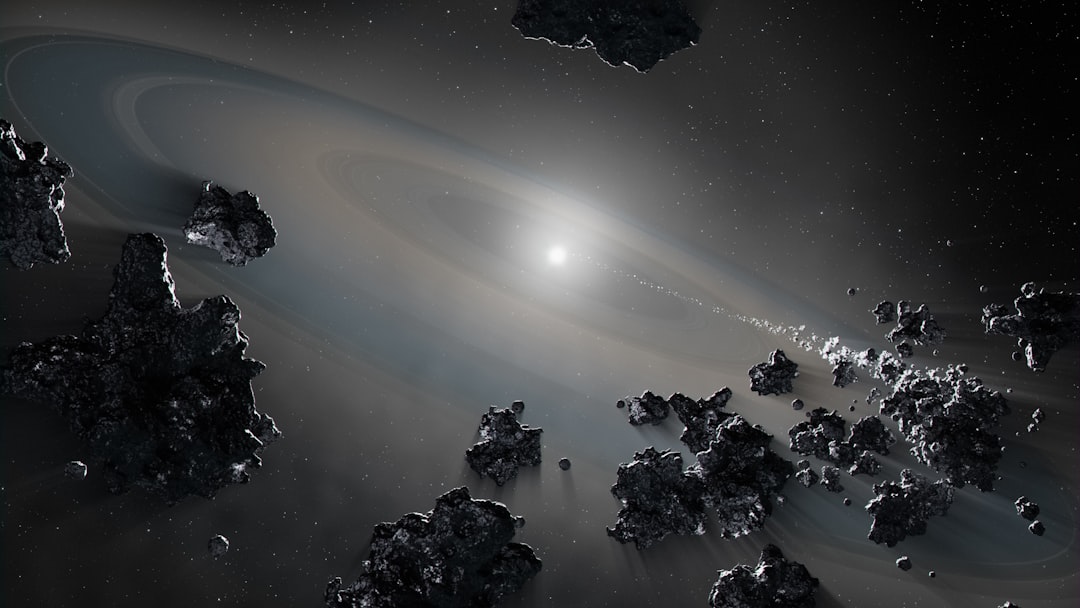
A Massive Stream of Gas Tilted This Planet-Forming Disk
In the simplest version of events, star formation begins when vast clouds of cold molecular hydrogen collapse under their own gravity, condensing into dense cores called protostars. Over millions of years, those protostars accrete more gas and dust from the surrounding cloud, gradually growing in mass. Eventually, the pressure and temperature at the protostar's core become so extreme that nuclear fusion is triggered, and a new main sequence star is born. It is an elegant, orderly picture — but nature, as astronomers are increasingly discovering, rarely operates so neatly.
The better astrophysicists get at observing star formation, and the more powerful their telescopes become, the more complex and turbulent the process reveals itself to be. Swirling streamers of gas, chaotic accretion flows, and gravitational interactions between multiple stellar bodies all conspire to make the birth of a solar system far messier — and far more interesting — than textbook models suggest. Nowhere is this more apparent than in the young triple star system known as GW Orionis.
GW Orionis: A Triple Star System Under the Microscope
GW Orionis (also written as GW Ori) is located approximately 1,500 light-years from Earth in the constellation Orion, one of the most active star-forming regions in our galactic neighborhood. The system is a gravitationally bound trio of young stars, and it is surrounded by a spectacular multi-ringed, circumtrinary protoplanetary disk — a swirling structure of gas and dust from which planets may one day form. What makes GW Orionis particularly fascinating, and particularly puzzling, is the fact that its three dust rings are not aligned with one another. Each ring is tilted at a different angle, creating one of the most dramatically warped disk structures ever observed around a young stellar system.
For years, astronomers have debated what could cause such extreme misalignment. Some studies pointed to the complex gravitational torques exerted by the three stars on one another and on the disk. Others suggested that the inner stars might be carving out and tilting sections of the disk through their orbital motion. Now, groundbreaking new research published in The Astronomical Journal offers a compelling new explanation: a massive streamer of gas — stretching a staggering one trillion miles in length — is actively feeding into GW Orionis from the surrounding molecular cloud, and its impact on the outer disk is almost certainly responsible for the observed tilting.
The study is titled "A Streamer Driving Misalignment in the Circumtriple Disk of GW Ori," and is led by Maria Galloway-Sprietsma, a PhD candidate at the University of Florida's Department of Astronomy. The research team combined archival and new observational data to paint the most complete picture yet of how external gas infall can shape — and warp — a planetary nursery.
Misaligned Rings: A Cosmic Mystery Solved?
In our own Solar System, the planets orbit the Sun on a relatively flat plane that is closely aligned with the Sun's equatorial rotation. There are minor variations — Mercury's orbit, for instance, is tilted about 7 degrees relative to the ecliptic plane — but the overall architecture is remarkably orderly. This is thought to reflect the original geometry of the disk of gas and dust from which the Solar System formed, known as the solar nebula.
Yet when astronomers look beyond our Solar System, they find that this kind of orderliness is far from universal. Exoplanets are frequently found in orbits tilted significantly relative to their host stars' equatorial planes — a phenomenon known as spin-orbit misalignment. Multi-ring protoplanetary disk systems with warped, non-coplanar structures, like GW Orionis, offer a potential window into how such architectural disorder originates. If the disk itself is already tilted and broken into misaligned sections before planets have fully formed, it stands to reason that the resulting planetary system will inherit that disorder.
"Previous studies of GW Orionis revealed that the system's inner, middle and outer rings are misaligned, with each ring tilted at a different angle. When our team modeled the infall of this streamer, we found that the angle at which it impacts the disk is closely aligned with the outer ring."
— Maria Galloway-Sprietsma, Lead Author, University of Florida
This finding is significant: rather than attributing the misalignment solely to the internal gravitational dynamics of the three stars, the new research identifies an external agent — the infalling gas streamer — as a key driver of the disk's warped architecture. The streamer's angular momentum vector is aligned with the outermost dust ring to within approximately 3 degrees, in stark contrast to a 32-degree misalignment with the system's innermost ring. This geometric relationship is far too precise to be coincidental.
The Role of ALMA: Seeing the Invisible
Detecting a gas streamer of this kind requires instruments capable of resolving extremely faint molecular emission over very large angular scales — a challenge that is beyond the capabilities of most telescopes. The research team turned to the Atacama Large Millimeter/submillimeter Array (ALMA), a transformative radio telescope array located in the high-altitude Atacama Desert of Chile. ALMA is specifically designed to detect the cold gas and dust that populate star-forming regions, and it remains the most powerful instrument in the world for this kind of work.
The team used molecular line data from two isotopologues of carbon monoxide — ¹²CO and ¹³CO — to trace the gas stream in unprecedented detail. Carbon monoxide is one of the most abundant molecules in the interstellar medium and serves as a reliable tracer of gas dynamics in star-forming environments. The two isotopologues provide complementary information:
- ¹²CO is the more abundant form and maps the full spatial extent and velocity structure of the streamer, revealing how far and how fast the gas is traveling.
- ¹³CO is rarer and traces the densest, most optically thick regions of the stream, providing a more precise measurement of how much gas is actually present.
Together, these two tracers allowed the team to construct a three-dimensional model of the streamer's trajectory, confirming that it originates from the remnant molecular cloud surrounding GW Orionis and intersects the disk at the location of the outermost dust ring. The research utilized all three ALMA array configurations — the 12-meter array, the 7-meter array, and the Total Power array — enabling the team to zoom out and capture the full, sweeping extent of the gas streamer while retaining the resolution necessary to resolve the fine structure of the disk's rings.
"None of this would have been possible without ALMA. ALMA has the highest resolution offered for these wavelengths. Archival data allowed astronomers to see these high-resolution dust rings to model their relative misalignments, and now our observations use all three ALMA arrays — the 12-meter, 7-meter, and Total Power — to zoom out and see the full extent of the streamer, so really the observations with ALMA have been building, year after year."
— Maria Galloway-Sprietsma
What the Data Reveal: A System Still Feeding
The observational picture that emerges from this research is remarkable. GW Orionis, despite being a relatively evolved young stellar system, remains dynamically connected to its parent molecular cloud through the ongoing infall of this massive gas streamer. The streamer is not a passive feature — it is actively delivering angular momentum to the outer disk, torquing it away from the orientation of the inner disk structures and driving the misalignment that previous studies had documented but could not fully explain.
The authors write in their paper: "Together, these results suggest that GW Ori remains dynamically linked to its parental cloud through ongoing accretion, with the streamer serving as the likely driver of its misaligned disk structure." The best-fit trajectory models show that the streamer meets the disk at the outermost dust ring, and the angular momentum alignment between streamer and outer ring — within just 3 degrees — is a near-perfect match that strongly implicates the streamer as the cause of the observed misalignment.
Crucially, the research also provides evidence that this particular episode of infall is drawing to a close. The total angular momentum of the streamer is smaller than that of GW Orionis' disk, and the measured accretion rate is low, leading the authors to conclude: "We are probably witnessing the end stages of infall." Over the coming astronomical timescales, the streamer will likely dissipate entirely, leaving GW Orionis to evolve in isolation — though the structural legacy of the misalignment it has introduced will almost certainly persist.
Broader Implications: Are Streamers Common?
The implications of this discovery extend far beyond GW Orionis itself. If gas streamers like this one are a common feature of young star-forming systems — rather than an exotic oddity — then they could hold the key to explaining a wide range of puzzling observations across the field of exoplanet science and stellar astrophysics.
"If these streamers are common, then we can naturally explain why planets may not necessarily end up in very orderly systems. They can have much more random orientations."
— Jaehan Bae, Astronomy Professor, University of Florida
Jaehan Bae, an astronomy professor at the University of Florida who co-led the research, points to the broader significance of this mechanism. The NASA Exoplanet Archive contains thousands of confirmed exoplanets, a substantial fraction of which exhibit spin-orbit misalignments that have long been difficult to explain through stellar and planetary dynamics alone. Streamers like the one identified in GW Orionis could provide a natural, elegant explanation for at least some of these misalignments — not as the result of post-formation gravitational scattering or tidal interactions, but as an imprint of formation itself.
Beyond orbital architecture, infalling streamers could also be responsible for other anomalies observed in stellar and planetary systems, including:
- Chemical abundance anomalies: Streams of gas carrying material of a different chemical composition than the host disk could introduce local enrichments or depletions in elements and isotopes, potentially explaining the metallicity variations seen in some stellar photospheres.
- Stellar rotation anomalies: Depending on the angular momentum delivered by a streamer, the spin rate and even the rotational axis of the host star could be affected — a subtle but potentially measurable consequence.
- Disk substructures: The impact point of a streamer on a disk could trigger local instabilities, spiral arms, or even ring-like gaps that might otherwise be attributed to the gravitational influence of unseen protoplanets.
The scientific community has, in recent years, identified a growing number of gas streamers around other young stellar objects, suggesting that this phenomenon is indeed more common than once thought. Observations with instruments like ALMA and, increasingly, the James Webb Space Telescope (JWST) are revealing a messy, dynamic universe of star formation that challenges the clean, sequential models that dominated the field for decades.
The Future: A Systematic Survey of Young Stars
The GW Orionis study represents a significant step forward, but the research team is clear that much work remains. The next priorities include searching for shock tracers within GW Orionis itself — chemical signatures that would pinpoint the exact location where the streamer's high-velocity gas crashes into the disk — as well as conducting broader, population-level surveys of other young star systems to determine how frequently such streamers occur.
The authors conclude their paper with a call to action: "Future work on shock tracers in GW Ori could help pinpoint where the streamer impacts the disk, and population-level studies of streamers will help determine if these structures are commonplace."
"What we need next is a systematic survey of young stars to see how many have streamers and how many don't. That will tell us how important they are in shaping planetary systems."
— Maria Galloway-Sprietsma
Such a survey, conducted with ALMA and potentially complemented by JWST's infrared sensitivity and the future capabilities of the Extremely Large Telescope (ELT), could fundamentally reshape our understanding of how planetary systems acquire their architectures. If streamers are found to be a universal or near-universal feature of young stellar systems, the conventional picture of orderly, disk-driven planet formation will need to be substantially revised to account for the ongoing, turbulent influence of the parent molecular cloud — long after the star itself has begun to shine.
For now, GW Orionis stands as a remarkable case study: a system caught in the act of being shaped by its environment, its three misaligned dust rings a frozen record of the chaotic forces that govern the birth of worlds. The planets that may one day form in those tilted rings will inherit a legacy of turbulence — a reminder, written in the language of gravity and angular momentum, that the universe rarely does things the simple way.
The research, "A Streamer Driving Misalignment in the Circumtriple Disk of GW Ori," was published in The Astronomical Journal. DOI: 10.3847/1538-3881/ae8bae.