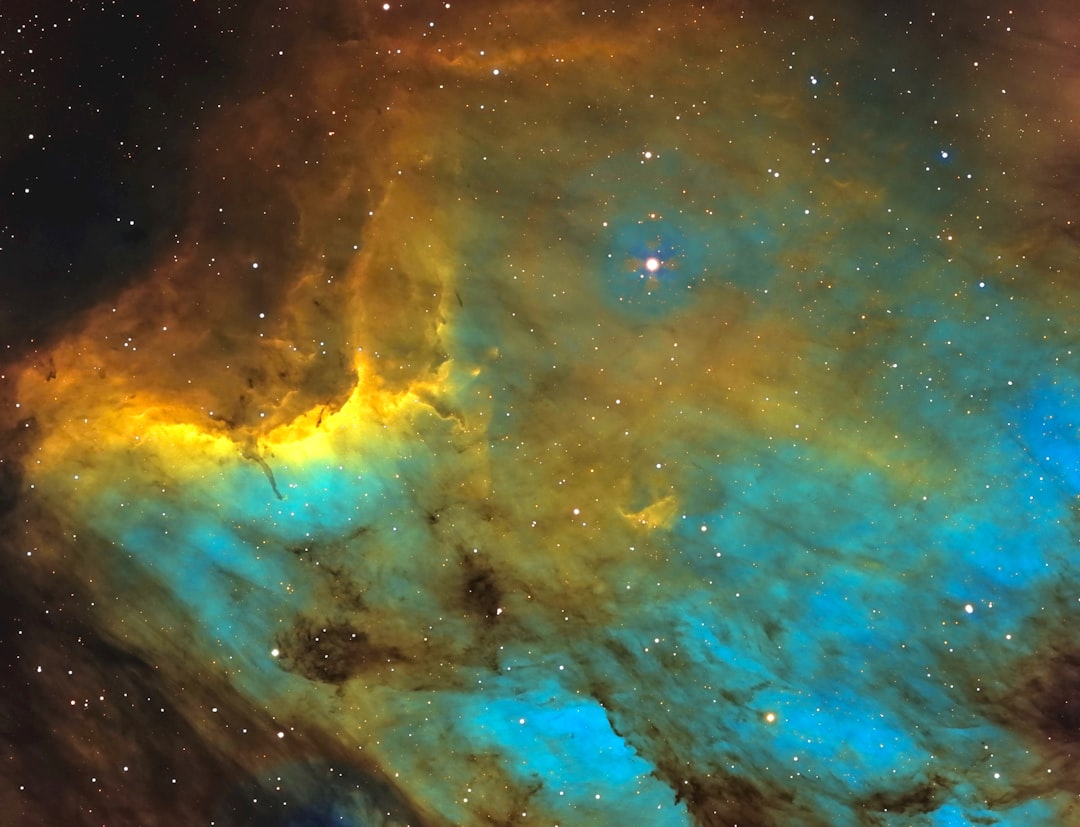
Webb Captures the Treasure Chest at the Heart of the Carina Nebula
The Carina Nebula (NGC 3324), located approximately 7,500 light-years away in the southern constellation Carina (the Keel), has long captivated astronomers and space enthusiasts alike. Once a favorite target of the NASA/ESA Hubble Space Telescope, this magnificent stellar nursery has now been revisited with extraordinary new clarity by the NASA/ESA/CSA James Webb Space Telescope (JWST). The resulting image, a breathtaking portrait of a feature known as the "Treasure Chest," was proudly featured as ESA's Picture of the Month — and it is easy to understand why.
Webb's advanced suite of infrared instruments pierces through the dense veils of dust that have historically obscured our view of star-forming regions, revealing the hidden machinery of stellar birth with unprecedented resolution and sensitivity. What we see inside the Carina Nebula is nothing short of a cosmic masterpiece.
A Stellar Nursery of Cosmic Proportions
Spanning roughly 260 light-years across, the Carina Nebula holds the distinction of being the nearest high-mass star-forming region in the Milky Way. This relative proximity — at least on a cosmic scale — makes it an extraordinarily valuable laboratory for astronomers. Because it is close enough to resolve individual stars and structures in remarkable detail, the Carina Nebula offers a rare window into the complete lifecycle of star formation, from the earliest gravitational collapse of gas clouds to the emergence of fully formed stellar systems.
The nebula is home to tens of thousands of protostars at various stages of development, as well as some of the most massive and luminous stars known in our galaxy. These stellar giants are not passive inhabitants; they actively sculpt the nebula's landscape through intense ultraviolet (UV) radiation and powerful stellar winds — streams of charged particles that carve, erode, and reshape the surrounding gas and dust over millions of years. Studying how these energetic young stars interact with and transform their environment is one of the central goals of modern astrophysics.
"The Carina Nebula is one of the best places in the sky to study how massive stars are born, live, and dramatically alter everything around them." — ESA Webb Mission Science Team
Webb's Infrared Vision: Seeing What Was Once Hidden
Unlike visible-light telescopes, Webb observes the universe primarily in infrared wavelengths, which pass through dust clouds that would otherwise block our view. This capability is transformative for studying regions like the Carina Nebula, where star formation is actively occurring within dense, dusty cocoons. Webb's Near-Infrared Camera (NIRCam) — the telescope's primary imager — captures light in wavelengths ranging from 0.6 to 5 microns, making it ideally suited to reveal the warm gas, glowing dust, and young stars embedded within nebulae like this one.
The resulting imagery does more than produce beautiful pictures. Each wavelength of infrared light carries specific physical information: the temperature of dust grains, the density of gas clouds, the presence of specific molecules, and the energetic output of newly formed stars. In this sense, Webb's images of the Carina Nebula are also rich scientific datasets, enabling researchers to extract quantitative measurements that drive our understanding of stellar evolution forward.
The Cosmic Cliffs and the Architecture of the Nebula
Long-time followers of Webb's journey will recall that the Carina Nebula holds a special place in the telescope's history. The iconic "Cosmic Cliffs" — a dramatic, mountain-like ridge of gas and dust — were among the very first images released publicly by the Webb mission, instantly demonstrating the telescope's extraordinary power. These towering formations are not mountains at all, but rather the edge of a gigantic, gaseous cavity hollowed out over time by the fierce ultraviolet radiation and stellar winds emanating from massive protostars concentrated at the nebula's core.
- The Cosmic Cliffs region rises roughly 7 light-years high — approximately the distance from our Sun to its nearest stellar neighbor.
- The cavity was carved by photoionization, a process in which high-energy UV photons strip electrons from hydrogen atoms, creating a glowing, ionized gas known as an HII region.
- Webb's infrared imaging revealed previously invisible jets of gas being expelled by young stars embedded in the cliffs — direct observational evidence of active star formation.
- The boundary between the hot ionized gas and the cold molecular cloud creates a photodissociation region (PDR), a chemically rich zone that is a focus of intensive scientific study.
Understanding these structures in the Carina Nebula provides broader insights into how massive star formation proceeds throughout the universe, including in distant galaxies observed at earlier cosmic epochs by Webb itself.
The Treasure Chest: A Jewel Box Within a Nebula
The centerpiece of the ESA Picture of the Month is a remarkable feature known as the "Treasure Chest" — an evocative name for a structure that lives up to every syllable of it. Formally classified as a cometary globule, the Treasure Chest is an isolated cloud of gas and dust characterized by a dark, dense head and an elongated, swept-back tail. Cometary globules earn their name from their striking resemblance to comets, even though they are vastly larger and have nothing chemically in common with the icy bodies orbiting our Sun.
Yet the Treasure Chest stands apart from a typical cometary globule. Rather than resembling a comet, its shape evokes something far more whimsical: a wooden chest thrown open wide, its interior glittering with the light of young stars like scattered jewels. This structure arises because the intense radiation pressure from nearby massive stars has not only shaped the cloud's exterior but has also partially eroded its front face, exposing the young star cluster sheltered within.
Astronomers estimate the Treasure Chest cluster contains approximately 70 stars, representing a compact and relatively young stellar population. Among these are some of the most extreme objects in the cluster: rare blue-white O-type stars, the hottest and most massive class of stars in the standard stellar classification system. These giants boast:
- Surface temperatures of approximately 30,000 Kelvin — roughly five times hotter than our own Sun's surface.
- Masses reaching up to 19 times that of the Sun, placing them firmly in the category of high-mass stars.
- Luminosities that can exceed the Sun's energy output by factors of tens of thousands, making them the dominant sources of radiation and stellar winds in their immediate environment.
- Relatively short lifespans of just a few million years — cosmically brief compared to the Sun's expected 10-billion-year lifetime — before ending their lives in violent supernova explosions.
It is these O-type stars that infuse the Treasure Chest with its characteristic ethereal, blue-tinged glow, beautifully rendered in Webb's NIRCam imagery. The interplay of ionized gas, fluorescent dust, and starlight creates a visual tapestry that is as scientifically informative as it is aesthetically stunning.
Eta Carinae: The Distant Architect
To understand the Treasure Chest's shape and evolution, one must look beyond the frame of the image to the most dominant force in the Carina Nebula: Eta Carinae. Situated approximately 39 light-years to the northwest of the Treasure Chest, Eta Carinae is the brightest and most energetic object in the entire nebula — and one of the most remarkable stellar systems in the Milky Way.
Eta Carinae is a binary system locked in a gravitationally bound dance, with the primary star being a true cosmic titan. Current estimates suggest this star is:
- Approximately 100 times more massive than our Sun.
- Roughly 5 million times more luminous than the Sun, making it one of the most intrinsically bright stars known.
- A Luminous Blue Variable (LBV) — an extremely unstable category of massive star prone to episodes of violent mass ejection.
- The likely progenitor of one of the most dramatic astronomical events in recorded history: the Great Eruption of 1843, during which Eta Carinae briefly became the second brightest star in the night sky without undergoing a full supernova.
The stellar wind and UV radiation from Eta Carinae are the primary forces sculpting the Treasure Chest's distinctive cometary shape, sweeping the gas and dust away from the direction of the massive star and creating the elongated tail that gives the globule its character. This process, known as radiation-driven ablation, is actively ongoing — the Treasure Chest is being slowly but relentlessly eroded by its powerful neighbor.
Planetary Nurseries and the Future of the Cluster
Despite the hostile environment created by nearby massive stars, life — or at least the potential for planetary systems — finds a way. Astronomers have confirmed that some individual stars within the Treasure Chest cluster are surrounded by circumstellar disks: flattened, rotating structures of gas and dust from which planets can form through the process of accretion. These protoplanetary disks are the nascent solar systems of tomorrow, and their presence in such an energetically extreme environment raises profound questions about the conditions under which planets can form throughout the galaxy.
The Treasure Chest cluster is estimated to be only about 1.3 million years old — a mere infant by cosmic standards. For context, our own Solar System is approximately 4.6 billion years old, meaning the Treasure Chest stars have completed less than 0.03% of a Sun-like stellar lifetime. They are, in every sense, newborns.
Yet even as these young stars are forming and potentially nurturing planetary systems, they are also sealing their own cluster's visible fate. Over the coming millions of years, the cumulative radiation and winds from the O-type stars will gradually dissipate the remaining gas and dust of the Treasure Chest, dispersing the cloud that currently wraps around the cluster. When that process is complete, the chest will be fully "opened," and the cluster of young stars will be fully exposed — no longer hidden jewels, but brilliant stellar beacons visible across the Carina Nebula.
The Broader Scientific Legacy of Webb's Carina Observations
Webb's observations of the Carina Nebula, including the Treasure Chest, form part of a broader scientific program aimed at understanding how stars and planetary systems form in high-mass star-forming environments. The data collected contributes to multiple fields of astrophysical research:
- Stellar evolution: Tracking the development of O-type and other massive stars from birth to supernova.
- Planet formation: Assessing whether circumstellar disks can survive intense UV radiation from nearby massive stars — a question with implications for the prevalence of habitable planets in the universe.
- ISM (Interstellar Medium) physics: Mapping the complex physical and chemical processes occurring at the boundaries between ionized and molecular gas.
- Galactic ecology: Understanding how feedback from massive stars regulates star formation rates across entire galaxies.
The ESA Webb mission continues to deliver transformative science from across the cosmos, and the Carina Nebula — with its rich tapestry of star-forming structures, massive stellar systems, and hidden jewels like the Treasure Chest — remains one of its most scientifically rewarding targets. Each new image and dataset refines our understanding of how the universe builds its stars, planets, and ultimately, the conditions that may give rise to life itself.
For those wishing to explore the primary data and mission details further, the Space Telescope Science Institute (STScI) maintains a comprehensive archive of Webb observations and associated scientific publications.