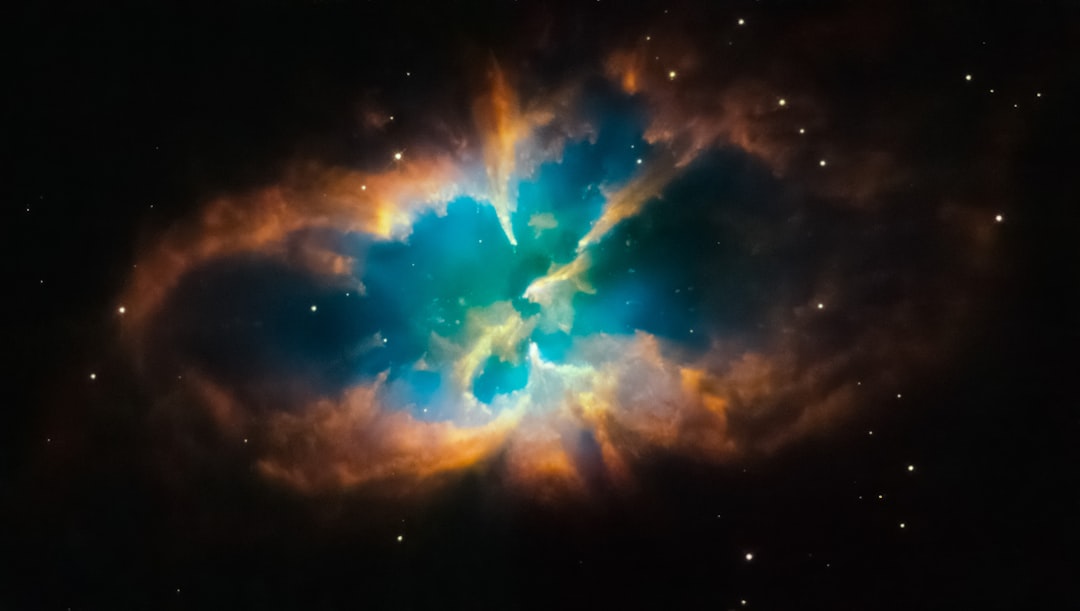
Webb Captures Clearest Image Yet of the Lion Nebula
The NASA/ESA/CSA James Webb Space Telescope (JWST) has delivered a breathtaking new portrait of NGC 2392, popularly known as the Lion Nebula — so named for its striking resemblance to a lion's face viewed head-on. The image represents the most detailed and scientifically rich view of this object ever obtained, shedding new light on the dramatic final stages of stellar evolution and the complex physics that govern planetary nebulae.
The venerable Hubble Space Telescope (HST) first observed NGC 2392 in 2000, revealing a fascinating population of hazy, comet-shaped objects embedded within the nebula's glowing shell. Now, by combining data from Webb's Near-Infrared Camera (NIRCam) and its powerful Mid-Infrared Instrument (MIRI), astronomers have achieved an unprecedented level of clarity and depth — exposing structural intricacies that remained hidden from previous observatories.
"Webb's infrared vision allows us to peer through layers of gas and dust that were previously opaque, revealing the full architectural complexity of dying stellar systems like NGC 2392."
Anatomy of a Lion: Decoding the Nebula's Structure
The new Webb image reveals the nebula's remarkably layered and complex architecture. At its heart lies a white dwarf — the dense, Earth-sized stellar remnant of the original star — which blazes at temperatures exceeding 40,000 Kelvin. This intensely hot object functions as the engine of the entire nebular system, and in the lion metaphor, it plays the role of the animal's nose.
Radiating outward from this central remnant is an expansive, luminous gaseous envelope composed of shells, rings, and delicate filamentary tendrils — the nebula's iconic "mane." These structures are not static. The ferocious ultraviolet radiation streaming from the white dwarf ionizes the surrounding hydrogen gas, causing it to fluoresce in characteristic colors. This radiation pressure also drives the gas bubble to expand outward at speeds of several kilometers per second, actively sculpting the nebula's appearance in real time.
The outer boundary of this expanding bubble acts like a cosmic snowplow, sweeping up and destroying much of the dust it encounters. Yet, as Webb's infrared instruments have revealed, not all of the dust is annihilated. Compact dust clumps — appearing in vivid shades of red, orange, and yellow in the processed image — have survived the onslaught. These resilient knots of material cast protective shadows behind them, shielding pockets of gas and dust from the destructive radiation in a process astronomers call self-shielding.
From Star to Nebula: The Life Cycle of a Low-Mass Star
To fully appreciate what Webb is observing, it is essential to understand how the Lion Nebula came to be. Unlike their more massive counterparts — which end their lives in cataclysmic supernova explosions, leaving behind neutron stars or black holes — lower-mass stars like the progenitor of NGC 2392 follow a far more gradual, yet equally dramatic, path to their demise.
When a star with a mass roughly similar to our own Sun exhausts its core supply of hydrogen fuel, it swells into a red giant, fusing helium in its core. As helium fuel runs low, the star's core contracts while its outer layers expand dramatically. The star enters what is known as the Asymptotic Giant Branch (AGB) phase, during which it becomes highly unstable and begins to pulsate on timescales of hundreds to thousands of years. These pulsations progressively expel the star's outer layers into the surrounding space, forming what is known as a circumstellar envelope.
Over tens of thousands of years, the ejected material forms a planetary nebula — a term that is, historically speaking, a misnomer, since these objects have nothing to do with planets. The name dates back to the 18th century, when early telescopes made these rounded, glowing objects superficially resemble the disk of a planet. Today, we know them to be among the most spectacular products of stellar evolution.
- Progenitor star mass: Typically 1–8 solar masses for planetary nebula formation
- Ejected material: Constitutes the majority of the star's original mass
- White dwarf remnant: Dense core of carbon and oxygen, roughly Earth-sized
- Nebula lifetime: Typically 10,000–50,000 years before dispersing into the interstellar medium
- Role in the cosmos: Primary source of carbon, nitrogen, and oxygen in the interstellar medium
An Oxygen-Rich Legacy
In the particular case of the Lion Nebula, the progenitor star was notably oxygen-rich in its outer layers — a characteristic that has profoundly influenced the nebula's chemistry and appearance. This oxygen enrichment means that the gas expelled by the dying star contains elevated abundances of oxygen and related molecules, which interact differently with the central star's radiation compared to carbon-rich nebulae.
The white dwarf at the center superheats the surrounding gas bubble, ionizing hydrogen and driving the expansion of the nebular shell. This ongoing process continuously reshapes the ring-and-shell structures visible in the Webb image. Understanding the precise mechanisms behind these layered morphologies — including why some nebulae are spherical while others are bipolar or highly asymmetric — remains one of the most compelling open questions in stellar astrophysics and is an active area of observational and theoretical research.
What Webb Reveals That Hubble Could Not
At first glance, Webb's image of NGC 2392 may appear broadly similar to Hubble's earlier optical portrait. However, the scientific depth they provide is fundamentally different. Webb's infrared sensitivity allows it to detect emission from cooler dust and molecular gas that is essentially invisible to optical telescopes. The compact red and orange dust clumps scattered throughout the nebula, clearly resolved in the new image, were previously unresolvable or indistinguishable from the diffuse glow of ionized gas.
Furthermore, MIRI's mid-infrared observations reveal the thermal emission from polycyclic aromatic hydrocarbons (PAHs) and other complex molecules trapped within surviving dust clumps. These molecules are considered potential precursors to organic chemistry and are distributed throughout the interstellar medium by exactly the kind of nebular dispersal event Webb is now imaging in NGC 2392. This underscores the profound connection between dying stars and the chemical enrichment of galaxies.
A Fleeting Cosmic Portrait
The Lion Nebula, as we see it today, is a transient phenomenon on cosmic timescales. Astronomers estimate that its distinctive, leonine appearance will disperse entirely in approximately 10,000 years — an eyeblink in the 13.8-billion-year history of the Universe. As the gas and dust continue to migrate outward from the stellar core, they will gradually merge with the surrounding interstellar medium (ISM), enriching it with heavy elements forged in the progenitor star's interior.
This process of chemical enrichment is foundational to the story of cosmic evolution. The carbon in your pencil, the nitrogen in the air you breathe, and the oxygen in the water you drink were all forged in the cores of stars and dispersed across galaxies through events precisely like the one Webb is now capturing in NGC 2392. In this sense, the Lion Nebula is not merely a beautiful object — it is a window into the ongoing cycle of stellar death and cosmic renewal that makes the existence of planets, and life itself, possible.
Webb's continued survey of planetary nebulae across the galaxy promises to revolutionize our understanding of these objects. Future observations will allow astronomers to better constrain models of AGB stellar winds, dust grain formation, and the hydrodynamics of expanding nebular shells — building a more complete picture of how stars like our own Sun will one day return their material to the cosmos.
Further Reading and Resources
- James Webb Space Telescope — Official Webb Telescope Site (NASA/ESA/CSA)
- Hubble Space Telescope — Original NGC 2392 Observations (HubbleSite)
- NASA — Planetary Nebulae: Stellar Life Cycles Explained
- European Space Agency — Webb Space Telescope Science Overview
- Chandra X-ray Observatory — Multiwavelength View of NGC 2392