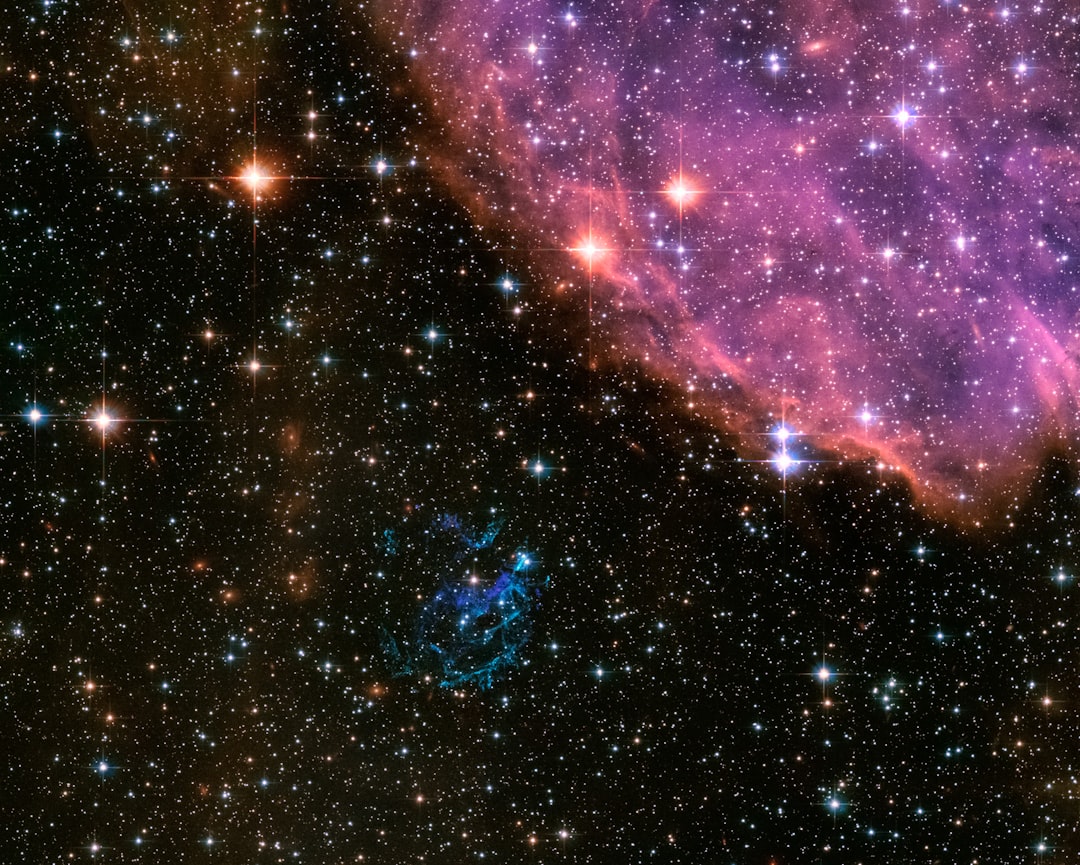
In the vast expanse of our cosmic neighborhood, an extraordinary event unfolded on December 18, 2019, that has captivated astronomers and challenged our understanding of the universe's most mysterious components. A star located in the Large Magellanic Cloud—a satellite galaxy orbiting our own Milky Way—experienced a peculiar brightening that lasted approximately one hour before returning to its normal luminosity. This wasn't a violent stellar explosion or an erratic flare, but rather a smooth, symmetrical increase in brightness that bore the unmistakable signature of something passing between us and that distant sun, warping the fabric of spacetime itself.
The invisible culprit behind this cosmic light show has been dubbed Phoebe, and determining its true nature has become one of the most compelling mysteries in contemporary astrophysics. What makes this discovery particularly intriguing is that Phoebe's mass—calculated to be roughly three times that of Earth's Moon—places it in an extraordinarily rare category of cosmic objects. This enigmatic entity could be a rogue planet wandering the darkness between stars, or something far more exotic: a primordial black hole forged in the universe's first moments, billions of years before the first stars ignited.
The Elegant Physics of Gravitational Microlensing
At the core of this astronomical detective story lies gravitational microlensing, one of the most beautiful confirmations of Einstein's general theory of relativity. This phenomenon occurs when a massive compact object—whether a planet, star, or black hole—passes directly between Earth and a more distant light source. The intervening object's gravitational field acts as a natural cosmic lens, bending and magnifying the background star's light in a characteristic pattern that cannot be replicated by any other astronomical process.
Unlike the chaotic brightness variations of variable stars or the sudden bursts from stellar flares, gravitational microlensing produces a distinctive symmetrical light curve. The brightness increases smoothly to a peak before declining in a mirror-image pattern, creating what astronomers call an Einsteinian signature. This predictable behavior, derived directly from general relativity's equations, allows researchers to distinguish genuine lensing events from the countless other ways stars can appear to change their brightness.
The Large and Small Magellanic Clouds, visible to the naked eye from the Southern Hemisphere, serve as ideal laboratories for microlensing surveys. These dwarf galaxies contain hundreds of millions of stars, providing a rich background tapestry against which passing objects can reveal themselves through their gravitational influence.
Detecting the Invisible: How Phoebe Was Found
When astronomers from Swinburne University in Melbourne discovered Phoebe while analyzing data from their high-cadence monitoring program of the Large Magellanic Cloud, they immediately recognized the telltale signs of authentic gravitational microlensing. Their survey, designed to capture rapid astronomical events, photographs the same regions of sky repeatedly, allowing them to detect even brief changes in stellar brightness that might otherwise go unnoticed.
The duration of the microlensing event serves as a cosmic fingerprint, encoding crucial information about the lensing object's mass and velocity. According to the physics of gravitational lensing, more massive objects create longer-duration events, while lighter objects zip across our line of sight more quickly, producing briefer brightenings. At approximately 60 minutes, Phoebe's event duration sits tantalizingly at the detection threshold of current survey capabilities—any shorter, and it might have been missed entirely; any longer, and it would suggest a more massive object.
"Working backwards through Einstein's equations, we can extract the mass of the lensing object from the event duration and the geometry of the encounter. What we found was something extraordinary—an object far too small to be a planet, yet potentially too massive to be explained by conventional astrophysics."
Three Possibilities: Unraveling Phoebe's Identity
The research team's analysis, published in their paper "AMPM II: A Lunar-Mass Primordial Black Hole Microlensing Candidate in the Milky Way Halo," narrowed down Phoebe's identity to three distinct possibilities, each with profound implications for our understanding of the cosmos:
Hypothesis One: A Free-Floating Rogue Planet
The first possibility is that Phoebe represents a free-floating planet—a world violently ejected from its birth solar system during the chaotic early phases of planetary system formation. Computer simulations suggest that such gravitational ejections are common during the first few million years of a planetary system's evolution, when massive planets migrate inward and destabilize smaller worlds. These cosmic orphans wander the galaxy in eternal darkness, invisible except when they happen to pass in front of a distant star.
However, Phoebe's calculated mass presents a significant challenge to this interpretation. At only three times the Moon's mass, it falls far below the threshold typically considered planetary. For comparison, Mercury, the smallest planet in our solar system, has a mass nearly 20 times greater than Phoebe. This would make Phoebe more of a rogue moon than a rogue planet—an object that might have been stripped from a larger planetary system through complex gravitational interactions.
Hypothesis Two: An Extragalactic Wanderer
The second scenario suggests that Phoebe might belong not to our Milky Way galaxy but to the Large Magellanic Cloud itself. If confirmed, this would represent the first-ever detection of an extragalactic microlensing planet—a world from another galaxy making its presence known across the vast intergalactic void. This possibility opens fascinating questions about planetary formation processes in dwarf galaxies, which have different chemical compositions and stellar populations compared to larger spiral galaxies like our own.
The Large Magellanic Cloud, located approximately 160,000 light-years from Earth, has been gravitationally interacting with the Milky Way for billions of years. These tidal interactions could have scattered objects from both galaxies into the space between them, creating a mixed population of wandering worlds with complex dynamical histories.
Hypothesis Three: A Primordial Black Hole from the Dawn of Time
The third and most exotic possibility is that Phoebe is a primordial black hole—a fundamentally different type of black hole than those formed from collapsing stars. Unlike their stellar-mass cousins, which require the death of massive stars and have minimum masses around five solar masses, primordial black holes could have formed in the universe's first fraction of a second, when extreme density fluctuations in the infant cosmos might have created microscopic regions dense enough to collapse directly into black holes.
These hypothetical objects, predicted by some models of the early universe but never definitively detected, could have masses ranging from less than a gram to thousands of solar masses. Crucially, they represent one of the leading candidates for dark matter—the mysterious invisible substance that comprises approximately 85% of the universe's matter but has eluded direct detection despite decades of searching.
The Mathematics of Probability: Why Dark Matter Wins
To determine which hypothesis best explains Phoebe, the Swinburne team performed detailed statistical analysis, calculating the probability that the lensing object belongs to various cosmic populations: stars in the Milky Way's disk, stars in the Large Magellanic Cloud, or objects in the dark matter halo that surrounds and permeates both galaxies.
The results were striking. The dark matter halo hypothesis emerged as the overwhelming favorite, more probable than the stellar alternatives by a factor of 100,000—five orders of magnitude. This enormous statistical preference stems from several factors: the geometry of the event, the object's calculated mass, and the expected spatial distributions of different populations.
The dark matter halo extends far beyond the visible boundaries of galaxies, forming a vast spherical cloud that dominates the gravitational landscape of the universe. If primordial black holes comprise even a small fraction of this dark matter, their numbers would vastly exceed the population of rogue planets or other conventional objects in the same volume of space.
Implications: A Window into the Universe's First Moments
If Phoebe is indeed a primordial black hole, its implications extend far beyond a single microlensing event. Such a confirmation would represent the detection of one of the oldest objects in the universe—something formed before the first atoms coalesced, before the first stars ignited, in the violent quantum fluctuations that characterized the cosmos when it was less than a second old, approximately 13.8 billion years ago.
This discovery would also provide crucial evidence for understanding dark matter's nature. Despite its gravitational effects being observed throughout the universe—in galaxy rotation curves, gravitational lensing patterns, and the cosmic microwave background—dark matter's composition remains one of physics' greatest unsolved problems. The European Space Agency's Euclid mission and other next-generation surveys are designed to detect more such events and potentially confirm or refute the primordial black hole hypothesis.
Future Observations and the Hunt for More Cosmic Ghosts
Phoebe's detection raises an intriguing question: if one such object has been found, how many more lurk undetected in the darkness? The answer depends critically on whether Phoebe represents a rare anomaly or the first member of a vast population waiting to be discovered. Current and planned microlensing surveys, including those conducted by the Vera C. Rubin Observatory, will dramatically increase the sensitivity and coverage of these searches.
The key characteristics that make an event detectable include:
- Event Duration: Shorter events from lower-mass objects require higher observation cadence to capture the complete light curve
- Survey Coverage: Monitoring larger areas of sky increases the probability of catching rare alignment events
- Photometric Precision: More accurate brightness measurements allow detection of subtler lensing signatures
- Background Star Density: Regions with more stars provide more opportunities for lensing events to occur
The Cosmic Significance of a Single Hour
What makes Phoebe's story particularly poignant is the ephemeral nature of its detection. After drifting silently through the cosmos for billions of years—perhaps since the universe's first moments—this object announced its existence through a single hour of bent starlight on a December night in 2019. It has not been seen to vary again, and likely never will be from our vantage point. The precise alignment required for gravitational microlensing is extraordinarily rare; the probability of the same object lensing the same star twice within human timescales is essentially zero.
This transient glimpse underscores both the power and limitations of modern astronomy. We can detect objects too small and dark to be seen directly, using only their gravitational influence on light from distant stars. Yet each detection is unique and unrepeatable, making follow-up observations impossible and leaving us to extract every possible piece of information from a single, fleeting event.
Whether Phoebe ultimately proves to be a wayward moon, an extragalactic wanderer, or a primordial black hole from the dawn of time, its discovery demonstrates the remarkable detective work possible with modern astronomical surveys. As observation technology continues to advance, we may find that the universe is populated by countless such invisible objects, each carrying its own story written in the subtle bending of starlight—cosmic ghosts that reveal themselves only through the elegant predictions of Einstein's century-old theory, reminding us that even in darkness, gravity leaves its mark on light.