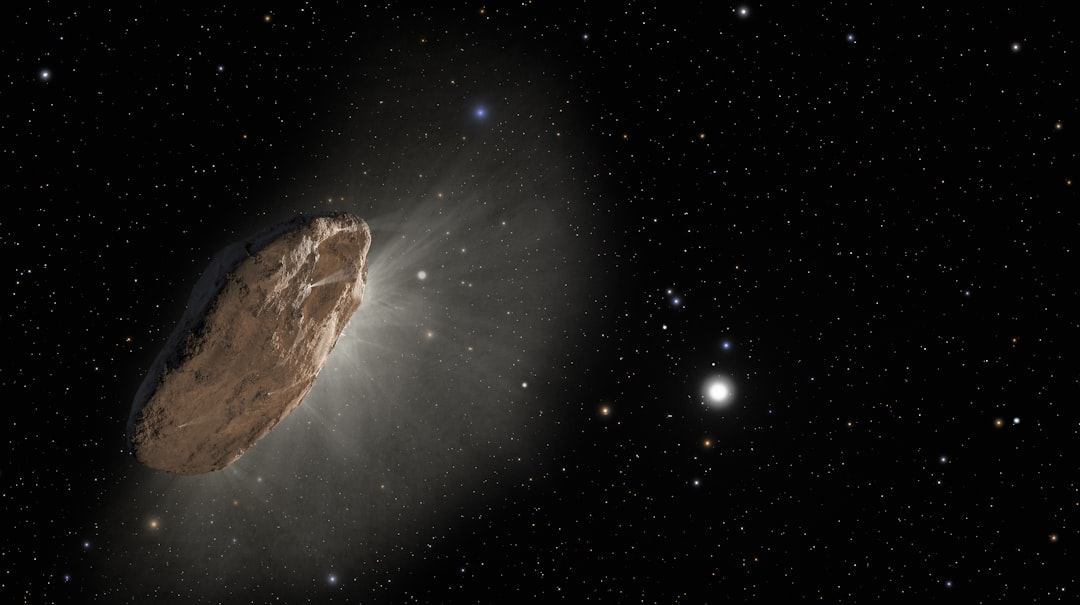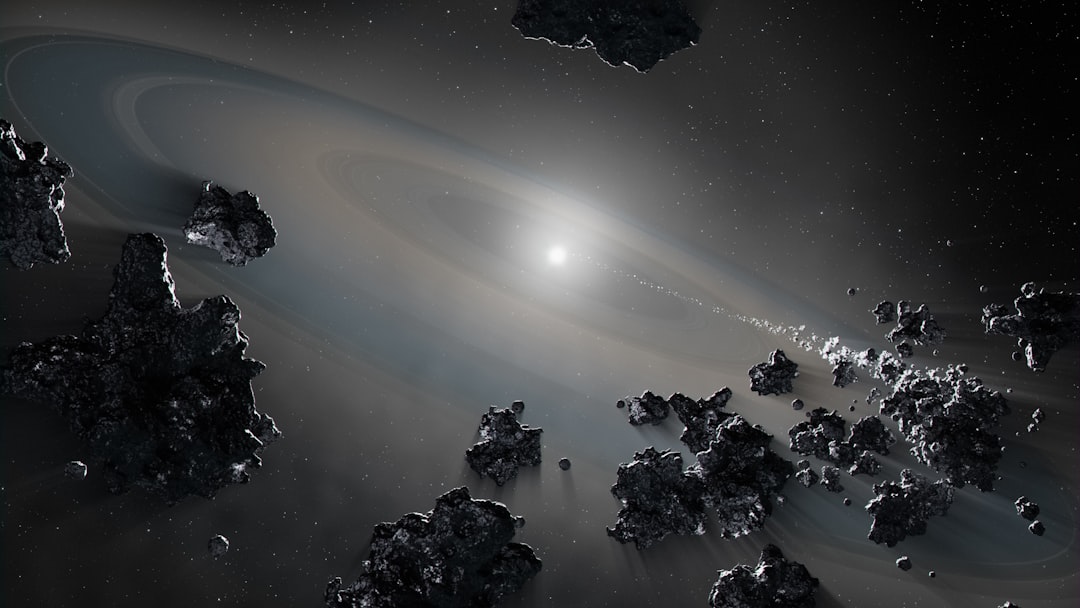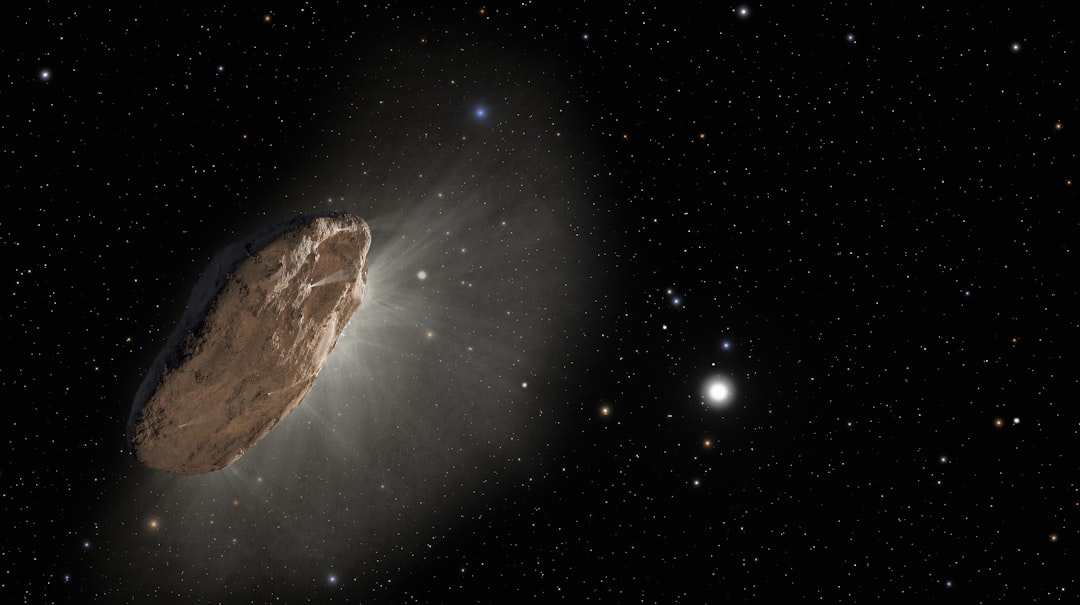
In the frozen archives of our solar system's ancient past, a peculiar mystery has puzzled astronomers for decades. The Trojan asteroids—thousands of rocky remnants trapped in Jupiter's gravitational embrace—have long been divided into two distinct color groups among their larger members. However, groundbreaking new research from Japanese astronomers has revealed an unexpected twist: their smaller counterparts refuse to follow the same pattern, challenging our fundamental understanding of these cosmic time capsules.
This revolutionary discovery, published in The Astronomical Journal, emerged from the final observing run of the legendary Suprime-Cam instrument aboard the 8.2-meter Subaru Telescope in Hawaii. The findings not only deepen the mystery surrounding these ancient objects but also raise profound questions about the formation and evolution of our solar system's earliest building blocks.
The Jupiter Trojans occupy two stable gravitational zones called Lagrange points—one cluster leading Jupiter in its orbit around the Sun, and another trailing behind. These populations, numbering in the thousands, represent some of the most pristine material from the solar system's formation approximately 4.6 billion years ago. Understanding their composition and characteristics provides crucial insights into the conditions that prevailed during our planetary system's tumultuous birth.
The Color Divide: A Long-Standing Astronomical Puzzle
For years, astronomers have recognized a striking pattern among larger Trojan asteroids: they segregate into two distinct spectral groups commonly referred to as "red" and "less red" populations. This color-coding isn't merely aesthetic—it reflects fundamental differences in their surface composition and evolutionary history.
The redder asteroids typically belong to the D-type classification, characterized by their exceptionally dark surfaces and high content of complex organic molecules. These objects absorb most incoming sunlight, reflecting only a small fraction with a distinctive reddish hue. In contrast, the "less red" category encompasses primarily P-type and C-type asteroids. While P-type asteroids share many characteristics with their D-type cousins, their spectroscopic signatures reveal a notably different slope—one that appears less red when analyzed through specialized instruments.
According to researchers at NASA's Lucy mission, which is currently en route to study these objects up close, understanding this color dichotomy is essential for reconstructing the early solar system's chemical and dynamical evolution. The bifurcation suggests either distinct formation locations or different evolutionary pathways—but which scenario is correct has remained frustratingly elusive.
Revolutionary Observations Using Cutting-Edge Technology
The Japanese research team, led by astronomers utilizing the Subaru Telescope's capabilities, faced a formidable technical challenge: accurately characterizing the spectral properties of small Trojan asteroids measuring between 3 and 16 kilometers in diameter. These diminutive objects present unique observational difficulties that have historically prevented detailed study.
The primary obstacle stems from their rapid rotation rates. Smaller asteroids spin significantly faster than their larger counterparts, completing full rotations in just a few hours or even minutes. To determine an asteroid's true color and spectral characteristics, astronomers must observe it through multiple filters that isolate different wavelengths of light. However, if the asteroid rotates substantially between filter changes, each image captures a different face of the object, potentially leading to systematic errors in the calculated spectral profile.
"The Suprime-Cam's ability to change filters rapidly proved absolutely critical for this research. Its superior filter-switching speed allowed us to capture complete spectral data before the asteroids could rotate significantly, ensuring unprecedented accuracy in our measurements of these small, fast-spinning objects."
This advantage became particularly valuable during Suprime-Cam's final observing run before being replaced by the newer Hyper Suprime-Cam. While the successor instrument offers improved sensitivity and field of view, the original Suprime-Cam's faster filter mechanism proved ideal for studying rapidly rotating small asteroids. The research team identified 120 small Trojans and carefully selected 44 unbiased samples for detailed analysis, cycling through filter changes in under one hour to capture comprehensive spectral data.
Unexpected Results Challenge Established Theories
The findings from this meticulous observational campaign delivered a stunning surprise. Unlike their larger counterparts, the small Trojan asteroids showed no clear bifurcation into red and less-red populations. Instead, their spectral properties formed a continuous distribution across the color spectrum, with no obvious clustering into distinct groups.
Even more intriguingly, when the researchers arbitrarily divided the small asteroids into "red" and "less red" categories based on their spectral slopes, they found that both groups exhibited identical size distributions. This stands in stark contrast to what would be expected under prevailing theoretical models and directly contradicts the clear color-coding observed among larger Trojans.
Implications for Solar System Formation Models
These unexpected results have profound implications for our understanding of how the Trojan asteroids—and by extension, the early solar system—formed and evolved. Two primary formation scenarios have dominated scientific discourse:
- In-situ formation: The Trojans formed near Jupiter's current orbit and were gravitationally captured during the planet's formation, becoming trapped in the stable Lagrange points as Jupiter's mass grew.
- Scattered disk origin: The asteroids originated in the distant Kuiper Belt beyond Neptune's orbit but were scattered inward during Jupiter's early migration through the solar system, eventually becoming trapped in the Trojan regions.
- Mixed population: Some combination of both scenarios, with different populations having distinct origins that might explain the color dichotomy.
However, none of these scenarios easily explains why larger Trojans exhibit clear color bifurcation while smaller ones do not. If the asteroids originated from the same source region, one would expect similar color distributions regardless of size. This puzzle has led researchers to explore alternative explanations involving collisional evolution.
The Collisional Evolution Hypothesis Under Scrutiny
One promising theory that had gained traction in recent years is the collisional evolution model. This hypothesis proposes that catastrophic impacts between Trojan asteroids could alter their surface properties dramatically. According to this model, when a red D-type asteroid experiences a violent collision, the impact energy vaporizes and blows away its volatile-rich, organic-laden surface layer, exposing less-processed material beneath. This freshly exposed material would appear "less red" in spectroscopic observations.
If this model were correct, it would predict a specific pattern: smaller asteroids, being the fragments of larger parent bodies destroyed in collisions, should predominantly fall into the "less red" category. The collision that created them would have stripped away the red, volatile-rich surfaces, leaving behind predominantly less-red fragments.
However, the new observations from the Subaru Telescope directly contradict this prediction. The small Trojans show equal proportions of red and less-red objects, with no size-dependent trend. As explained by researchers at the European Space Agency's planetary science division, this finding suggests that collisional evolution alone cannot explain the color dichotomy observed among larger Trojans.
Future Investigations and the Lucy Mission
As with many groundbreaking discoveries in science, these new findings raise more questions than they answer. The mystery of the Trojan asteroids' color distribution has deepened rather than resolved, demanding new theoretical frameworks and additional observational data.
Fortunately, help is on the way. NASA's Lucy spacecraft, launched in October 2021, is currently journeying toward the Trojan asteroids for an unprecedented close-up investigation. Beginning in 2027, Lucy will conduct detailed flybys of multiple Trojan asteroids over a six-year primary mission, visiting representatives of all three major spectral types: C-type, P-type, and D-type asteroids.
Lucy's sophisticated instrument suite will provide high-resolution imagery, detailed compositional maps, and precise measurements of asteroid properties that are impossible to obtain from Earth-based telescopes. The mission will examine both surface characteristics and internal structure, potentially revealing whether the color differences extend throughout the asteroids or are merely surface phenomena.
What Lucy Might Reveal
The Lucy mission's observations could help resolve several critical questions:
- Surface composition: Detailed spectroscopic analysis will determine the exact nature of the materials responsible for the red and less-red colorations, potentially identifying specific organic compounds or minerals.
- Crater populations: By studying impact crater distributions and characteristics, Lucy can test predictions of the collisional evolution model and determine whether impacts have indeed altered asteroid surfaces.
- Internal structure: Measurements of asteroid density and gravity fields may reveal whether red and less-red asteroids have fundamentally different internal compositions or structures.
- Formation history: Combining all observations, scientists hope to reconstruct the formation and evolutionary history of the Trojan populations, potentially distinguishing between in-situ formation and scattered disk origin scenarios.
A Testament to Scientific Perseverance
The completion of this research marks a poignant moment in astronomical history. The Suprime-Cam instrument, after 18 years of groundbreaking observations at the Subaru Telescope, has concluded its service with a final contribution that exemplifies the unexpected discoveries that drive scientific progress. Its successor, the Hyper Suprime-Cam, will continue advancing our understanding of the cosmos, but the original instrument's unique capabilities proved essential for this particular investigation.
Interestingly, while scientists can precisely measure and categorize the spectral differences between red and less-red Trojans, human eyes would likely struggle to distinguish them visually. The color variations that appear so significant in spectroscopic data are subtle enough that they require specialized instruments to detect reliably. This serves as a reminder that modern astronomy increasingly relies on sophisticated technology to reveal phenomena invisible to human perception.
As researchers continue analyzing the Subaru data and preparing for Lucy's arrival at the Trojans, the scientific community eagerly anticipates new insights into these ancient objects. The mystery of their color distribution—now complicated by the unexpected behavior of small asteroids—represents exactly the kind of puzzle that drives astronomical research forward, reminding us that even well-studied regions of our solar system can still surprise us with unexpected revelations.
For more information about ongoing research into primitive solar system bodies, visit the NASA Solar System Exploration website, which provides comprehensive resources about asteroids and their role in understanding planetary formation.