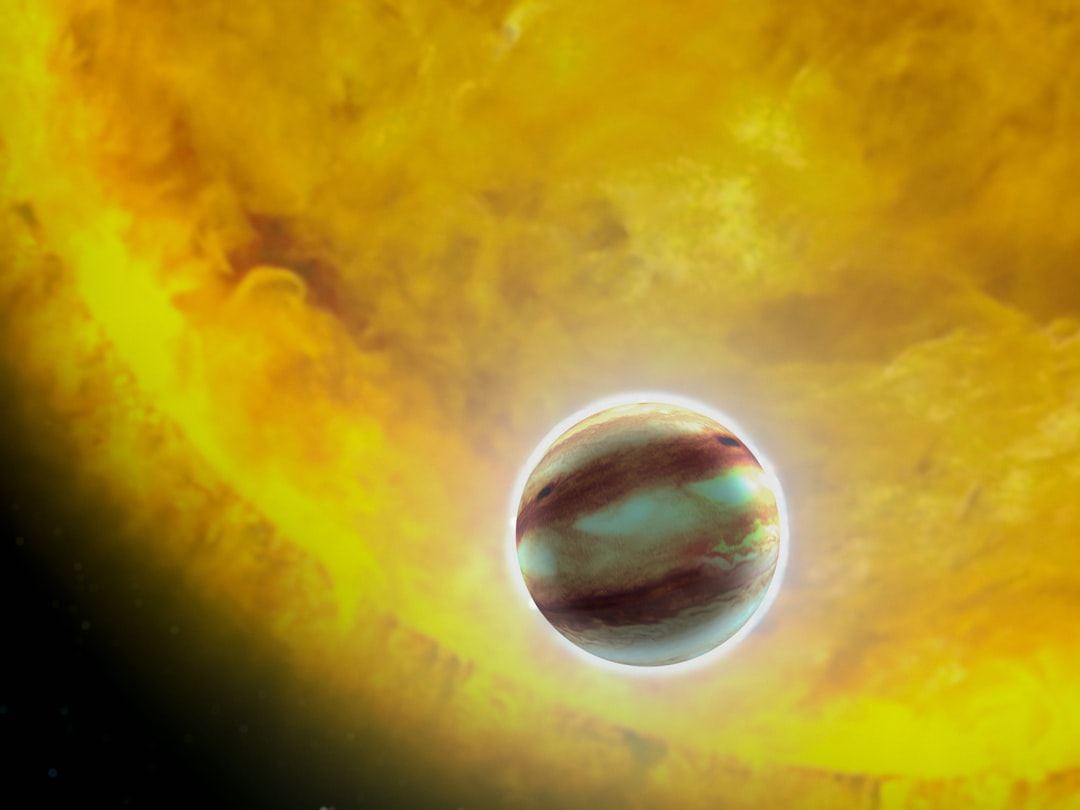
In a groundbreaking revelation that challenges our fundamental understanding of planetary atmospheres, astronomers have unveiled the most compelling evidence to date for a substantial atmosphere surrounding a molten rocky world beyond our solar system. Using the James Webb Space Telescope (JWST), an international team of researchers has detected what appears to be a thick, volatile-rich atmosphere blanketing the ultra-hot super-Earth TOI-561 b, a planet that defies conventional theories about how small, close-orbiting worlds interact with their host stars.
This discovery marks a pivotal moment in exoplanetary science, as it demonstrates that rocky planets orbiting perilously close to their parent stars—once thought incapable of retaining atmospheres—may be far more diverse and resilient than previously imagined. The finding, published in The Astrophysical Journal Letters on December 11th, represents yet another triumph for the James Webb Space Telescope, which has revolutionized our ability to characterize distant worlds since beginning science operations in mid-2022.
Led by Dr. Johanna Teske from the Carnegie Institution for Science's Earth and Planets Laboratory, the research team conducted an intensive 37-hour observation campaign that tracked TOI-561 b through nearly four complete orbits of its star. What they discovered was a world unlike anything in our own solar system—a planet with a global magma ocean churning beneath a dense atmospheric blanket, creating what researchers describe as a "wet lava ball" in space.
A Planet at the Extremes of Existence
Located approximately 275 light-years from Earth, TOI-561 b belongs to an exotic class of worlds known as ultra-short period (USP) exoplanets. With a radius 1.4 times that of Earth, this super-Earth completes a full orbit around its Sun-like host star in less than 11 hours—a dizzying pace that places it closer to its star than one-fortieth the distance between Mercury and our Sun. To put this in perspective, while Mercury takes 88 days to orbit the Sun, TOI-561 b completes more than 190 orbits in the same timeframe.
The extreme proximity to its star subjects TOI-561 b to intense stellar radiation, resulting in dayside temperatures that exceed the melting point of rock. The research team concludes that the planet must be tidally locked, meaning one hemisphere perpetually faces the star while the other remains in eternal darkness—similar to how our Moon always shows the same face to Earth. This configuration creates one of the most extreme thermal environments imaginable, with the star-facing hemisphere transformed into a roiling ocean of molten rock.
What makes TOI-561 b particularly intriguing is its surprisingly low density. Measurements of the planet's size and mass revealed a bulk density lower than expected for a rocky world, suggesting it may possess a relatively small iron core and a mantle composed of rock less dense than Earth's. This unusual composition could be a direct result of the planet's ancient origins and the chemical environment in which it formed.
Ancient Origins in the Galactic Thick Disk
The host star of TOI-561 b is approximately 10.5 billion years old—more than twice the age of our 4.6-billion-year-old Sun. This ancient star resides in a region of the Milky Way known as the thick disk, a stellar population characterized by low metallicity and high orbital velocities. Stars in this region formed when the universe was relatively young, containing fewer heavy elements than younger stars like our Sun.
"TOI-561 b is distinct among ultra-short period planets in that it orbits a very old, iron-poor star in a region of the Milky Way known as the thick disk," explained Dr. Teske. "It must have formed in a very different chemical environment from the planets in our own solar system. The planet's composition could be representative of planets that formed when the universe was relatively young."
This ancient heritage provides a unique window into planetary formation during the early epochs of cosmic history. Understanding worlds like TOI-561 b helps astronomers piece together how planetary systems evolved under different chemical conditions, offering insights into the diversity of worlds that may exist throughout the galaxy and how planet formation has changed over billions of years of cosmic evolution.
Revolutionary Observational Techniques Reveal Hidden Atmosphere
To investigate whether TOI-561 b harbored an atmosphere, the research team employed JWST's Near-Infrared Spectrometer (NIRSpec) in an innovative observation strategy. Rather than using the traditional transit method—which measures the dimming of starlight as a planet passes in front of its star—the team utilized secondary eclipse observations, measuring the decrease in the system's brightness as the planet passed behind its star.
This technique, similar to methods used to study rocky planets orbiting red dwarf stars like TRAPPIST-1, allows astronomers to directly measure the infrared light emitted by the planet's dayside. By comparing the brightness of the system when the planet is visible versus when it's hidden behind the star, researchers can determine the planet's temperature and infer the presence of an atmosphere.
The theoretical predictions were clear: if TOI-561 b lacked an atmosphere, it would have no mechanism to redistribute heat from the intensely irradiated dayside to the frigid nightside. In such a scenario, the team expected to measure a dayside temperature of approximately 2,700°C (4,900°F)—hot enough to vaporize most known materials.
The Unexpected Temperature Anomaly
However, the NIRSpec observations revealed something surprising: the planet's dayside temperature measured closer to 1,800°C (3,200°F)—still incredibly hot by terrestrial standards, but a full 900°C cooler than predictions for an airless world. This significant temperature deficit could only be explained by the presence of a substantial atmosphere capable of transporting heat around the planet.
Dr. Anjali Piette from the University of Birmingham, a co-author on the study, elaborated on the implications:
"We really need a thick, volatile-rich atmosphere to explain all the observations. Strong winds would cool the dayside by transporting heat over to the nightside. Gases like water vapour would absorb some wavelengths of near-infrared light emitted by the surface before they make it all the way up through the atmosphere. The planet would look colder because the telescope detects less light, but it's also possible that there are bright silicate clouds that cool the atmosphere by reflecting starlight."
The Magma Ocean-Atmosphere Connection
The discovery of a substantial atmosphere on TOI-561 b raises a fascinating question: how can such a small, intensely irradiated planet maintain a dense atmospheric envelope? On Earth, our atmosphere is protected by our planet's magnetic field and relatively large mass. Venus, despite its thick atmosphere, orbits much farther from the Sun than TOI-561 b does from its star. The extreme radiation and stellar winds that bombard ultra-short period planets should, in theory, strip away their atmospheres over time.
The answer may lie in a remarkable equilibrium between the planet's molten surface and its gaseous envelope. Dr. Tim Lichtenberg from the University of Groningen proposed a compelling mechanism:
"We think there is an equilibrium between the magma ocean and the atmosphere. While gases are coming out of the planet to feed the atmosphere, the magma ocean is sucking them back into the interior. This planet must be much, much more volatile-rich than Earth to explain the observations. It's really like a wet lava ball."
This dynamic interaction creates a self-sustaining cycle where volatile compounds—including water vapor, carbon dioxide, and possibly other gases—continuously outgas from the molten surface while simultaneously being reabsorbed. The magma ocean acts as both a source and sink for atmospheric gases, maintaining a steady-state atmosphere despite the intense stellar radiation trying to strip it away.
Composition and Chemical Complexity
The composition of TOI-561 b's atmosphere likely differs dramatically from Earth's nitrogen-oxygen mixture. Given the extreme temperatures and the interaction with molten rock, the atmosphere probably contains high concentrations of rock-forming elements in gaseous form, including silicon, magnesium, and iron compounds. Water vapor, despite the planet's hellish conditions, may also be present in significant quantities, locked in a continuous cycle between the atmosphere and the magma ocean below.
The presence of silicate clouds—clouds composed of vaporized rock particles—represents another intriguing possibility. Such clouds could play a crucial role in the planet's energy balance, reflecting incoming starlight and contributing to the lower-than-expected dayside temperatures. Similar phenomena have been theorized for hot Jupiters, but observing them on a rocky super-Earth would be unprecedented.
Implications for Planetary Science and Astrobiology
The detection of a substantial atmosphere on TOI-561 b fundamentally challenges prevailing theories about atmospheric retention on small, close-orbiting planets. This discovery suggests that rocky worlds in extreme environments may be capable of maintaining atmospheres through mechanisms we're only beginning to understand. The implications extend far beyond this single planet:
- Diversity of Rocky Worlds: The universe may harbor a much wider variety of rocky planet atmospheres than previously thought, with magma ocean worlds representing an entirely new category of planetary environments
- Early Earth Analogues: Understanding magma ocean atmospheres could provide insights into Earth's own early history, when our planet's surface was largely molten following its formation and the giant impact that created the Moon
- Volatile Delivery: The high volatile content of TOI-561 b raises questions about how planets acquire and retain water and other volatiles during formation, particularly in the metal-poor environments of the early universe
- Atmospheric Evolution: The dynamic equilibrium between magma oceans and atmospheres may represent an important phase in planetary evolution, potentially affecting the long-term habitability of worlds that eventually cool and solidify
While TOI-561 b itself is far too hot to support life as we know it, understanding extreme planetary environments helps astronomers refine their search for potentially habitable worlds. The catalog of known exoplanets continues to reveal surprising diversity, and each discovery helps us better understand the conditions necessary for life to emerge and thrive.
Future Observations and Ongoing Research
The findings reported in December 2024 represent the first results from JWST's General Observers (GO) Program 3860, part of the telescope's Cycle 2 observation programs. The research team is currently conducting detailed analysis of the complete dataset to extract additional information about the planet's atmospheric composition and thermal structure.
Future observations will focus on several key objectives:
- Nightside Temperature Measurements: Determining the temperature of TOI-561 b's nightside will reveal how efficiently the atmosphere redistributes heat around the planet
- Atmospheric Composition: Detailed spectroscopic analysis may identify specific molecular species in the atmosphere, potentially including water vapor, carbon dioxide, silicon monoxide, and other volatiles
- Cloud Properties: If silicate clouds are present, their composition, altitude, and coverage fraction will provide crucial insights into the planet's energy balance
- Temporal Variations: Long-term monitoring could reveal changes in the atmosphere over time, helping to constrain the dynamics of the magma ocean-atmosphere interaction
The research team's work contributes to a broader effort to characterize rocky exoplanet atmospheres using JWST. Since beginning operations, the telescope has detected carbon dioxide in WASP-39b's atmosphere, water vapor in WASP-96 b, and heavy elements in HD149026b, demonstrating its unprecedented capability to probe the chemical compositions of distant worlds.
A New Era in Exoplanet Characterization
The discovery of a substantial atmosphere on TOI-561 b exemplifies the transformative impact of the James Webb Space Telescope on planetary science. Before JWST, detecting atmospheres on rocky exoplanets—particularly those as small and distant as TOI-561 b—remained beyond our technological capabilities. The telescope's infrared sensitivity and spectroscopic precision have opened a new window into the diversity of worlds orbiting distant stars.
As astronomers continue to study TOI-561 b and similar ultra-short period planets, we can expect more surprises that challenge our understanding of planetary physics and atmospheric chemistry. Each discovery refines our models of planet formation and evolution, bringing us closer to answering fundamental questions about our place in the cosmos: How common are Earth-like worlds? What conditions are necessary for life? And what exotic environments might exist on the countless planets scattered throughout our galaxy?
The "wet lava ball" of TOI-561 b reminds us that the universe's creativity in crafting worlds far exceeds our imagination. As we peer deeper into space with increasingly sophisticated instruments, we continue to find that reality is stranger—and more fascinating—than fiction. This ancient world, forged in the early universe and bathed in the light of a star more than twice as old as our Sun, offers a glimpse into planetary environments we're only beginning to comprehend.
For more information about this discovery and ongoing exoplanet research, visit NASA's Exoplanet Exploration program and follow the latest results from the James Webb Space Telescope.