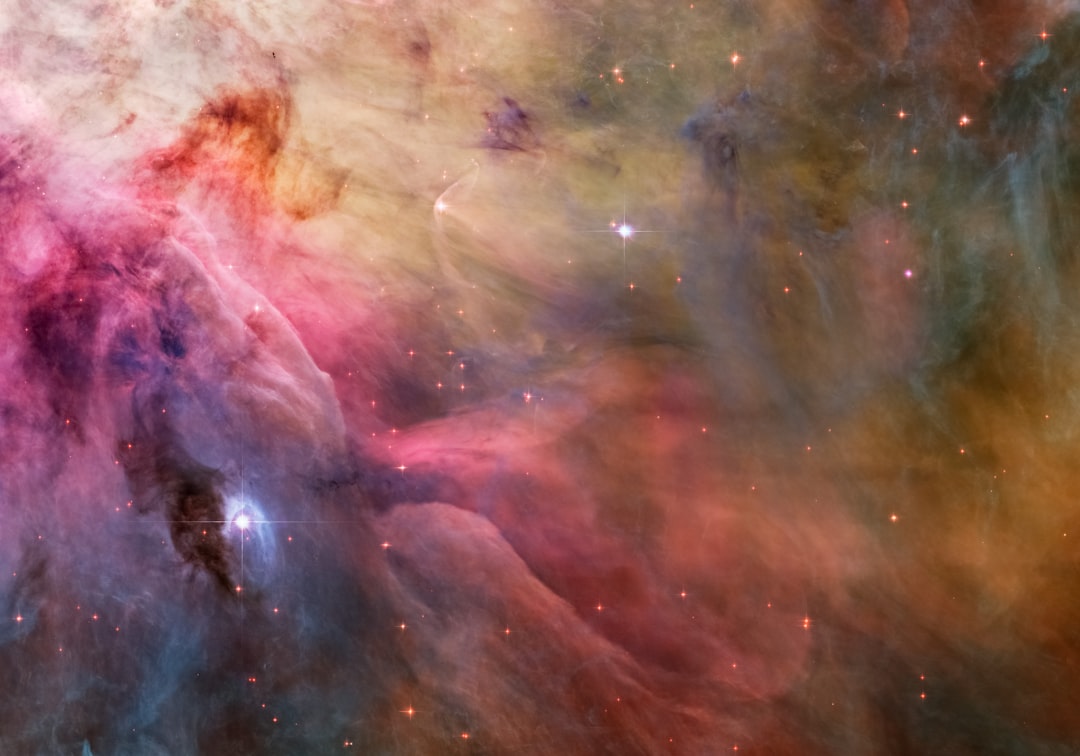
In the vast cosmic theater, stars appear as eternal, unchanging points of light scattered across the night sky. Yet this perception couldn't be further from reality. These celestial furnaces undergo dramatic transformations over billions of years—expanding into red giants, ejecting their outer layers into space, and ultimately collapsing into dense stellar remnants. Now, groundbreaking research from the Institute of Science and Technology Austria reveals that something fundamental survives this entire cosmic journey: magnetic fields that act as fossil records, persisting through every violent stage of stellar evolution and eventually emerging at the surface of white dwarfs billions of years later.
This discovery, led by PhD student Lukas Einramhof and Assistant Professor Lisa Bugnet, addresses a fundamental mystery in astrophysics that has puzzled astronomers for decades. While scientists have long observed powerful magnetic fields on the surfaces of white dwarfs—the Earth-sized remnants of Sun-like stars—and more recently detected magnetism deep within red giant interiors, no one had successfully connected these two observations. The critical question remained unanswered: Are these the same magnetic structures, or do they arise independently at different evolutionary stages?
The Stellar Life Cycle and Magnetic Mysteries
To fully appreciate this discovery, we must first understand the dramatic journey stars undergo during their lifetimes. Stars like our Sun spend roughly 10 billion years fusing hydrogen into helium in their cores, maintaining a delicate balance between gravitational collapse and outward radiation pressure. However, when the hydrogen fuel depletes, this equilibrium shatters. The core contracts and heats up, while the outer layers expand dramatically, transforming the star into a red giant—a bloated stellar behemoth that can swell to hundreds of times its original size.
During this red giant phase, which lasts several hundred million years, the star becomes increasingly unstable. It pulsates, ejects mass through powerful stellar winds, and eventually sheds its entire outer envelope, creating spectacular structures like planetary nebulae. What remains is the exposed core—a white dwarf with a mass comparable to the Sun but compressed into a volume roughly the size of Earth, making it one of the densest forms of matter in the universe.
Observations from missions like the Chandra X-ray Observatory have revealed that approximately 10-20% of white dwarfs possess detectable surface magnetic fields, some exceeding millions of Gauss—far stronger than anything achievable in terrestrial laboratories. Meanwhile, asteroseismic observations of red giants have revealed magnetic signatures deep within their cores. The question that has haunted stellar physicists is whether these represent the same magnetic structures surviving across billions of years of stellar evolution.
Asteroseismology: Listening to Stellar Heartbeats
The breakthrough in solving this mystery came from an innovative technique called asteroseismology—essentially the study of "starquakes." Just as geologists use seismic waves from earthquakes to map Earth's internal structure, astronomers can analyze the subtle oscillations and pulsations rippling across a star's surface to probe conditions deep within its interior. These stellar vibrations, caused by sound waves bouncing around inside the star, create patterns that reveal information about temperature, density, composition, and crucially, magnetic field configurations in regions otherwise completely hidden from view.
Data from space missions like NASA's Kepler Space Telescope and its successor TESS have revolutionized asteroseismology, providing continuous, high-precision observations of stellar oscillations for thousands of stars. These missions have detected oscillation modes with periods ranging from minutes to months, each carrying unique information about the stellar interior. By analyzing how these oscillation frequencies shift and split in the presence of magnetic fields, researchers can effectively "see" magnetism hidden deep within stars.
"Asteroseismology has given us X-ray vision into stellar interiors. We can now probe magnetic fields in regions that were completely inaccessible just two decades ago," explains Dr. Bugnet, whose team combined asteroseismic data from red giants with observations of magnetic white dwarfs to test whether a single magnetic field structure could survive the entire evolutionary journey.
Fossil Magnetism: A Magnetic Time Capsule
The ISTA team's theoretical models reveal a fascinating picture of magnetic field evolution within stars. Contrary to intuitive expectations, the magnetic fields don't concentrate at the stellar core like a bar magnet. Instead, they form hollow, shell-like structures surrounding the core—imagine a magnetic bubble or nested spherical shells of magnetism threading through the star's interior. This geometry proves crucial to their survival.
These magnetic structures originate early in a star's life, possibly during the initial collapse of the molecular cloud that formed the star, or through dynamo processes in the convective envelope of young stars. Once established, the simulations demonstrate that these fields remain remarkably stable throughout the star's evolution. As the star expands into a red giant, the magnetic shells persist, neither dissipating nor being destroyed by the violent convective motions in the outer layers.
During the dramatic mass loss phase, when the red giant ejects its outer envelope to form a planetary nebula, the magnetic field structure survives within the contracting core. As this core settles into its final configuration as a white dwarf, something remarkable occurs: over millions to billions of years, as the white dwarf slowly cools and its internal structure evolves, the ancient magnetic fields migrate outward, eventually reaching the surface where they become observable. This process represents genuine fossil magnetism—magnetic structures preserved across cosmic timescales, carrying information about conditions that existed billions of years earlier.
The Critical Spatial Requirement
The research reveals an important caveat to the fossil field hypothesis. For these magnetic structures to successfully survive the transition from red giant to white dwarf, the magnetic field within the red giant's core must already extend across a substantial fraction of the core's radius. This doesn't necessarily mean the field needs to be stronger—magnetic field strength and spatial extent are independent properties. Rather, the field must reach further through the core than many previous models assumed.
This requirement has significant implications for our understanding of stellar magnetism. It suggests that the magnetic fields threading through stellar cores may be more spatially extended than previously thought, potentially influencing stellar structure and evolution in ways current models don't fully capture. The team notes that while most stars probably harbor internal magnetic fields, detecting them remains extraordinarily challenging, particularly in main-sequence stars like our Sun where asteroseismic signals are more subtle.
Implications for Stellar Evolution and Our Sun's Future
If magnetic fields genuinely persist throughout a star's entire lifetime as this research suggests, the implications for stellar physics are profound. Internal magnetic fields could significantly influence stellar evolution through several mechanisms. They can suppress or enhance convection, the process by which heat is transported from the core to the surface. They can also drive mixing between different layers of the star, potentially transporting fresh hydrogen fuel from the outer envelope down into the nuclear-burning core.
This mixing process could extend a star's main-sequence lifetime by providing additional fuel for nuclear fusion. Even a modest extension of 10-20% would have significant implications for stellar population models and our understanding of galactic evolution. Magnetic fields might also influence the mass loss rates during the red giant phase, affecting the final mass of the white dwarf remnant and potentially the occurrence of Type Ia supernovae, which serve as crucial distance indicators for cosmology.
For our own Sun, these findings raise intriguing questions about its future evolution. In approximately 5 billion years, the Sun will exhaust its core hydrogen and begin its transformation into a red giant, eventually becoming a white dwarf. Whether internal magnetic fields shape this evolution remains an open question. As Einramhof emphasizes, despite the Sun being our nearest star and the most intensively studied object in astronomy, we remain "practically blind" to conditions at its center.
Current helioseismology observations—the solar equivalent of asteroseismology—haven't definitively detected a magnetic field in the Sun's core, but the sensitivity limits of current techniques may simply be insufficient. If the Sun's core proves to be magnetic, it would necessitate fundamental revisions to solar models that have been refined over decades. These models predict everything from the Sun's future evolution to the solar neutrino flux, and magnetic fields could alter these predictions in ways we're only beginning to understand.
Future Directions and Observational Challenges
This research opens numerous avenues for future investigation. Upcoming space missions and ground-based facilities will provide unprecedented opportunities to test the fossil magnetism hypothesis. The European Space Agency's PLATO mission, scheduled for launch in 2026, will conduct asteroseismic observations of thousands of stars with extraordinary precision, potentially detecting subtle magnetic signatures in stellar cores that current missions cannot resolve.
Key questions that remain include:
- Origin mechanisms: How do these magnetic fields form in the first place? Are they primordial, dating back to the star's formation, or do they arise through dynamo processes during the star's main-sequence lifetime?
- Strength and geometry: What determines the strength and spatial configuration of core magnetic fields? Why do some white dwarfs show strong surface fields while others appear non-magnetic?
- Evolutionary impact: How significantly do internal magnetic fields influence stellar structure, mixing, and lifetimes? Can we detect these effects through asteroseismology or other observational techniques?
- Binary star systems: How do magnetic fields behave in binary systems where stars interact and exchange mass? Could magnetic fields influence the formation of exotic objects like blue stragglers or cataclysmic variables?
Broader Astrophysical Context
The concept of fossil magnetism extends beyond individual stellar evolution. Understanding how magnetic fields persist and evolve has implications for diverse astrophysical phenomena. Magnetic fields play crucial roles in accretion disk physics, influencing how matter spirals onto compact objects. They drive powerful jets from neutron stars and black holes. They shape the structure of planetary nebulae and influence the chemical enrichment of the interstellar medium.
In the broader context of galactic evolution, the magnetic fields emerging from white dwarfs contribute to the overall magnetic field structure of galaxies. White dwarfs are extremely common—they represent the final fate of roughly 97% of all stars in the Milky Way. If a significant fraction of these objects possess magnetic fields inherited from their progenitor stars, they collectively contribute to the magnetic environment of the galaxy, potentially influencing star formation in subsequent generations.
The research also connects to fundamental questions in plasma physics and magnetohydrodynamics. The survival of magnetic field structures through extreme changes in density, temperature, and pressure provides natural laboratories for testing our understanding of how magnetic fields behave under conditions impossible to replicate on Earth. These insights have applications beyond astronomy, informing research on magnetic confinement fusion and space weather prediction.
As observational techniques continue to advance and computational models become more sophisticated, the story of stellar magnetism will undoubtedly become richer and more complex. The discovery that magnetic fields may act as fossil records, preserving information across billions of years of cosmic evolution, reminds us that stars are not merely simple balls of gas, but complex, dynamic systems whose full nature we are only beginning to comprehend. Each new insight brings us closer to understanding not just the lives of distant stars, but the ultimate fate awaiting our own Sun and the legacy it will leave in the cosmos.