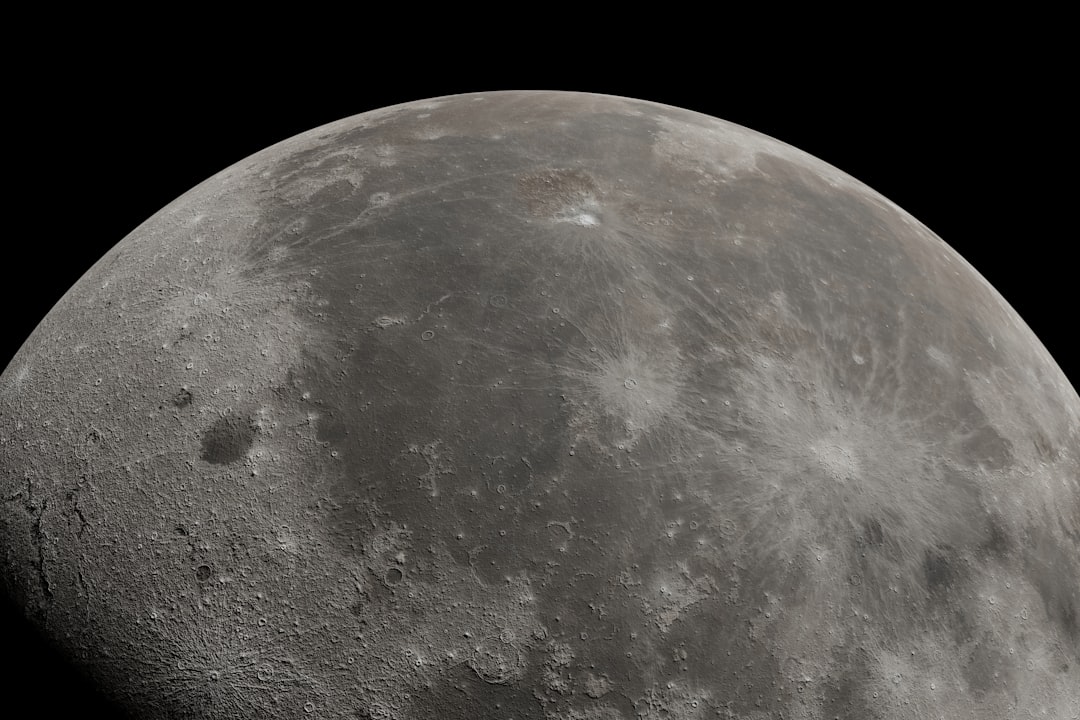
In the race to establish a permanent human presence on the Moon, one resource stands above all others: water ice locked within the Permanently Shadowed Regions (PSRs) near the lunar south pole. While orbital observations have confirmed the existence of these frozen reserves, the critical question remains—exactly how much water exists, and where can it be most efficiently extracted? Blue Origin's newly unveiled Oasis-1 mission, presented at the 2025 Lunar and Planetary Science Conference (LPSC), aims to answer these fundamental questions through an innovative dual-satellite prospecting mission that will fly closer to the lunar surface than any previous water-mapping endeavor.
The commercial space company, backed by Amazon founder Jeff Bezos, is taking a bold approach to lunar resource assessment by deploying twin SmallSats into an extremely low polar orbit—skimming just 10 kilometers above the Moon's surface at their closest approach. This unprecedented proximity represents a quantum leap in our ability to map lunar resources with the precision necessary for actual mining operations. According to mission planners, the data collected will transition humanity from broad estimates to mineable-scale prospecting information, the critical bridge between scientific curiosity and commercial viability.
Revolutionary Low-Altitude Orbital Architecture
The Oasis-1 mission design breaks new ground in lunar observation strategy. The two identical spacecraft will be deployed from Blue Origin's uncrewed MK1 lunar lander and subsequently enter a highly elliptical polar orbit measuring 10 by 50 kilometers. This extreme ellipse places the satellites' periapsis—the lowest point in their orbit—directly over the lunar south pole, the region of greatest scientific and commercial interest.
This orbital configuration isn't merely ambitious; it's absolutely necessary for the mission's scientific objectives. As researchers at NASA's Moon to Mars program have demonstrated, the resolution of remote sensing instruments degrades significantly with altitude. By flying so close to the lunar surface, Oasis-1 can achieve measurement precision that would be impossible from higher orbits, even with more sophisticated instruments.
The 90-day primary mission phase will focus on comprehensive global mapping, building detailed resource maps of the entire lunar surface with special emphasis on the polar regions. But perhaps the most daring aspect of the mission comes in its final act: a controlled 10-day deorbit phase that mission designers describe as a "slow-motion kamikaze dive." During this terminal descent, the satellites will continue collecting data at progressively lower altitudes, potentially achieving resolutions measured in hundreds of meters per pixel rather than the tens of kilometers typical of current datasets.
Advanced Instrumentation Suite for Deep Resource Detection
Each Oasis-1 satellite carries three sophisticated instruments specifically selected for their complementary capabilities in resource prospecting. The Hybrid Gamma-Ray and Neutron Spectrometer (GRNS) serves as the mission's primary water-detection system. Neutron spectroscopy represents the only remote sensing technique currently capable of quantifying subsurface water content down to approximately one meter depth—a crucial capability since lunar water ice is buried beneath protective layers of regolith.
Traditional neutron spectrometers face a significant challenge: unlike optical instruments, they lack sharp resolution at high altitudes. The Lunar and Planetary Institute notes that most orbital neutron measurements achieve resolutions of 100-150 kilometers per pixel. Oasis-1's low-altitude approach aims to achieve approximately 15 kilometers per pixel resolution at the south pole—representing a ninefold improvement over existing global datasets. While this may seem coarse by terrestrial standards, it provides the spatial precision necessary to identify specific craters and regions worthy of surface exploration.
"The challenge isn't just finding water on the Moon—we've known it's there for years. The challenge is determining exactly where the highest concentrations exist and whether they're accessible enough to support sustained human operations. That's the gap Oasis-1 is designed to fill."
The second instrument, a high-sensitivity magnetometer, will be deployed on an extended boom to minimize interference from the spacecraft itself. This instrument will map crustal magnetic anomalies at 15-30 kilometer resolution, serving dual purposes. Scientifically, these measurements will help researchers understand the Moon's geological history and the ancient magnetic field that once existed. Commercially, magnetic signatures can indicate the presence of platinum group metals—rare elements that could prove valuable both for lunar operations and potential return to Earth.
The Helium-3 Question
Perhaps the most speculative aspect of Oasis-1's instrument package is the multispectral pushbroom spectrometer designed to detect helium-3 concentrations. This rare isotope, implanted in lunar regolith by billions of years of solar wind bombardment, has captured imaginations as potential fuel for future fusion reactors. While commercial fusion power remains decades away, the element's rarity on Earth—and relative abundance on the Moon—makes it a resource worth cataloging.
The spectrometer will achieve impressive spatial resolution of less than 5 meters per pixel, enabling detailed mapping of helium-3 distribution across the lunar surface. This data could prove valuable not only for future fusion applications but also for understanding the Moon's space weathering processes and the dynamics of solar wind interaction with airless bodies throughout the solar system.
A New Business Model for Space Science
What truly distinguishes Oasis-1 from previous lunar missions is its innovative commercial structure. Rather than treating the collected data as a public good to be freely distributed, Blue Origin plans to license commercially valuable resource maps to other space companies developing lunar mining and in-situ resource utilization (ISRU) technologies. This approach reflects a fundamental shift in how space exploration might be financed in the coming decades.
For companies designing lunar water extraction systems or oxygen production facilities, precise resource maps represent critical de-risking data. Knowing exactly where to land, how deep to dig, and what concentrations to expect can mean the difference between a viable business plan and an expensive failure. By providing this information on a commercial basis, Blue Origin aims to both recover mission costs and establish itself as an essential service provider in the emerging lunar economy.
However, the company has committed to releasing data without direct commercial applications to the public through a partnership with the European Space Resource Innovation Centre (ESRIC). This ensures that the scientific community retains access to valuable lunar datasets while allowing Blue Origin to monetize information most relevant to commercial operations.
Integration with the Broader Oasis Campaign
Oasis-1 represents only the opening salvo in Blue Origin's comprehensive three-phase lunar resource development strategy. The company envisions this orbital reconnaissance mission as Phase 1 of what they're calling the "Oasis Campaign"—an ambitious program to transition from exploration to exploitation of lunar resources.
Phase 2 will deploy surface mobility systems—likely rovers or hoppers—to conduct ground-truth measurements in regions identified as promising by the orbital surveys. These surface missions will provide centimeter-scale resolution and enable direct sampling of regolith, confirming the orbital data and identifying optimal extraction sites. The mobility phase bridges the gap between orbital reconnaissance and actual mining operations, providing the final layer of data necessary for commercial confidence.
Phase 3 marks the beginning of actual resource extraction operations. This phase dovetails with Blue Origin's ongoing Blue Alchemist project, which focuses on manufacturing solar cells and other critical infrastructure components directly from lunar regolith. The Blue Alchemist system has already demonstrated the ability to produce silicon and extract metals from simulated lunar soil, representing a crucial step toward self-sustaining lunar operations that don't require constant resupply from Earth.
Timeline and Technical Challenges
Mission planners are targeting a launch window in late 2027 or early 2028, dependent on the readiness of the MK1 lander and the completion of satellite integration and testing. This timeline places Oasis-1 in a competitive position within the broader international race to map and claim lunar resources, with NASA's VIPER rover and several commercial missions pursuing similar objectives.
The technical challenges facing Oasis-1 are substantial. Maintaining stable orbits at such low altitudes requires precise navigation and frequent trajectory corrections to account for the Moon's uneven gravity field—the result of mass concentrations called mascons beneath the surface. The extreme thermal environment of the lunar poles, where sunlit areas can reach 127°C while shadowed regions plunge to -173°C, places demanding requirements on spacecraft thermal management systems.
Implications for Lunar Settlement and Beyond
The success of Oasis-1 carries implications far beyond Blue Origin's commercial interests. The mission represents a test case for whether private enterprise can lead deep space exploration while maintaining scientific rigor and data accessibility. If successful, the model could be replicated for resource assessment missions to asteroids, Mars, and other bodies of interest throughout the solar system.
For lunar settlement advocates, the mission addresses one of the most fundamental questions: can the Moon support sustained human presence without constant resupply from Earth? Water ice doesn't just provide drinking water—it can be split into hydrogen and oxygen for rocket propellant, enabling refueling operations that make the Moon a true gateway to deeper space exploration rather than an expensive dead end.
The platinum group metals that the magnetometer might help locate could provide economic justification for lunar operations beyond scientific curiosity. While the economics of space mining remain speculative, some analysts suggest that even small quantities of rare metals could offset mission costs if extraction and return technologies mature sufficiently.
As humanity stands on the threshold of returning to the Moon after more than half a century, missions like Oasis-1 represent the practical groundwork necessary to transform inspirational visions into operational reality. Whether Jeff Bezos's dream of millions of people living and working in space becomes reality may indeed come down to whether a pair of small satellites can successfully map water ice in the eternal darkness of the lunar south pole. The answers they provide will shape not just Blue Origin's future, but the trajectory of human space exploration for decades to come.