Automated Assembly in Space is the Future, and NOM4D is Showing the Way
If humanity ever hopes to build truly large-scale infrastructure in space — from sprawling solar power satellites to kilometer-wide radio telescopes — we will have to construct them far above Earth's surface, not on the ground. The fundamental constraints of rocket engineering have long imposed a harsh ceiling on what we can send into orbit in one piece, and no amount of ingenuity has yet managed to fully circumvent that ceiling. Now, a pioneering program backed by the Defense Advanced Research Projects Agency (DARPA) is demonstrating, for the first time, that automated robotic assembly in the space environment is not just theoretically possible — it is practically achievable.
The Tyranny of the Rocket Fairing
To understand why in-space assembly matters so profoundly, one must first appreciate the constraints imposed by rocket engineering. Every payload launched to orbit must fit inside the payload fairing — the aerodynamic nose cone that protects spacecraft during the violent ascent through Earth's atmosphere. For even the most powerful rockets currently in operation, this translates to a usable diameter of roughly 5 to 8 meters. The NASA Space Launch System (SLS), one of the largest rockets ever built, features a fairing roughly 8.4 meters in diameter. SpaceX's Starship, still maturing, may eventually offer a payload volume exceeding 1,000 cubic meters — but even that pales beside the ambitions of next-generation space infrastructure.
Beyond physical size, there is the inescapable Tsiolkovsky rocket equation, which dictates that the propellant required to lift a given mass grows exponentially with the desired change in velocity. The heavier the payload, the disproportionately larger the rocket must be. This stubborn mathematical reality has governed spaceflight since the first orbital launches in the 1950s, and it fundamentally limits how much mass — and therefore how large a structure — any single rocket can deliver to orbit.
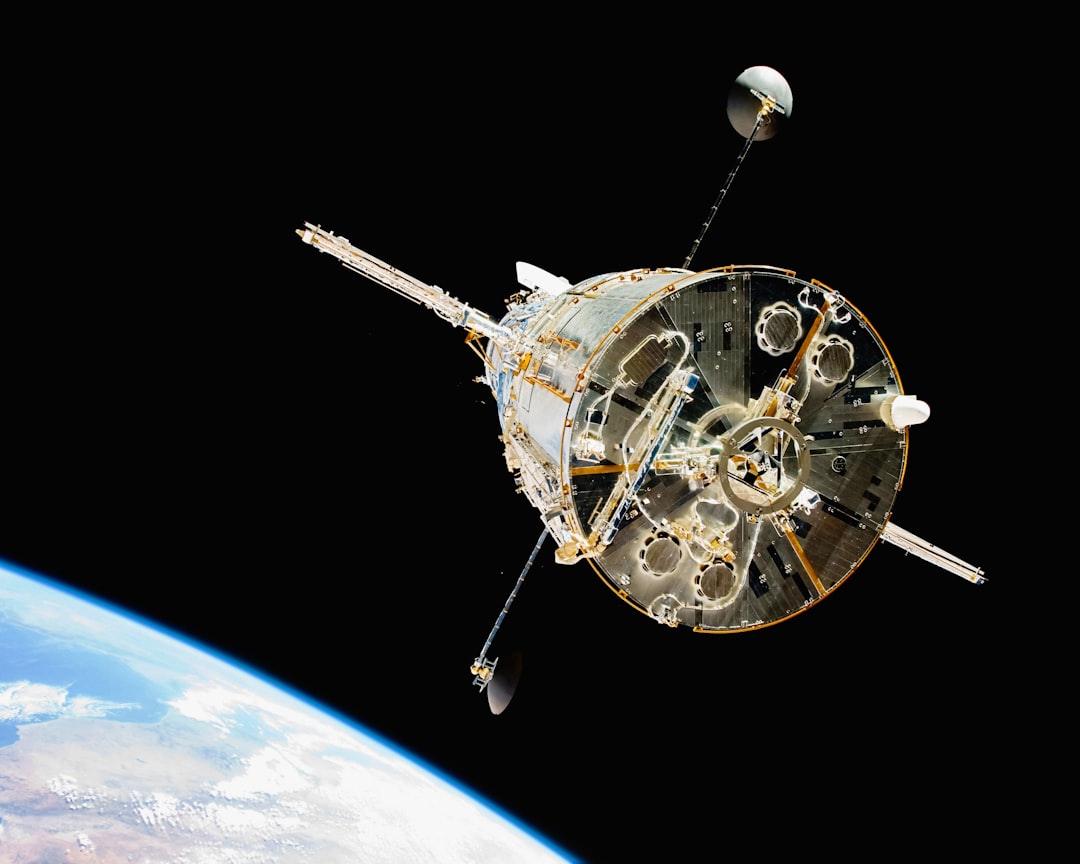
Some missions have found elegant workarounds. The James Webb Space Telescope (JWST), for example, features an extraordinarily intricate folding design: its primary mirror segments, sunshield, and secondary mirror all folded origami-like to fit inside the Ariane 5 fairing, then unfolded autonomously in deep space over the course of two weeks after launch. The engineering achievement was remarkable, but it required nearly two decades of development, cost approximately $10 billion, and carried enormous risk — a single deployment failure could have doomed the entire mission. This approach, while impressive, is not a scalable solution for the kinds of vast structures space visionaries have long imagined.
"NOM4D's objective is to enable efficient, scalable construction of very large structures in space. By 'very large,' I mean hundreds of meters or kilometers in scale. Nothing approaching that scale can be achieved today." — Andrew Detor, NOM4D Program Manager, DARPA
What is NOM4D?
Enter NOM4D: the Novel Orbital and Moon Manufacturing, Materials, and Mass-efficient Design program. Funded and managed by DARPA, NOM4D is a multi-institution research initiative designed to develop and demonstrate the technologies necessary for autonomous, large-scale construction of structures in space. Its core philosophy is deceptively simple: rather than attempting to launch enormous pre-assembled structures, send up smaller, standardized components in modest rocket fairings, then assemble them robotically once in orbit or on the lunar surface.
The program brings together elite research institutions, most notably the California Institute of Technology (Caltech) and the University of Illinois Urbana-Champaign (UIUC), alongside commercial space launch providers. Each institution is contributing distinct technical capabilities — Caltech focusing on structural assembly and materials, UIUC on advanced composite material processing — in a coordinated push to mature the technology rapidly through real-world testing.
Recently, NOM4D reached a landmark milestone: the first successful demonstration of automated in-space assembly. This achievement, accomplished well ahead of the program's original schedule, marks a pivotal inflection point in the history of space engineering.
How the On-Orbit Demonstration Worked
The on-orbit assembly demonstration was built around a gantry robot — also known as a linear or Cartesian robot — a type of robotic system that moves along three perpendicular linear axes (x, y, and z). Gantry robots are well understood in terrestrial manufacturing environments, used extensively in automotive assembly, logistics, and CNC machining. Their predictability, repeatability, and mechanical simplicity make them an attractive choice for autonomous assembly tasks where reliability is paramount.
The payload, developed by Caltech, consisted of individual modular truss components featuring custom-engineered joints. The gantry robot methodically assembled these components into a larger truss structure — a classic architectural form used in bridges, aircraft fuselages, and spacecraft alike, prized for its high strength-to-weight ratio. Crucially, as each section of the truss was assembled, a thin reflective mesh — analogous to the reflecting surface of a space-based antenna — was simultaneously applied to the structure. This parallel operation demonstrated that NOM4D's approach could not only build structural frameworks but integrate functional components during the assembly process itself.
"You can think of the Caltech approach as similar to Tinkertoys or K'nex construction toys: individual truss members are joined at nodes, one section at a time, to create a larger structure. Within the automated assembly box, each section is built piece by piece, a reflective mesh is attached, and the assembled sections are deployed as they are complete. There are no complicated robotics or advanced algorithms; it's just solid engineering from the Caltech team to combine operations in a way that scales." — Andrew Detor, DARPA
The elegance of this approach lies in its deliberate simplicity. Rather than relying on sophisticated artificial intelligence or complex multi-armed robotic systems — technologies that, while advancing rapidly, introduce significant failure modes and development risk — the Caltech team engineered a mechanically straightforward solution that is robust by design. In the unforgiving environment of space, where maintenance is impossible and a single malfunction can end a mission, this philosophy of engineered reliability over algorithmic complexity represents a profound pragmatic insight.
A Compressed Timeline: From Idea to Orbit in 15 Months
Perhaps the most remarkable aspect of NOM4D's recent success is the speed at which it was achieved. In February 2025, program leadership made a bold decision: rather than proceeding with a planned third phase of additional laboratory testing, they would leap directly to on-orbit demonstration. The maturity of the technology, they judged, was sufficient. SpaceX launched Caltech's NOM4D payload into space in March 2026, completing a journey from initial concept to working orbital prototype in just 15 months — a timeline that would have seemed implausible in the conventional government space program paradigm.
"It's the speed and the scale that made this a DARPA project. We went from the idea of an on-orbit demo to launching a working prototype into space in 15 months. Operating in space is much harder than operating on the ground — there's virtually no margin to address issues that may arise. Testing in the operational environment is instrumental to rapidly maturing the technology." — Andrew Detor, DARPA
This compressed timeline reflects DARPA's distinctive organizational culture — one that explicitly accepts higher risk in exchange for dramatically accelerated development. It also reflects genuine advances in the underlying technology. The first two phases of NOM4D yielded far greater progress than anticipated, particularly in the areas of structural materials, joint design, and robotic integration, giving program managers the confidence to skip the intermediate laboratory phase and go directly to the ultimate test environment: space itself.
Next Frontier: Composite Material Processing Aboard the ISS
With the on-orbit assembly demonstration now successfully completed, NOM4D's next chapter is already being written. The University of Illinois Urbana-Champaign team is preparing to launch an experiment to the International Space Station (ISS), where they will attempt something even more ambitious than structural assembly: in-space composite material processing.
The experiment will use a monomer resin that, when cured using an energy-efficient heating method, forms a high-strength polymer — a process directly analogous to how Carbon Fiber Reinforced Polymers (CFRPs) are manufactured on Earth. CFRPs are among the most prized structural materials in aerospace engineering, offering exceptional strength and stiffness at remarkably low weight. They form the primary structure of modern aircraft like the Boeing 787 Dreamliner and the Airbus A350, as well as rocket components and high-performance spacecraft.
The challenge of replicating this manufacturing process in microgravity is substantial. On Earth, gravity assists in the consolidation and flow of resin through fiber reinforcement during curing. In microgravity, the physics of fluid flow and heat transfer behave quite differently, and outgassing — the release of volatile compounds from materials in vacuum — poses additional complications. Successfully demonstrating CFRP-equivalent processing aboard the ISS would represent a transformative advance, potentially enabling future space structures built not merely from pre-manufactured components but from raw or semi-processed materials delivered to orbit in bulk.
- Higher structural performance: In-space cured composites could be optimized for the specific thermal and mechanical loads of the space environment, rather than being engineered for the additional stresses of launch.
- Reduced launch mass: Liquid resins and fiber feedstocks pack far more efficiently than finished structural components, enabling more material to be delivered per kilogram of launch mass.
- Greater design flexibility: Manufacturing in space allows structural forms impossible to achieve with pre-fabricated components constrained by fairing dimensions.
- Long-term sustainability: As in-space resource utilization matures, locally sourced materials from the Moon or asteroids could eventually serve as feedstocks for orbital manufacturing.
The Grand Vision: What Could Be Built?
The practical applications of scalable in-space assembly span an extraordinary range — from near-term operational infrastructure to long-horizon concepts that push the boundary between engineering ambition and science fiction.
Large Space Telescopes and Radio Arrays
Among the most compelling near-term applications is the construction of next-generation space telescopes far exceeding the aperture of JWST's 6.5-meter primary mirror. The angular resolution of a telescope — its ability to distinguish fine detail — scales directly with mirror diameter. An in-space assembled telescope with a primary mirror of 20, 50, or even 100 meters would offer astronomical capabilities essentially unimaginable with current technology, potentially enabling direct imaging of Earth-like exoplanet surfaces and detection of biosignatures in their atmospheres.
Similarly, large-aperture radio antennas assembled in space could achieve baselines and collecting areas far beyond any terrestrial radio telescope. NASA's Lunar Crater Radio Telescope (LCRT) concept envisions a 1-kilometer-diameter wire mesh antenna deployed inside a natural crater on the lunar far side — permanently shielded from Earth's radio frequency interference — that could observe the universe at very low radio frequencies completely inaccessible from Earth's surface. Such a facility could probe the cosmic Dark Ages, the epoch before the first stars formed, via redshifted hydrogen emission — a window onto the universe's earliest structure formation that no existing telescope can access.
Solar Power Satellites
One of the oldest proposed applications of large space structures is the Space Solar Power Satellite (SSPS), first proposed by Peter Glaser in 1968 and studied extensively by NASA in the 1970s. The concept is straightforward in principle: a massive array of photovoltaic panels in geostationary orbit collects sunlight continuously — without the interruptions of Earth's day-night cycle or atmospheric absorption — and transmits the energy to Earth's surface via microwave or laser beams. A viable SSPS would need to be on the order of several kilometers in scale, making it essentially impossible to launch pre-assembled. In-space construction, as demonstrated by NOM4D, is the enabling technology. Both ESA's SOLARIS initiative and several private ventures are actively pursuing this concept.
Orbital Habitats and Transfer Stations
The Lunar Gateway — a proposed modular space station in lunar orbit intended to serve as a staging point for surface missions and a communications relay — represents a more near-term application of space-assembled infrastructure. While the Gateway as currently conceived relies primarily on pre-manufactured modules, NOM4D-style technology could complement such designs by constructing large structural frameworks, docking adapters, and antenna arrays autonomously, reducing the number of dedicated assembly missions required.
Further into the future lie more ambitious habitat concepts. Lunar lava tubes, subsurface conduits formed by ancient volcanic flows, may extend for hundreds of kilometers beneath the Moon's surface, offering natural protection from cosmic radiation, micrometeorite impacts, and the extreme thermal swings of the lunar surface. Robotic systems derived from NOM4D technology could feasibly reinforce and partition these natural structures into pressurized habitable volumes, leveraging geology rather than fighting it.
The O'Neill Vision Revisited
Fifty years ago, physicist Gerard K. O'Neill published The High Frontier: Human Colonies in Space, a meticulously reasoned argument that large-scale space habitation was not merely possible but perhaps inevitable — and urgently desirable. O'Neill's most iconic concept, the O'Neill Cylinder, described a pair of counter-rotating cylindrical space stations, each roughly 8 kilometers in diameter and 32 kilometers long, housing tens of thousands of inhabitants in an interior landscape of towns, farms, forests, and rivers — all sustained by sunlight admitted through long windows and reflected by orbital mirrors. The centripetal acceleration of rotation would simulate Earth-normal gravity throughout the habitat.
"More important than material issues, I think there is reason to hope that the opening of a new, high frontier will challenge the best that is in us, that the new lands waiting to be built in space will give us new freedom to search for better governments, social systems, and ways of life, and that our children may thereby find a world richer in opportunity by our efforts during the decades ahead." — Gerard K. O'Neill, The High Frontier
The O'Neill Cylinder remains in the realm of extraordinarily ambitious long-term vision — the mass of steel, glass, and soil required would likely need to be sourced from the Moon or near-Earth asteroids rather than lifted from Earth's gravity well. But the program that O'Neill envisioned would necessarily begin with exactly the kind of capabilities NOM4D is demonstrating: the ability to assemble large, complex structures autonomously in space. In this light, NOM4D is not merely a DARPA demonstration project — it is potentially the first tentative step toward a civilizational-scale transformation in humanity's relationship with the solar system.