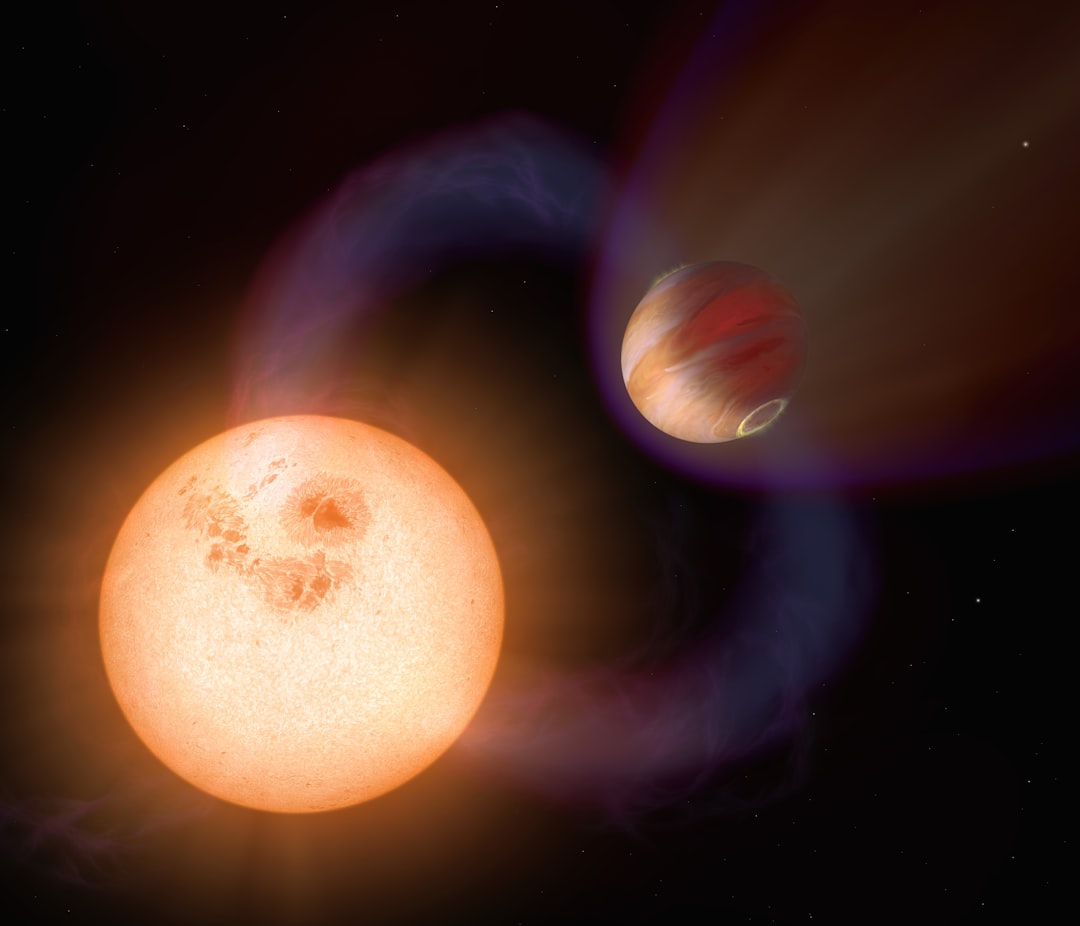
Astronomers Discover a Hidden Binary in a Star System Used to Calibrate the JWST
When cutting-edge observatories like the James Webb Space Telescope (JWST) begin observation campaigns, they typically start by pointing their instruments at carefully selected calibration stars — objects whose physical properties are so precisely known that they serve as reliable yardsticks for all subsequent measurements. The integrity of JWST's science depends critically on these standards. Yet a new discovery has revealed that one of those trusted benchmarks may not be quite what astronomers assumed it to be.
A star known as HD 158485, long classified as a solitary A-type star and used as a flux calibration reference for the JWST, has now been identified as a binary star system — containing not one, but two stellar components. The discovery, made by a team from the Xinjiang Astronomical Observatory of the Chinese Academy of Sciences (CAS), raises important questions about the precision of instrument calibration and the methods used to characterize stellar standards across the broader astronomical community.
Why Calibration Stars Matter So Much
To appreciate the significance of this finding, it helps to understand what calibration stars actually do. Before any space telescope can deliver scientifically reliable data, its instruments must be carefully tuned. Calibration stars — objects with precisely measured spectral energy distributions (SEDs) — allow engineers and scientists to convert raw detector signals into accurate physical measurements of stellar flux, essentially the amount of radiant energy arriving from a star per unit area per unit time.
The Space Telescope Science Institute (STScI), which manages JWST science operations, maintains a network of such calibration standards across the sky. These stars span a range of spectral types and brightnesses, ensuring that JWST's four scientific instruments — NIRCam, NIRSpec, NIRISS, and MIRI — can be reliably cross-calibrated at every wavelength they observe, from near-infrared to mid-infrared light.
The challenge is that any undetected companion star orbiting alongside a calibration standard silently contaminates its combined light, altering the measured flux in ways that may be subtle yet persistent. As JWST pushes the boundaries of sensitivity — detecting the atmospheres of exoplanets, peering into the first galaxies, and probing the formation of stars — even small systematic errors in calibration can cascade into significant scientific uncertainties.
"Stellar pulsations can reveal binaries that conventional observations leave unresolved — underscoring the need to account for hidden stellar companions when evaluating calibration standards."
— Chenglong LV et al., The Astrophysical Journal Letters (2026)
The Pulsating Star That Gave Away Its Secret
HD 158485 belongs to a fascinating class of variable stars known as Delta (δ) Scuti stars. Named after the prototype star in the constellation Scutum, these are typically A- or F-type stars located on or near the main sequence that pulsate with remarkable regularity. Their brightness oscillations — driven by pressure and gravity waves propagating through the stellar interior — occur on timescales ranging from roughly 18 minutes to 8 hours, making them natural laboratories for the field of asteroseismology: the study of stellar interiors through the analysis of oscillation modes.
It was precisely this pulsating behavior that exposed HD 158485's hidden companion. Using long-baseline photometric data from NASA's Transiting Exoplanet Survey Satellite (TESS), the CAS team identified six distinct δ Scuti pulsation modes within the star's light curve. What made these pulsations extraordinary was not their existence, but their behavior over time: the six modes fell neatly into two separate groups, and each group showed opposite light-travel-time variations.
This phenomenon — known as the pulsation timing method or phase modulation technique — is a powerful diagnostic tool. When a pulsating star orbits a companion, its distance from Earth changes periodically. As the star moves toward us, its pulsation signals arrive fractionally earlier; as it recedes, they arrive fractionally later. By measuring these minute timing shifts across different pulsation modes, astronomers can reconstruct the orbital geometry of the system without ever directly resolving the two stars.
The fact that the two groups of pulsation modes showed opposing timing variations was the definitive clue: each group of modes belonged to a different star in the binary system, and both stars were betraying their orbital motion through their pulsations. This elegant technique effectively allowed the team to listen to the heartbeats of two stars and deduce that they were dancing around each other.
Orbital Architecture of the Hidden Binary
By modeling the timing variations extracted from TESS data, the researchers derived the first complete orbital solution and dynamical mass ratio for the HD 158485 system. Their findings paint a detailed picture of a gravitationally bound pair:
- Orbital period: 382.8 days — the two stars complete one full orbit around their common center of mass in just over a year.
- Orbital eccentricity: 0.242 — indicating a moderately elongated elliptical orbit, neither perfectly circular nor highly stretched.
- Mass ratio: The companion is approximately 80% as massive as the primary star, making it a likely F-type (yellow-white) main-sequence star.
- Orbital confirmation: The orbital solution derived from one TESS observing sector successfully predicted the timing variations observed in an entirely independent TESS campaign — a robust independent verification of the results.
The companion's inferred spectral type is particularly telling. An F-type star is cooler and intrinsically less luminous than the primary A-type star, but it is by no means negligible. Combined with the primary, it contributes meaningfully to the system's total brightness and spectral shape — particularly at longer wavelengths where JWST operates. This is a binary pair that has been hiding in plain sight, its combined light masquerading as a single, well-characterized object.
Implications for JWST Calibration Accuracy
The team's most consequential finding concerns the photometric impact of this misidentification. By comparing a two-star atmospheric model against the conventional single-star model for HD 158485 — using the newly derived mass ratio to constrain each component's properties — the researchers quantified how much the unresolved companion distorts the system's predicted flux:
- A flux discrepancy of approximately 1.6% between 1 and 5 micrometers (μm) — a range covering JWST's NIRCam and NIRSpec instruments.
- A larger discrepancy of approximately 2.5% between 5 and 28 μm — squarely in the domain of JWST's MIRI instrument, which probes mid-infrared wavelengths where the cooler companion contributes proportionally more light.
The researchers are careful to note that these figures do not represent a confirmed measurement error currently propagating through JWST science data; rather, they illustrate the potential magnitude of systematic bias that an unresolved binary can introduce into flux calibration. Nevertheless, at an observatory designed to achieve sub-percent photometric precision, even a 1–2.5% systematic offset is a concern that demands attention. For context, JWST's scientific goals include characterizing exoplanet atmospheres where detecting molecular features may require photometric stability at the fraction-of-a-percent level.
The findings strongly advocate for a systematic reassessment of JWST's calibration star network using modern pulsation timing and high-resolution imaging techniques to screen for unresolved companions. ESA's Gaia mission, which has produced an unprecedented all-sky catalog of stellar positions, proper motions, and radial velocities, may also offer complementary data to help flag potential binary contaminants among calibration standards.
A New Tool for Stellar Archaeology
Beyond its immediate implications for JWST, this study demonstrates the remarkable power of asteroseismic pulsation timing as a binary detection tool. Many binary systems — particularly those with wide separations — evade detection by traditional methods such as radial velocity spectroscopy (which may require decades of monitoring) or direct imaging (which struggles to resolve companions within fractions of an arcsecond). The phase modulation technique, applied to high-cadence photometric data from missions like TESS and its predecessor Kepler/K2, can reveal orbital periods of months to years from just a few seasons of continuous observation.
This approach has broader implications for stellar astrophysics. As NASA's archive of Kepler and TESS photometry continues to grow, astronomers can apply similar pulsation timing analyses to entire catalogs of δ Scuti stars and other pulsating variables, potentially uncovering a population of previously unknown binary systems. Each discovery refines our understanding of stellar multiplicity — the fact that most stars in our galaxy are not solitary, like our Sun, but share their existence with one or more companions.
The study, published in The Astrophysical Journal Letters, was led by Chenglong LV and colleagues at the Xinjiang Astronomical Observatory, Chinese Academy of Sciences. It provides the first orbital solution and dynamical mass ratio for HD 158485 and sets a compelling precedent for how pulsation analysis can contribute to maintaining the integrity of space telescope calibration programs worldwide.
Key Takeaways
- HD 158485, a star used to calibrate JWST, has been revealed as a binary system rather than a single A-type star.
- The discovery was made using pulsation timing analysis of TESS photometric data — not direct imaging or radial velocity monitoring.
- The companion is likely an F-type main-sequence star, approximately 80% as massive as the primary, orbiting every 382.8 days in a moderately elliptical orbit.
- The unresolved binary introduces a potential flux calibration error of 1.6–2.5% across JWST's operational wavelength range.
- The findings highlight the importance of vetting calibration standards for hidden companions — and the power of asteroseismology to detect them.
In essence, this discovery is a reminder that even the stars we think we know best can still surprise us — and that the quest for precision in astronomy demands constant vigilance, even about the tools we use to achieve it.