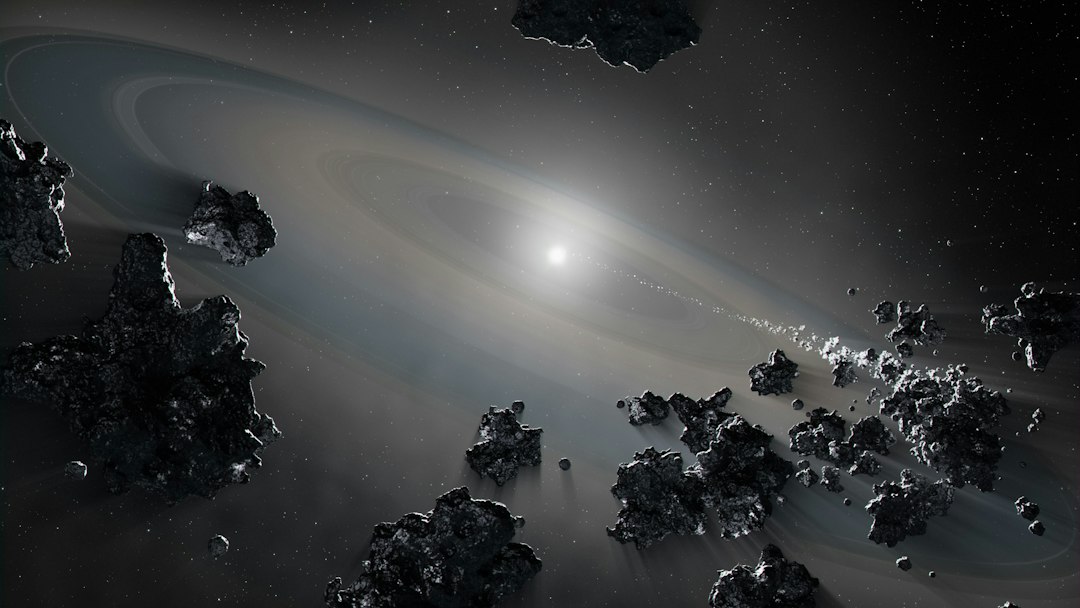
Asteroid Bennu's Sample Delivers Another Surprise: Primordial Molecules From the Dawn of the Solar System
One of the most profound and exciting discoveries in modern planetary science is that some of the molecules fundamental to life as we know it are found not only on Earth, but scattered across the cosmos — embedded in asteroids, comets, and meteorites that have drifted through space for billions of years. Sample return missions from asteroids have fundamentally transformed our understanding of these ancient rocky bodies, revealing that they are far more than inert lumps of stone and metal. They serve as cosmic time capsules, preserving some of the fundamental chemical building blocks of life — including amino acids, the molecular units used to construct proteins — in a state that may be nearly as pristine as when the Solar System itself was born.
These discoveries represent a collective scientific revelation. It is becoming increasingly clear that the precursors for life could be remarkably widespread throughout our Solar System, and by extension, throughout the galaxy. If the chemical ingredients necessary to spark life can form spontaneously in the cold, radiation-bathed environment of deep space and survive for billions of years inside rocky bodies, then the possibility of life arising elsewhere in the universe becomes significantly more plausible. Each new finding nudges the scientific community closer to answering one of humanity's oldest and most profound questions: Are we alone?
OSIRIS-REx and the Treasure of Asteroid Bennu
NASA's OSIRIS-REx mission (Origins, Spectral Interpretation, Resource Identification, Security–Regolith Explorer) has been a landmark chapter in this unfolding story. After a remarkable journey of over seven years — including a careful approach, an audacious touch-and-go sample collection maneuver, and a fiery return to Earth — the mission successfully delivered a sample from near-Earth asteroid (101955) Bennu in September 2023. The sample, carefully sealed and transported to dedicated clean-room laboratories, has since become one of the most scientifically valuable extraterrestrial materials ever studied.
Examination of those samples has already revealed extraordinary results. Scientists identified the presence of 14 of the 20 amino acids that make up proteins in Earth life, along with four of the essential nucleobases — the building blocks for DNA and RNA. The finding sent ripples of excitement through the astrobiology and planetary science communities. For the first time, researchers had access to pristine asteroid material, untainted by terrestrial contamination, that contained the very molecular alphabet of life.
Now, a new study has taken the investigation a remarkable step further, probing deeper into the atomic structure of one of those molecules than ever before — and the results have left even seasoned geochemists astonished.
"I was genuinely gobsmacked by the enormous isotope difference between two neighboring atom positions within the same molecule. The preservation of such startling differences is an indicator of the primordial nature of these molecules. We are working with molecules formed at the very dawn of the solar system, possibly even before the formation of Earth." — Katherine Freeman, Professor of Geosciences, Penn State University
The New Study: Isotopic Fingerprints of a Primordial Molecule
The new research, published in Nature Communications Earth and Environment, is titled "Nitrogen and intramolecular carbon isotopic measurements of β-alanine in samples from asteroid Bennu and the Murchison meteorite." The lead author is Ophélie McIntosh, a former postdoctoral researcher in Penn State's Department of Geosciences. The team focused on a single molecule — β-alanine (beta-alanine) — comparing its isotopic composition in the Bennu sample with the same molecule found in the famous Murchison meteorite, a carbonaceous chondrite that fell over Murchison, Victoria, Australia in September 1969 and has since become one of the most studied extraterrestrial objects on Earth.
Beta-alanine is a naturally occurring amino acid, but it is not one of the 20 standard amino acids encoded by the human genetic code for protein synthesis. Instead, it plays other biochemical roles in terrestrial life and is of significant scientific interest in prebiotic chemistry — the study of chemical reactions that may have preceded and enabled the origin of life. Its presence in both asteroid samples and meteorites makes it a valuable molecular probe for understanding the chemistry of the early Solar System.
As the authors write in the study: "Amino acids are central to prebiotic chemistry, and their abundances and isotopic compositions provide critical constraints on the synthetic mechanisms and environments in which they formed. Samples delivered to Earth from the carbonaceous asteroid (101955) Bennu by NASA's OSIRIS-REx mission offer an opportunity to investigate amino acids preserved in pristine material unaffected by terrestrial contamination."
"Amino acids are the building blocks of proteins and peptides, but they are also found in carbon-rich meteorites and asteroid samples, so they can provide a direct link between space chemistry and the origins of life on Earth," lead author McIntosh said. "Most studies focus on the distribution and quantification of amino acids, so our question about how they're formed is quite new. We used very unique isotope instruments, including one that exists only at Penn State, to help answer those questions."
What Are Isotopes, and Why Do They Matter?
To appreciate why this research is so groundbreaking, it helps to understand the concept of isotopes. Isotopes are variants of chemical elements that share the same number of protons but differ in the number of neutrons in their nuclei. Carbon, for instance, exists primarily as carbon-12 (12C), but a small fraction of carbon atoms in the universe are carbon-13 (13C), a heavier, stable isotope. The ratio of these isotopes in a substance — its isotopic composition — acts like a chemical fingerprint, encoding information about the conditions and environments in which the substance formed.
Different physical and chemical processes fractionate isotopes in predictable ways, meaning that by measuring isotopic ratios, scientists can reverse-engineer the history of a molecule. This technique has long been used in geology, oceanography, and climate science to reconstruct past environments. Applied to extraterrestrial materials, it becomes a tool for probing the chemistry of the early Solar System itself.
"Isotope ratios provide a measurable tag that can link molecules to specific reservoirs or processes," said paper co-author Christopher House, professor of geosciences at Penn State. "For our study, isotopes provided clues to an older history for specific atoms in a molecule."
Cutting-Edge Instruments: Seeing Inside a Single Molecule
What makes this study truly exceptional is the unprecedented level of analytical detail the researchers were able to achieve. Previous isotopic studies of meteoritic amino acids measured the bulk isotopic composition of molecules — essentially averaging the isotopic signal across all atoms of a given element within the molecule. This study went far beyond that, achieving intramolecular isotopic measurements — measuring the isotopic composition of individual carbon and nitrogen atoms at specific positions within the beta-alanine molecule.
This was made possible by two remarkable instruments:
- pico-CSIA (Picomolar-scale Compound-Specific Isotope Analysis): A device unique to Penn State that can measure isotopic averages in extraordinarily small samples — a critical capability given the precious and limited nature of the Bennu material.
- Modified GC-Orbitrap (Gas Chromatography-Orbitrap Mass Spectrometer): A highly sensitive instrument modified to measure isotopic compositions at specific atomic positions within individual molecules, delivering position-specific isotopic data with remarkable precision.
Together, these instruments allowed the team to generate what McIntosh describes as a far richer molecular portrait. "This intramolecular information provides a much more detailed isotopic fingerprint," she explained. "Instead of simply asking whether a molecule is enriched or depleted in a particular isotope, we can investigate how that isotope is distributed within the molecule and use this pattern to distinguish between possible formation pathways."
The technique also allowed the researchers to study an almost vanishingly small amount of sample — a critical advantage when working with material as rare and irreplaceable as the Bennu regolith. "Being able to analyze the isotope values for each carbon and nitrogen within the beta-alanine molecule is a dream for geochemistry," House said. "And here it is coupled to the ability to study a pristine asteroid sample returned to Earth by NASA."
A Startling Discovery: Wildly Different Atoms Within the Same Molecule
When the researchers examined the intramolecular isotopic compositions of beta-alanine from both Bennu and Murchison, they expected to find some variation — but the scale of what they discovered far exceeded their expectations. The isotopic values from one carbon atom to the next, within the very same molecule, were dramatically different. This level of internal isotopic heterogeneity was not anticipated and points to something remarkable about the origin of these molecules.
The key finding centered on elevated 13C enrichment in the carboxyl carbon (COOH) of beta-alanine from the Bennu sample. As the authors write: "The substantially greater 13C enrichment of the carboxyl carbon in Bennu is consistent with the incorporation of carbon from isotopically distinct precursor reservoirs, potentially reflecting differences in the local chemical environments in which β-alanine or its precursors formed."
Critically, while the bulk isotopic compositions of beta-alanine from Bennu and Murchison were strikingly similar — so close that within the margin of error they appear essentially identical — the intramolecular compositions were completely different. As McIntosh explained: "When you compare the Bennu and Murchison samples, the carbon isotope average is so close that when you factor in margin of error, they're basically the same. But when you look at intramolecular carbon, they're completely different."
The study summarizes this remarkable duality: "The samples display similar intramolecular isotope distributions, consistent with a common synthetic route, but differ markedly in their position-specific carbon and nitrogen isotope compositions."
What Does This Mean? Chemistry Across the Protoplanetary Disk
The implications of this finding are significant. The fact that beta-alanine in Bennu and Murchison appears to have formed through similar chemical pathways — but in isotopically distinct environments — tells scientists that the protoplanetary disk from which our Solar System coalesced was not chemically uniform. Rather, it was spatially heterogeneous, with different regions hosting different chemical reservoirs that could give rise to the same molecules under different physical and chemical conditions.
These intramolecular isotope differences cannot be explained by processes occurring inside the parent bodies — the asteroids themselves — after they formed. Instead, they appear to reflect the primordial chemistry of the disk itself, in the period before planets and large asteroids had fully assembled. The molecules may even pre-date the formation of Earth.
"One of the main things we discovered, for both glycine and beta-alanine, is that they might have formed in different environments or places in the solar system," McIntosh said. "This broadens our understanding of the type of environments where you can form those very important molecules for prebiotic chemistry."
This heterogeneity in the disk is consistent with observations from modern astrophysics. NASA's planetary science research has long suggested that the early Solar System was a dynamic, turbulent environment, with significant chemical and physical gradients across the disk. The idea that prebiotic chemistry was not confined to a single narrow region, but could emerge across a wide variety of conditions, has profound implications for our understanding of the universality of life's building blocks.
The Murchison Meteorite: A Long-Standing Scientific Touchstone
The Murchison meteorite has been a cornerstone of astrobiology and meteoritics for over five decades. When it fell in 1969, it arrived at a moment of intense scientific excitement — just weeks after the Apollo 11 mission returned lunar samples to Earth — and its study has yielded a treasure trove of organic compounds, including amino acids, nucleobases, sugars, and other prebiotic molecules. However, as a meteorite, it was exposed to Earth's atmosphere and environment during and after its fall, raising questions about the degree of terrestrial contamination.
The Bennu sample, by contrast, was collected by OSIRIS-REx's Touch-And-Go Sample Acquisition Mechanism (TAGSAM), sealed in a sterile capsule, and transported to Earth in a controlled environment before being opened in a dedicated curation facility at NASA's Johnson Space Center. This meticulous handling ensures that the Bennu sample represents the gold standard of pristine extraterrestrial material, making it an ideal reference point for comparing with meteoritic samples like Murchison.
Implications for the Search for Life Beyond Earth
Beyond the immediate findings about beta-alanine and the early Solar System, this research carries significant implications for the broader search for life elsewhere in our cosmic neighborhood. As missions are planned and developed to explore the icy moons of Jupiter — particularly Europa and Ganymede, targets of ESA's JUICE mission and NASA's Europa Clipper — and Saturn's moon Enceladus, the ability to identify and interpret chemical biosignatures will be critical.
As the authors note in their study: "Isotopic analyses of amino acids and other prebiotic molecules in Bennu samples and other pristine astromaterials provide a critical abiotic baseline for the search and identification of chemical biosignatures within our Solar System." In other words, by establishing what abiotic (non-living) chemistry looks like at the molecular and isotopic level, scientists can more confidently identify anomalous signatures that might indicate biological activity.
The research also underscores the broader message that prebiotic chemistry — the molecular scaffolding upon which life is built — is not an exotic or unlikely phenomenon. It appears to be a natural and widespread product of cosmic chemistry, capable of arising in diverse environments across a protoplanetary disk.
"Beta-alanine is a prominent example of the amazingly diverse collection of amino acid-like molecules found in space samples," said project principal investigator Katherine Freeman. "It can help us understand why there are so many different types of these compounds and where and how they were made. Ultimately, this helps us understand ways that space organics potentially shaped the unique chemistry in life."
Key Takeaways From This Research
- Pristine asteroid material matters: The carefully preserved Bennu sample, free from terrestrial contamination, provides an unprecedented window into the chemistry of the early Solar System.
- Intramolecular isotope analysis is a powerful new tool: The ability to measure isotopic compositions at individual atomic positions within a molecule opens a new chapter in geochemistry and astrobiology.
- The protoplanetary disk was chemically heterogeneous: The same prebiotic molecules can form in different parts of the disk under different conditions, suggesting that life's building blocks are even more widespread than previously thought.