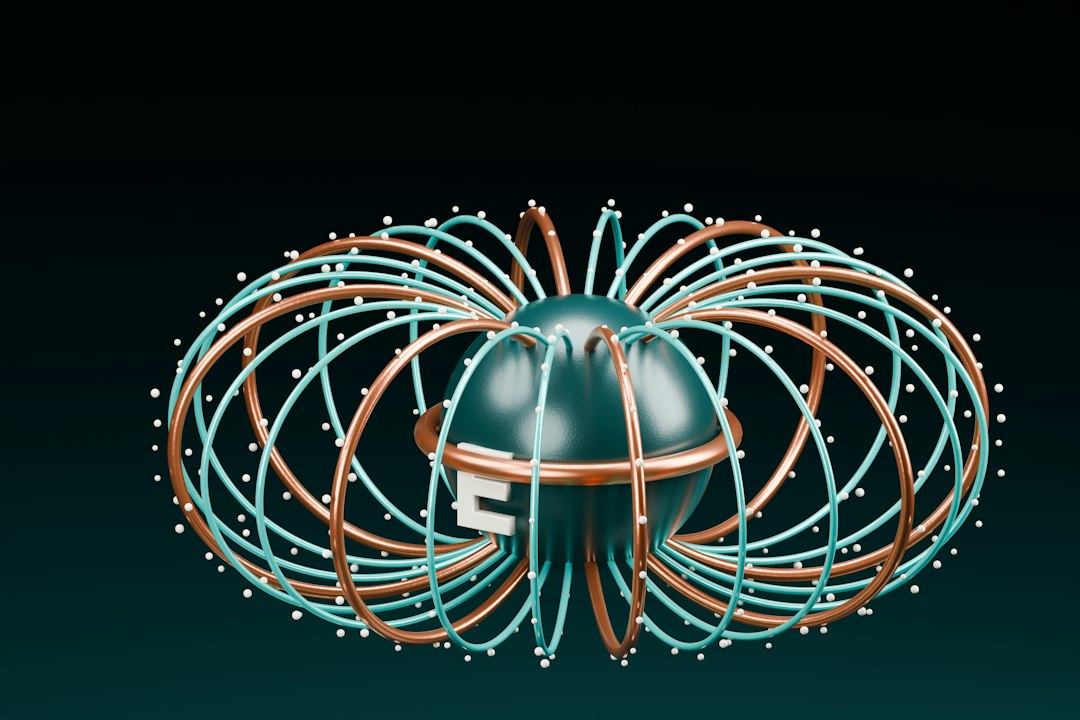
The Ice Giants' Magnetic Fields Are Profoundly Strange — And New Research Is Beginning to Explain Why
Of all the planetary systems in our solar neighborhood, few are as scientifically tantalizing — or as poorly understood — as the ice giants Uranus and Neptune. These distant, frigid worlds sit at the outer edge of our solar system, cloaked in mystery largely because only a single spacecraft has ever visited them. Now, a compelling new study published in Nature Communications Physics is shedding fresh light on one of their most enigmatic features: their deeply unusual magnetic fields.
To appreciate just how bizarre Uranus and Neptune's magnetism is, it helps to first understand what a "normal" planetary magnetic field looks like — and why Earth's serves as the gold standard of comparison.
The Planetary Magnetic Field Spectrum: From Earth to the Outer Giants
Almost every planet in our solar system generates some form of magnetic field, though the mechanisms and strengths vary considerably. Earth's magnetic field is produced by its geodynamo — a process in which the circulation of liquid iron and nickel in the outer core, driven by heat escaping from the inner core and amplified by our planet's rotation, generates powerful electrical currents that in turn produce a robust magnetic field. This field extends tens of thousands of kilometers into space, creating the magnetosphere that shields life on the surface from harmful solar wind particles and cosmic radiation.
Earth's magnetic field is what scientists call dipolar and axisymmetric — it has two clearly defined poles (north and south) aligned reasonably close to the planet's rotational axis, and it is broadly symmetrical. While it does experience geomagnetic reversals — complete flips of the north and south magnetic poles — these events occur on timescales of hundreds of thousands to millions of years, with the magnetic north pole drifting only about 5 to 60 kilometers per year under normal conditions.
The gas giants Jupiter and Saturn share this same general character. Both generate enormously powerful magnetic fields through deep metallic hydrogen dynamos — Jupiter's field is roughly 20,000 times stronger than Earth's — and both are dominated by symmetric, well-organized dipolar structures. Their magnetic fields are strange only in terms of scale, not in fundamental character.
- Mercury: Has a weak, dipolar field, likely from a partially liquid iron core
- Venus: Lacks a significant intrinsic magnetic field, possibly due to the absence of a solidifying inner core or sufficient rotation
- Mars: Has only a fossil remnant field preserved in ancient crustal rocks
- Jupiter: Possesses the most powerful planetary magnetic field in the solar system, generated by metallic hydrogen
- Saturn: Has a surprisingly symmetrical magnetic field for its size, slightly tilted from its rotational axis
Then there are Uranus and Neptune — and they break all the rules.
Voyager 2's Shocking Revelations
NASA's Voyager 2 remains the only spacecraft ever to have conducted close-up flybys of both ice giants — Uranus in 1986 and Neptune in 1989. The magnetic field measurements it returned were, to put it mildly, astonishing. Scientists had expected to find something at least broadly resembling Earth's or Jupiter's ordered dipolar structure. Instead, they found something that looked, by comparison, like it had been scrambled.
"Uranus and Neptune exhibit magnetic fields that are non-dipolar and non-axisymmetric, unlike those of any other known planet. These fields are generated by fluid motions in electrically conducting planetary interiors via dynamo action, offering a window into otherwise inaccessible deep processes." — Yan et al., Nature Communications Physics, 2026
Uranus's magnetic field is tilted nearly 60 degrees from its rotational axis — an enormous deviation — and it does not originate from the planet's geometric center. Instead, it appears to be offset toward one side of the planet, resulting in a highly asymmetrical surface field that is dramatically stronger on one hemisphere than the other. Neptune's situation is similarly chaotic: its magnetic field is tilted approximately 47 degrees from its rotational axis and is likewise offset from the planet's physical center.
Beyond the tilt and offset, both planets exhibit what researchers describe as non-dipolar, non-axisymmetric field configurations. Rather than being dominated by a single, clean dipole component, the fields of Uranus and Neptune contain significant contributions from higher-order multipole terms — quadrupoles, octupoles, and beyond — all in disarray relative to the rotation axis. This is quantified using what is known as the M=1 mode, or the first non-symmetric component of a spherical harmonic decomposition of the magnetic field.
On Earth, Jupiter, and Saturn, the symmetric (M=0) component completely dominates — the asymmetric M=1 component is at least an order of magnitude weaker. But on Uranus and Neptune, the M=1 peak is exceptionally strong, rivaling or even competing with the symmetric components. The result is a lopsided, geometrically complex magnetic field that doesn't correspond to anything else in our solar system's known inventory.
What Generates the Ice Giants' Magnetic Fields?
The source of these strange fields lies in the deep interiors of Uranus and Neptune — regions we cannot directly observe and can only probe indirectly through models. Unlike Earth's iron-rich core or Jupiter's metallic hydrogen mantle, the interiors of ice giants are thought to contain vast quantities of water, ammonia, and methane compressed to extreme pressures and temperatures.
Under these extraordinary conditions — pressures millions of times greater than Earth's atmospheric pressure, and temperatures measured in thousands of Kelvin — these substances don't behave in any familiar way. Water molecules, for instance, can be driven into what physicists call a superionic phase, in which the oxygen atoms lock into a crystalline lattice while the hydrogen protons flow freely through that lattice like a liquid, creating a material that is simultaneously solid and electrically conductive. Ammonia and methane undergo similarly exotic transformations, entering ionic phases that allow them to carry electric current.
It is the interplay between electrical conductivity, convection, and planetary rotation in these deep fluid layers that is believed to generate the ice giants' dynamos. But the precise architecture of this dynamo — which layers contribute most, how conductivity varies with depth, and how convection cells are structured — has long remained a subject of educated speculation.
For further background on planetary magnetic fields and dynamo theory, see NASA's Solar System Exploration resource on planetary science and the ESA's Ice Giants mission concept page.
New Research: Electrical Conductivity Is the Key
The new study, titled "Electrical conductivity structure drives anomalous and potentially time-varying magnetic fields at Uranus and Neptune," published in Nature Communications Physics in 2026, represents a significant advance in our understanding. The lead author, Chi Yan, a research associate at the University of Texas Jackson School of Geosciences, and colleagues developed a series of sophisticated numerical dynamo models designed to test whether specific interior conductivity structures could reproduce the observed field configurations.
The team's central hypothesis was both elegant and physically motivated: what if electrical conductivity increases systematically with depth in the ice giants' interiors? This assumption is consistent with our understanding of how pressure and temperature affect the exotic phases of water and ammonia found in these worlds. As you descend deeper, the increasingly extreme conditions ionize more material, making the fluid progressively more conductive.
When the researchers incorporated this radially variable conductivity profile into their dynamo models — testing several different shell geometries for the convective regions — they found that the resulting magnetic fields bore a striking resemblance to what Voyager 2 actually measured. Specifically, their models naturally produced the strong M=1 asymmetric peak characteristic of both ice giants, the offset-from-center field geometry, and the large axial tilt.
"Deep inside Uranus and Neptune, pressures and temperatures become extremely high. Under these conditions, which can cause water molecules to break apart into ions, the material may become increasingly electrically conductive with depth." — Chi Yan, University of Texas Jackson School of Geosciences
"We demonstrate that dynamo models incorporating an electrical conductivity that increases with depth can promote non-dipolar, non-axisymmetric magnetic fields," the authors write, confirming that the M=1 peak observed at both Uranus and Neptune is a natural consequence of this interior structure rather than an anomalous accident. This is a crucial insight: the strangeness of the ice giants' magnetic fields is not random disorder but a predictable outcome of their unique interior physics.
Time-Varying Fields: A Magnetic System in Constant Flux
Perhaps the most dramatic finding of the new research is not about the shape of the magnetic fields, but about their temporal behavior. Voyager 2 gave us a snapshot — a single set of measurements taken at a single moment in each planet's history. The new models suggest that those snapshots may already be significantly out of date.
Unlike Earth's field, which drifts by approximately one degree every 50 years under normal conditions, the models predict that the ice giants' magnetic fields can swing dramatically on decadal timescales. The axial tilt of the magnetic field — a parameter that remains nearly stable on Earth — could potentially shift by tens of degrees within a few decades on Uranus or Neptune, though the models also show periods of relative quiescence where changes are slower.
"Earth's magnetic tilt drifts by only a degree or so over 50 years. Our models show the ice giants can behave very differently. In some stretches the tilt swings by tens of degrees within decades. In others it shifts only slightly over the same span." — Chi Yan
"These non-dipolar dynamos exhibit substantial temporal variation, although the rate fluctuates and can be transiently slow," the authors write, noting that changes in both field intensity and orientation are plausible in the decades since Voyager 2 flew past these worlds, "though the extent of any such variation remains poorly constrained observationally as each planet has been measured in situ only once."
This has profound implications. The magnetic field configurations we have treated as the definitive reference for Uranus and Neptune since the late 1980s may now bear little resemblance to the actual configurations those planets present today. The magnetospheres — the vast regions of space dominated by each planet's magnetic influence, which shape radiation belts, plasma dynamics, and the environments of orbiting moons — could be fundamentally different from what we modeled based on Voyager 2 data.
JWST: A New Window on Ice Giant Magnetism
The researchers are not entirely without new data, however. The James Webb Space Telescope (JWST) has recently been used to observe auroral activity at both Uranus and Neptune — a significant scientific milestone. Aurorae are produced when charged particles accelerate along magnetic field lines and collide with atmospheric gases, creating glowing emission signatures. Because the structure and location of an aurora is intimately tied to the architecture of the planet's magnetic field, auroral observations can serve as a remote diagnostic of magnetic field geometry.
JWST's Near-Infrared Spectrograph (NIRSpec) has captured the first detailed infrared auroral detections at Neptune, revealing cyan-glowing patches of emission from ionized hydrogen. Combined with ionospheric measurements showing complex, irregular patterns, these observations hold the promise of constraining how much the magnetic fields have shifted since Voyager 2.
"We are busy working on what's contained within these observations, but the shape and structure of the aurora, as well as other weird patterns in the ionosphere promises to provide us with a way of understanding how the magnetic fields have changed, an important stepping stone," said Tom Stallard, a professor at Northumbria University who led the JWST observation campaign.
The research team plans to combine the JWST auroral data with the new dynamo models and the original Voyager 2 measurements to construct the best possible picture of where the ice giant magnetic fields stand today. This kind of multi-dataset, multi-decade analysis represents the state of the art in remote planetary magnetometry — using light, rather than in situ instruments, to probe a planet's internal dynamics. You can learn more about the JWST's solar system science program at the Space Telescope Science Institute's approved programs page.
Why Understanding Ice Giant Dynamos Matters More Broadly
Beyond their intrinsic fascination, Uranus and Neptune occupy a special position in planetary science as outliers — systems that behave differently enough from the norm to reveal which aspects of dynamo theory are truly universal and which are specific to particular interior conditions. As the authors of the new study put it: "Understanding why Uranus and Neptune have such unusual magnetic fields provides critical insight into dynamo processes across planets and stars."
This principle extends well beyond our solar system. Exoplanets with masses between Earth's and Neptune's — so-called sub-Neptunes and mini-Neptunes — are among the most common planet types detected by telescopes like Kepler and TESS, yet we understand their interiors poorly. If a gradient in electrical conductivity can produce such dramatically different dynamo behavior in our own ice giants, then the magnetic environments of similar worlds around other stars could be radically diverse — with significant consequences for atmospheric retention, radiation environments, and potentially even habitability.
Furthermore, some stellar dynamos — including those in low-mass M-dwarf stars — may operate in regimes where the physics more closely resembles an ice-giant-like dynamo than a solar-like one. The lessons learned from modeling Uranus and Neptune could therefore have implications for understanding the magnetic activity and flaring behavior of the most common type of star in the galaxy. For more on the broader context of dynamo theory, the American Geophysical Union's resources on geophysics and planetary magnetism provide excellent background.
The Road Ahead: Future Missions and the Habitability Question
Despite the progress represented by this new research, the authors are candid about the limitations that remain. Without new in situ measurements — an actual spacecraft in orbit around Uranus or Neptune, measuring the magnetic field directly with dedicated magnetometers — many key questions simply cannot be answered. The models are powerful, but they are still models, constrained by observations that are now four decades old.
The planetary science community has formally recognized this gap. The National Academies' Planetary Science and Astrobiology Decadal Survey 2023–2032 ranked a Uranus orbiter and atmospheric probe as the highest-priority large mission for the coming decade, reflecting broad scientific consensus about the importance of ice giant exploration. NASA's Uranus Orbiter & Probe concept would place a spacecraft in sustained orbit around Uranus, mapping its magnetic field in detail, probing