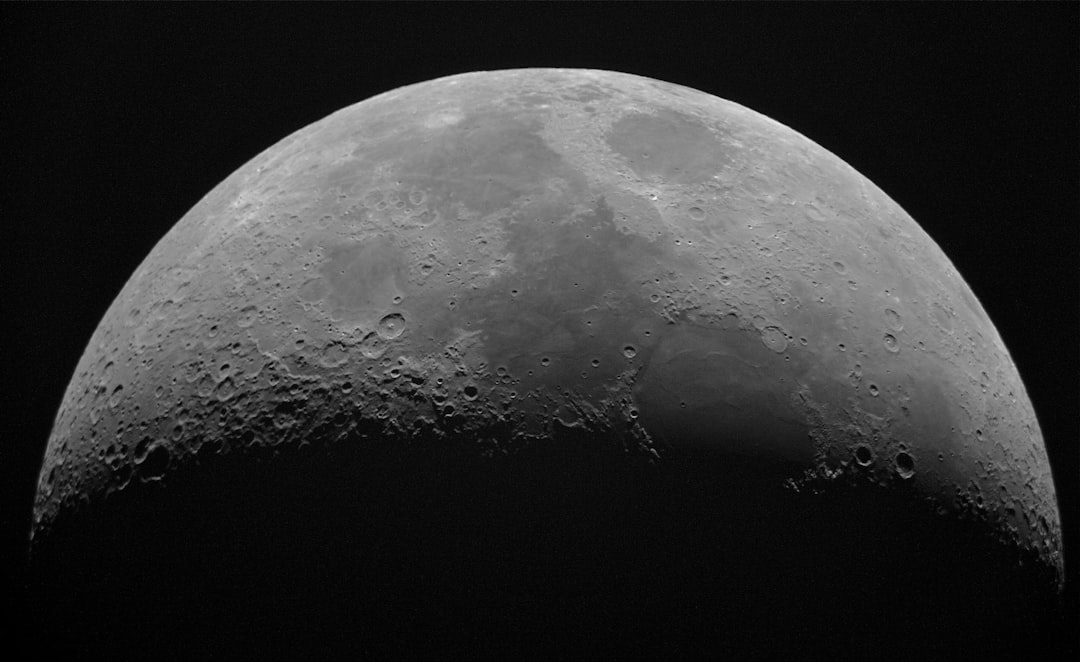
Our planet Earth doesn't journey through space alone. A fascinating collection of celestial companions shadows our world, maintaining an intricate cosmic dance that has captivated astronomers for decades. These objects, scientifically designated as co-orbital asteroids, share Earth's orbital period around the Sun with remarkable precision, completing their solar circuits in exactly one year. For years, the astronomical community has operated under the assumption that these space rocks originated from the main asteroid belt between Mars and Jupiter. However, recent spectroscopic investigations have unveiled a provocative possibility: some of these cosmic travelers might actually be fragments of our own Moon, ejected into space by ancient impacts and now locked in gravitational harmony with their parent world.
This scientific mystery has sparked one of the most intriguing debates in modern planetary science. A groundbreaking study published in the prestigious journal Icarus by researchers Elisa Alessi and Robert Jedicke has now provided compelling statistical evidence that tips the scales toward an asteroid belt origin for most of these objects. Yet the question remains tantalizingly unresolved—until now. With China's Tianwen-2 spacecraft currently en route to collect actual samples from one of these mysterious objects, we stand on the precipice of definitively answering one of space science's most persistent questions about our cosmic neighborhood.
Understanding Earth's Celestial Companions: The Co-Orbital Phenomenon
To fully appreciate this scientific detective story, we must first understand what makes these objects so special. Co-orbital asteroids exist in what astronomers call a 1:1 mean motion resonance with Earth. This technical term describes a precise gravitational relationship where these space rocks take exactly the same amount of time to orbit the Sun as our planet does—approximately 365.25 days. However, unlike Earth's orbit, these asteroids follow more complex trajectories that can take several forms.
Some follow quasi-satellite orbits, appearing to orbit Earth when viewed from our planet's perspective, though they're actually in independent solar orbits. Others trace out horseshoe-shaped paths, periodically approaching and retreating from Earth's position in space. Still others occupy tadpole orbits at gravitationally stable points known as Lagrange points. These various orbital configurations create a dynamic population of cosmic companions that have likely accompanied Earth for millions of years.
The discovery and cataloging of these objects has accelerated dramatically in recent years thanks to advanced near-Earth object survey programs. Currently, astronomers have identified 57 known co-orbitals larger than 10 meters in diameter, though statistical models suggest many more await discovery. Each new detection adds another piece to the puzzle of understanding how these objects arrive at their current positions and where they originally came from.
The Curious Case of Kamo'oalewa: A Moon Fragment or Asteroid Impostor?
Among all known co-orbital asteroids, one stands out as particularly enigmatic: (469219) Kamo'oalewa. This small space rock, measuring somewhere between 24 and 107 meters in diameter, has become the poster child for the lunar origin hypothesis. Its name, derived from Hawaiian, appropriately translates to "oscillating celestial object" or "moving fragment of heaven"—a fitting description for an object whose very nature oscillates between two competing theories.
What makes Kamo'oalewa so special is its spectral signature—the unique pattern of light wavelengths it reflects when observed through telescopes. When astronomers analyzed this spectral fingerprint, they found it bore a striking resemblance to space-weathered lunar silicates, the materials that compose the Moon's ancient surface. This discovery sent shockwaves through the planetary science community, as it suggested something extraordinary: this asteroid might actually be a piece of the Moon itself, blasted into space by a cataclysmic impact.
The spectral match between Kamo'oalewa and lunar surface materials is remarkably close, exhibiting the characteristic absorption features of pyroxene-rich lunar regolith that has been weathered by billions of years of solar radiation and micrometeorite bombardment.
Some researchers proposed an audacious origin story: Kamo'oalewa could have been created during the impact that formed Giordano Bruno, a prominent 22-kilometer-wide lunar crater located on the Moon's far side. Geological evidence suggests this crater formed relatively recently in cosmic terms—somewhere between 1 and 10 million years ago. The theory posits that this violent collision could have excavated material with sufficient velocity to escape the Moon's gravitational pull and eventually settle into a co-orbital trajectory with Earth.
The Energy Problem: Why Lunar Origin Seems Astronomically Unlikely
Here's where the physics becomes challenging. Launching a 50-meter rock from the lunar surface into a stable quasi-satellite orbit around Earth requires an absolutely staggering amount of energy. The Moon's escape velocity is approximately 2.38 kilometers per second, but achieving the precise trajectory needed for co-orbital capture demands even more specific conditions. The impacting object would need to strike at exactly the right angle, with precisely the right velocity, to eject fragments that could eventually stabilize into Earth's co-orbital space.
The new research by Alessi and Jedicke tackled this problem with sophisticated computational modeling. Using advanced supercomputers, they simulated the trajectories of 12,000 synthetic particles launched from the lunar surface at varying speeds and angles. These virtual fragments were tracked through millions of years of orbital evolution, accounting for the complex gravitational influences of the Sun, Earth, Moon, and other planets. The simulation aimed to determine how many of these ejected particles would eventually settle into stable co-orbital configurations.
The results were sobering. According to their models, the probability of an impact event capable of creating a co-orbital like Kamo'oalewa occurs only once every 20 billion years—nearly 1.5 times the current age of the universe itself. Their calculations suggested that the current steady-state population of lunar-derived co-orbitals larger than 10 meters should number only around 70 objects. Based purely on orbital dynamics, they assigned approximately a 21% probability that Kamo'oalewa originated from the Moon.
The Asteroid Belt Alternative: A More Probable Source
If lunar origin seems statistically improbable, where else could these co-orbitals come from? The researchers turned their attention to the main asteroid belt, that vast reservoir of rocky debris orbiting between Mars and Jupiter. This region contains millions of asteroids ranging from dust-sized particles to dwarf planet Ceres, which spans nearly 1,000 kilometers in diameter. Over millions of years, gravitational perturbations from Jupiter and other planets gradually nudge some of these asteroids into orbits that bring them closer to the Sun and Earth.
Using a sophisticated population model called NEOMOD3 (Near-Earth Object Model version 3), the researchers simulated the steady drift of objects from the main belt into near-Earth space. This model accounts for various dynamical pathways, including resonances with planets, the Yarkovsky effect (a subtle force caused by thermal radiation from asteroids), and close planetary encounters that can dramatically alter orbits. The results painted a very different picture from the lunar origin scenario.
According to their simulations, the main asteroid belt should supply approximately 1,600 co-orbital objects larger than 10 meters under current conditions. This number dwarfs the predicted lunar contribution by more than 20-fold. By combining both populations, the researchers calculated that the likelihood of any randomly selected co-orbital being of lunar origin is only about 4.3%—making asteroid belt provenance the overwhelming favorite from a statistical standpoint.
The Sample Size Problem and Observational Biases
However, statistics based on models are only as good as the observations that validate them. Currently, astronomers have identified only 57 confirmed co-orbitals in the relevant size range—a sample size that's far too small to definitively test whether the theoretical predictions match reality. This limited census results from several observational challenges:
- Detection Difficulty: These objects are small, dark, and spend most of their time far from Earth, making them extremely challenging to spot even with modern telescopes
- Survey Coverage Gaps: Astronomical surveys have traditionally focused on potentially hazardous asteroids on Earth-crossing orbits, potentially missing many co-orbitals
- Brightness Variations: Co-orbitals vary dramatically in brightness as their distance from Earth changes, complicating detection and characterization
- Observational Bias: Surveys may preferentially detect co-orbitals with certain orbital characteristics, skewing our understanding of the true population
These limitations mean that while the models strongly favor an asteroid belt origin, observational confirmation remains elusive. The true test will come not from statistics or simulations, but from direct physical analysis of actual samples—which is exactly what's about to happen.
Tianwen-2: China's Mission to Solve the Mystery
Launched in May 2025, China's Tianwen-2 spacecraft represents humanity's best chance to definitively answer the question of Kamo'oalewa's origin. The mission is currently making its final approach to the enigmatic asteroid, carrying sophisticated instruments designed to analyze its composition in unprecedented detail. The spacecraft's primary objective is ambitious yet straightforward: collect approximately 1 kilogram of surface material and return it to Earth for comprehensive laboratory analysis.
This sample return mission follows in the footsteps of other successful asteroid sample return missions, including Japan's Hayabusa2 and NASA's OSIRIS-REx. However, Tianwen-2 faces unique challenges due to Kamo'oalewa's small size and complex orbital dynamics. The spacecraft must execute precise maneuvers to match the asteroid's motion, gently touch down on its surface, collect samples using a sophisticated sampling mechanism, and then begin the long journey back to Earth.
The samples, once returned to Earth, will undergo an exhaustive battery of tests. Scientists will analyze their mineralogical composition, isotopic ratios, crystalline structure, and space weathering characteristics. These analyses will provide definitive answers about whether the material matches lunar samples collected during the Apollo missions or if it bears the distinct chemical fingerprints of main belt asteroids.
Scientific Implications: Either Answer Revolutionizes Our Understanding
Regardless of what Tianwen-2's samples reveal, the results will profoundly impact our understanding of planetary science. If the samples confirm an asteroid belt origin, scientists will face the fascinating challenge of explaining Kamo'oalewa's lunar-like spectral signature. This could reveal new insights into:
- Asteroid Composition Diversity: The main belt may contain a wider variety of materials than previously recognized, including silicate-rich asteroids that spectroscopically mimic lunar material
- Space Weathering Processes: The effects of solar radiation and micrometeorite bombardment might create spectral signatures that can mislead remote observations
- Dynamical Evolution: Understanding how asteroids migrate from the main belt to Earth co-orbital space could inform planetary defense strategies
Conversely, if the samples unequivocally prove a lunar origin, the implications would be even more revolutionary. Scientists would need to fundamentally reconsider their understanding of:
- Impact Mechanics: Current models of how impacts eject material from planetary bodies would require substantial revision to explain how such large fragments could achieve the necessary velocities
- Crater Scaling Laws: The relationships between impact energy, crater size, and ejecta velocity might be more complex than current theories suggest
- Lunar Bombardment History: A confirmed lunar fragment in co-orbital space would provide new constraints on the timing and intensity of impacts on the Moon
- Near-Earth Object Population: Other spectroscopically unusual near-Earth asteroids might also be lunar fragments, requiring a comprehensive reassessment of the near-Earth object population
The beauty of this investigation lies in its binary nature: either outcome fundamentally advances our knowledge. If Kamo'oalewa is an asteroid, we learn something profound about asteroid composition and spectroscopy. If it's lunar, we revolutionize our understanding of impact processes and the Moon's recent history.
The Future of Co-Orbital Research and Exploration
The Tianwen-2 mission represents just the beginning of a new era in co-orbital asteroid research. As telescope technology advances and survey programs become more comprehensive, astronomers expect to discover many more of these cosmic companions. Future missions might visit other co-orbitals, building a more complete picture of this diverse population. Some researchers have even proposed that co-orbital asteroids could serve as ideal targets for asteroid mining operations or as waypoints for deep space missions, given their relatively accessible orbits.
The European Space Agency and NASA are also planning missions that could provide additional context for understanding Earth's co-orbital population. The upcoming ESA Hera mission to the Didymos binary asteroid system will test technologies applicable to future co-orbital missions, while NASA's near-Earth object survey programs continue to expand our census of these objects.
As we await Tianwen-2's sample return, currently expected in the coming years, the astronomical community remains engaged in active observation and modeling of co-orbital asteroids. Each new discovery and each refined model brings us closer to understanding not just where these objects come from, but what they can tell us about the broader dynamics of our Solar System. The answer to Kamo'oalewa's origin will arrive not through theoretical arguments or statistical analyses, but through the hard evidence of actual samples—the gold standard of scientific investigation that has driven space exploration since its inception.
This ongoing investigation exemplifies how modern space science combines ground-based observation, sophisticated computer modeling, and ambitious spacecraft missions to answer fundamental questions about our cosmic environment. Whether Kamo'oalewa proves to be a wandering asteroid or a lunar fragment, the journey to discover its true nature has already enriched our understanding of the complex gravitational choreography that shapes the space around our planet.