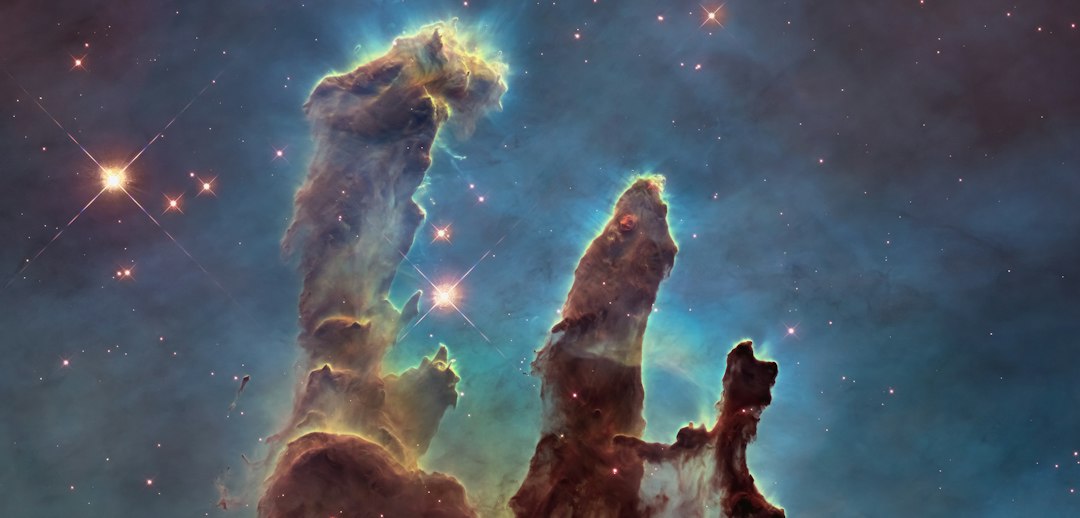
Examining the Cat's Head Nebula with the Hubble Space Telescope and JWST
Few cosmic structures capture the imagination quite like a nebula that resembles a living creature. The Cat's Head Nebula earns its evocative name from a striking visual resemblance: when viewed through a telescope, the structure appears as a cat sitting with its body facing away from the observer, its head turned back over its shoulder — an effect dramatically highlighted by a brilliantly positioned star that serves as a glowing, almost watchful eye. Far from being a mere astronomical curiosity, however, this sculptural formation is a dynamic, scientifically rich environment carved from gas and dust by the ferocious radiation of some of the galaxy's most extreme young stars.
The unusual shape is not accidental. It is the direct consequence of stellar feedback — the collective term for the radiation pressure, ultraviolet photons, and supersonic stellar winds that young, massive stars pump relentlessly into their surroundings. These forces sculpt the interstellar medium over millions of years, creating pillars, arcs, globules, and intricate filaments that trace the ongoing, turbulent drama of star birth and death.
A Window into the Carina Nebula
The Cat's Head Nebula is a relatively compact feature nestled within one of the most spectacular and scientifically important regions in the southern sky: the Carina Nebula (NGC 3372). Sprawling across more than 300 light-years and located approximately 7,500 light-years from Earth in the constellation Carina, this vast stellar nursery is one of the largest and brightest emission nebulae in the entire Milky Way. It dwarfs even the famous Orion Nebula in both size and total stellar mass, and it hosts some of the most extreme stellar environments known to astronomers.
At the heart of the region lies the Carina OB1 association, a grouping of young, hot, and extraordinarily massive stars whose combined radiative output is difficult to overstate. OB associations are loose clusters of O-type and B-type stars — the most luminous and shortest-lived stars in the universe — that have recently formed from the same molecular cloud and have not yet had time to drift apart. Their powerful ultraviolet radiation and stellar winds are the primary architects of the nebula's complex morphology.
"The Carina Nebula is a natural laboratory for studying the interplay between massive stars and their surroundings — a process that has shaped galaxies since the earliest cosmic epochs."
Of particular scientific and historical interest within this region is Eta Carinae, one of the most luminous and enigmatic stellar systems known. This binary system — consisting of at least two massive stars — radiates with a combined luminosity more than 5 million times greater than the Sun. Eta Carinae underwent a spectacular eruption in the 1840s, briefly making it the second-brightest star in the night sky, an event now classified as a supernova impostor. The aftermath of that eruption produced the Homunculus Nebula, a bipolar shell of gas and dust ejected during the outburst, still expanding today and not visible in the Cat's Head images. Eta Carinae is widely considered a prime candidate for a future core-collapse supernova, an event that would be visible to the naked eye from Earth. You can learn more about this remarkable system through the NASA Hubble Mission site and the HubbleSite image archive.
Two Observatories, Three Wavelength Windows
In a landmark observational effort, both the Hubble Space Telescope (HST) and the James Webb Space Telescope (JWST) turned their instruments toward the Cat's Head Nebula. Rather than redundant coverage, each telescope offered a fundamentally different and complementary perspective — a scientific strategy that illustrates why astronomers rely on multi-wavelength astronomy to build a complete picture of cosmic phenomena.
Hubble's Visible-Light Portrait
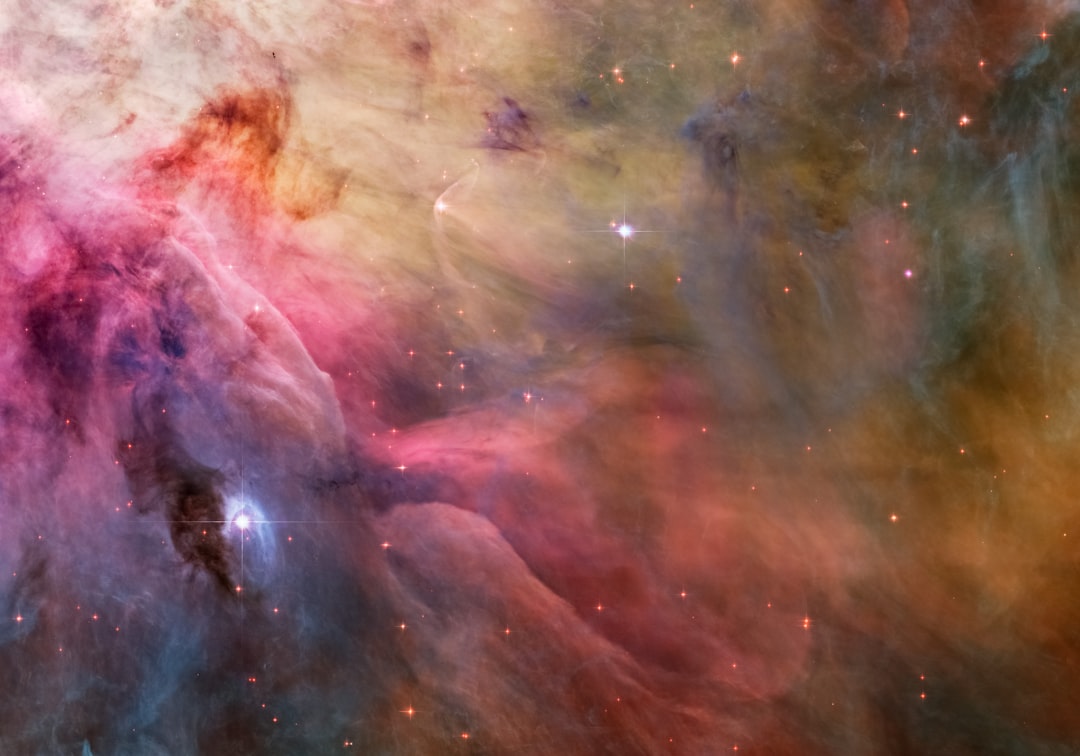
Hubble's image of the Cat's Head is captured in visible light, the portion of the electromagnetic spectrum our own eyes are sensitive to, supplemented by narrowband filters tuned to specific atomic emission lines. These filters isolate light emitted by ionized elements such as sulfur (S II), hydrogen (Hα), and doubly ionized oxygen (O III), each glowing at a characteristic wavelength as electrons cascade between energy levels following ionization by ultraviolet radiation.
In this image, the central pillar of the Cat's Head reveals itself to be composed of thick, cold molecular dust that has so far withstood the onslaught of stellar wind and radiation emanating from the surrounding massive stars. The survival of this structure reflects a delicate balance: the column density of the dust is high enough to shield inner regions from ionizing photons, but the battle is being lost at the margins. A distinctive yellow outline along the pillar's right side marks an active photoevaporation front — a boundary where ultraviolet radiation is energetic enough to strip electrons from hydrogen atoms, ionizing the gas and driving it away into the surrounding nebula at speeds of several kilometers per second. Over timescales of tens of thousands to millions of years, this process will ultimately erode the pillar entirely, potentially triggering the collapse of dense knots within the structure into new protostars — or preventing it, depending on the local conditions.
The multicolored arcs and turbulent shoals visible across the Hubble image are equally informative. These structures trace the wavefronts of stellar winds and radiation pressure from the OB association, creating ionization fronts that propagate outward into the surrounding molecular cloud. The interplay between these fronts and the density variations within the cloud produces the intricate, layered morphology that makes images like these so visually compelling.
JWST's Near-Infrared Vision
The James Webb Space Telescope, humanity's most powerful space observatory and the scientific successor to Hubble, was engineered from its inception to excel in infrared astronomy. Its 6.5-meter segmented gold-coated mirror and suite of advanced instruments — particularly NIRCam (Near Infrared Camera) and MIRI (Mid-Infrared Instrument) — allow it to peer through dust that is completely opaque at visible wavelengths, revealing the hidden stellar populations and structures within.
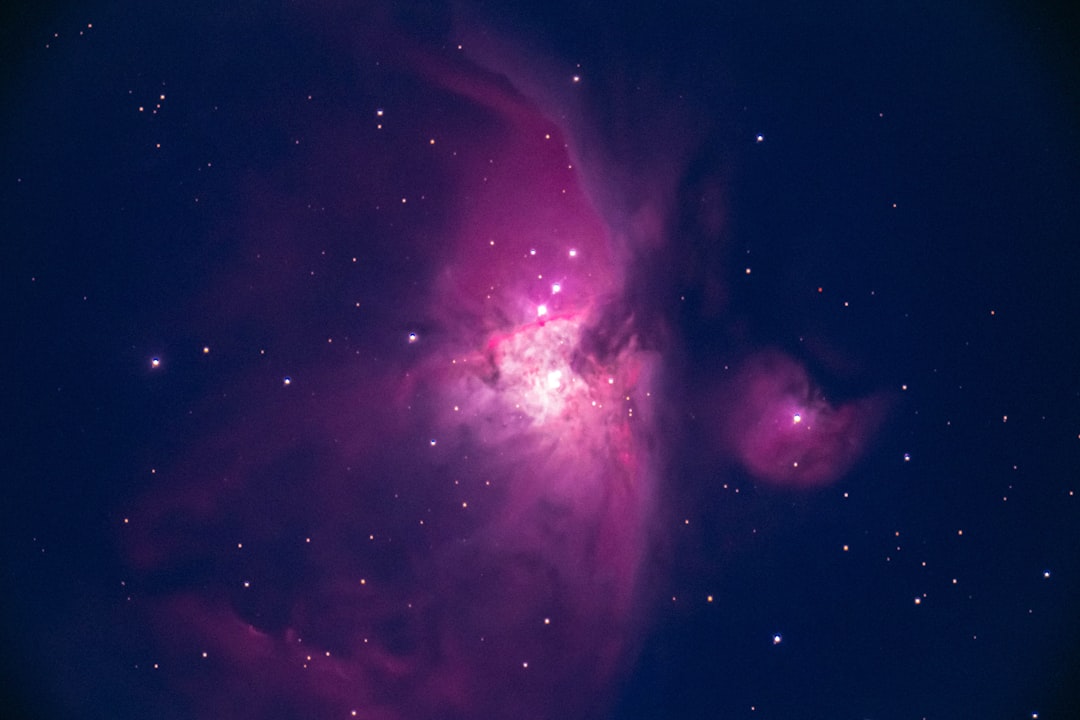
In the near-infrared (NIR) image, the Cat's Head Nebula takes on an ethereal, almost otherworldly appearance. The ghostly quality arises because infrared light penetrates dust more efficiently than visible light; regions that appear as impenetrable dark pillars in Hubble's image become semi-transparent, allowing background stars — and even distant background galaxies — to shine through. This transparency is not merely aesthetic: it allows astronomers to probe the stellar populations embedded within and behind the nebula, characterize their ages and masses, and study how their radiation interacts with the gas and dust on multiple scales.
The NIR image also emphasizes the wispy filamentary structures on the left side of the field, tracing the influence of stellar winds as they encounter and reshape the surrounding interstellar medium. These filaments are diagnostic of the physical conditions in the gas — their morphology, brightness, and spectral properties encode information about the local temperature, density, and magnetic field geometry. The star forming the Cat's Eye feature also appears considerably brighter in infrared, as less of its light is absorbed by intervening dust along the line of sight.
JWST's Mid-Infrared Revelation
Perhaps the most scientifically distinctive view is provided by JWST's mid-infrared (MIR) channel. At these longer wavelengths — roughly 5 to 28 micrometers — the emission is dominated not by starlight scattered or transmitted through the dust, but by the thermal emission of the dust itself, along with complex polycyclic aromatic hydrocarbons (PAHs) and other carbon-based molecules that are excited by ultraviolet photons and re-radiate in the mid-infrared. These molecular species are fundamental tracers of the photodissociation regions (PDRs) that form at the boundaries between ionized and neutral gas.
In this image, the Cat's Head Nebula is transformed into something almost unrecognizable — a muted, spectral palette of whites and pastels that evokes Earthly clouds more than any conventional conception of a nebula. The gas appears thicker and more pervasive, as the dust emission fills in regions that appeared transparent in shorter wavelengths. Stars are less dominant in this view, their photospheric emission falling well below the peak of their spectral energy distributions at mid-infrared wavelengths.
Most compellingly, a likely protostellar object — a star in the very earliest stages of formation — emerges into view in the MIR image, embedded within a cocoon of thick dust that is entirely opaque at visible and even near-infrared wavelengths. This infant star is heating its surrounding dust envelope, causing it to glow at mid-infrared wavelengths and betraying its presence to JWST's sensitive detectors. Such embedded protostars are essentially invisible to Hubble, making this a dramatic demonstration of JWST's unique scientific capabilities. For more on JWST's infrared science, visit the official James Webb Space Telescope site.
The Science of Stellar Feedback
Beautiful as these images undeniably are, their primary value is scientific. Together, the three wavelength windows — Hubble's visible light, JWST's near-infrared, and JWST's mid-infrared — provide astronomers with a comprehensive, multi-dimensional portrait of a region where stellar feedback is actively regulating the process of star formation in real time.
Stellar feedback is one of the most consequential and least well-understood processes in astrophysics. The radiation and winds from massive stars can influence star formation in fundamentally opposing ways:
- Triggered star formation: Compression of molecular gas by expanding ionization fronts and stellar winds can push cold, dense gas over the threshold for gravitational collapse, initiating the formation of new stars that might otherwise never have formed.
- Suppressed star formation: The same radiation can also heat and disperse molecular clouds, destroying the reservoir of cold gas from which stars form and effectively shutting down star formation in a region.
- Photoevaporation: UV photons ionize and evaporate the outer layers of dense structures like the Cat's Head pillar, gradually eroding potential star-forming material.
- Turbulence injection: Stellar winds and radiation drive turbulence in the surrounding gas, which can either promote or inhibit gravitational collapse depending on its scale and intensity.
- Chemical enrichment: Massive stars enrich their surroundings with heavy elements synthesized in their interiors, altering the metallicity and cooling properties of the gas and influencing subsequent generations of star formation.
Disentangling these competing effects requires precisely the kind of multi-wavelength, multi-scale observations that the combination of Hubble and JWST provides. By mapping the distribution of ionized gas, warm and cold dust, embedded protostars, and molecular emission simultaneously, astronomers can begin to construct physically self-consistent models of how stellar feedback shapes the star-formation efficiency of a region over time. For the latest research on this topic, the ESA's Webb science portal and the NASA Astrophysics Division provide extensive resources.
JWST and the Quest to Understand Star Formation
It is no accident that star formation across cosmic time is one of JWST's four primary science themes. Understanding how, when, and where stars form — and how efficiently molecular clouds convert their gas into stellar mass — is fundamental to understanding the evolution of galaxies, the enrichment of the interstellar medium, and ultimately the origin of planetary systems like our own.
The Cat's Head Nebula, embedded within the extraordinary laboratory of the Carina Nebula, represents an ideal target for advancing this understanding. The region spans a range of environmental conditions — from the extreme radiation fields near the most massive OB stars to the relatively quiescent outer regions of the molecular cloud — allowing researchers to study how stellar feedback operates across a spectrum of intensities within a single, well-characterized system.
The metallicity of the gas, the age distribution of the stellar population, the dust grain size distribution, and the local magnetic field geometry all play roles in determining where and how efficiently stars form. The multi-wavelength dataset provided by Hubble and JWST allows these parameters to be constrained simultaneously, providing unprecedented leverage on the theoretical models. The HubbleSite remains an excellent resource for tracking ongoing discoveries from both observatories.
Beyond the Eye Candy: A Deeper Appreciation
It is tempting — and entirely forgivable — to appreciate images of the Cat's Head Nebula purely as works of natural art. The swirling gas, the luminous filaments, the semi-transparent dust pillars with galaxies glowing through them, the cloud-white mid-infrared vistas: these are images that inspire awe in scientists and non-scientists alike. The color palettes, while partly chosen for aesthetic clarity, are rooted in real physical data: each hue encodes a specific element, ionization state, temperature, or dust composition that astronomers are actively working to interpret.
But the deeper appreciation — the one that motivates the construction of billion-dollar space telescopes, the careers of thousands of researchers, and decades of theoretical work — comes from recognizing what these images represent. Wrapped within the visual chaos and beauty of the Cat's Head Nebula, the fundamental laws of physics are playing out on a scale that dwarfs all human experience: gravity assembling gas into stars, radiation tearing that same gas apart, molecules forming and dissociating in the interstellar medium, and new suns — perhaps with their own planetary systems — being born from the ruins.
"These images are more than eye candy to astronomers. They are working hard on understanding a process fundamental to the cosmos — deciphering the laws that Nature uses to build stars."
The partnership between Hubble and the James Webb Space Telescope represents one of the most powerful tools ever assembled for exploring these questions. As their combined datasets continue to be analyzed, the Cat's Head Nebula will yield its secrets slowly — one spectrum, one photometric measurement, one carefully modeled image at a time. The result will be a richer, more precise understanding of how the universe makes its stars, and by extension, itself.
For those of us without doctorates in astrophysics, enjoying these images on their visual merits alone is a perfectly worthy pursuit. And it is, in its own way, a participation in the grand human project of looking up and wondering what it all means.