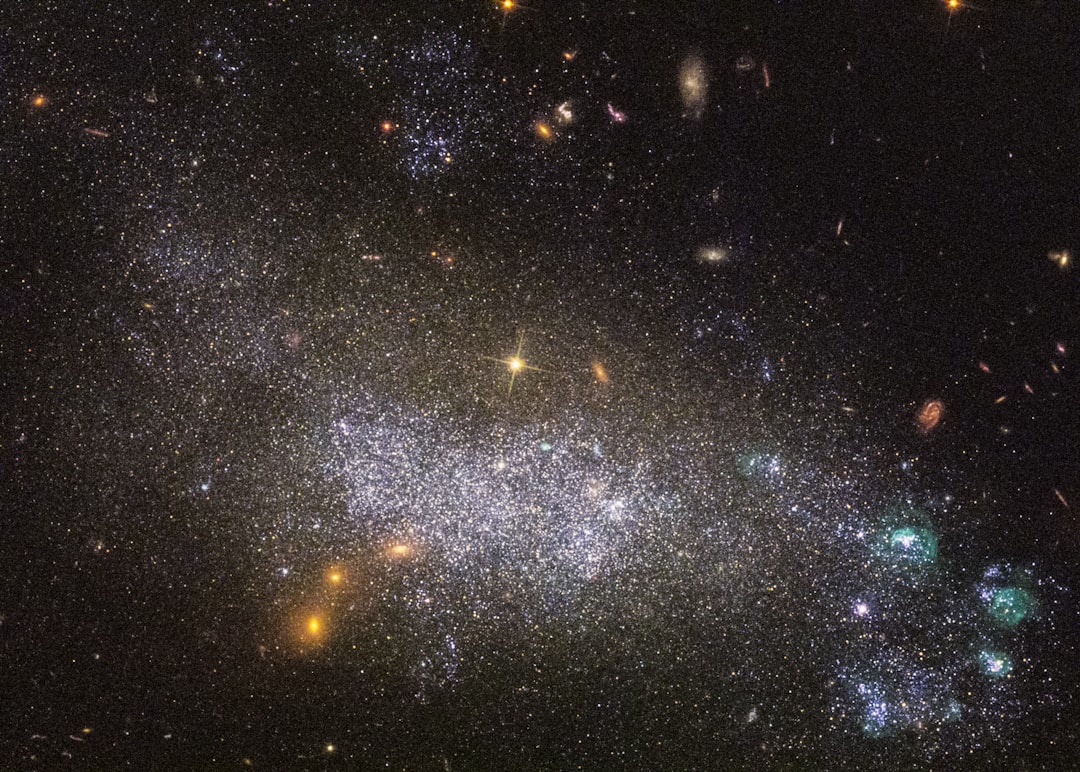
In a groundbreaking astronomical survey that has transformed our understanding of the early cosmos, researchers have identified an astounding 33,000 massive hydrogen gas halos surrounding ancient galaxies that formed during the universe's infancy. This discovery, made possible by the Hobby-Eberly Telescope Dark Energy Experiment (HETDEX) at The University of Texas at Austin's McDonald Observatory, represents a tenfold increase in the number of known Lyman-alpha nebulae and provides unprecedented insight into the mechanisms that fueled galaxy formation during the epoch known as Cosmic Dawn.
The research, led by Dr. Erin Mentuch Cooper and Professor Karl Gebhardt, addresses a fundamental question that has puzzled cosmologists for decades: how did the first galaxies acquire sufficient material to form so rapidly in the early universe? According to Big Bang cosmology and the Lambda Cold Dark Matter (ΛCDM) model, the primordial universe was permeated by vast clouds of neutral hydrogen gas—the raw material from which all cosmic structures would eventually emerge. These findings, published in The Astrophysical Journal, confirm that enormous hydrogen reservoirs, spanning hundreds of thousands of light-years, were indeed ubiquitous during the critical period between 10 and 12 billion years ago.
What makes this discovery particularly significant is not merely the quantity of halos detected, but the comprehensive statistical catalog it provides. Previously, astronomers had identified only approximately 3,000 such structures, leaving major gaps in our understanding of their properties, distribution, and role in cosmic structure formation. The new HETDEX dataset fundamentally changes this landscape, offering researchers a representative sample that spans an enormous range of sizes and luminosities.
Understanding Cosmic Dawn and the Role of Hydrogen Halos
The period known as Cosmic Dawn represents one of the most transformative epochs in the history of the universe. Following the Big Bang approximately 13.8 billion years ago, the universe underwent a period of rapid expansion and cooling. During the first few hundred million years, known as the "Dark Ages," the cosmos was filled with neutral hydrogen gas but contained no luminous objects. This changed dramatically when the first stars and galaxies began to form, illuminating the universe and fundamentally altering its chemical composition through a process called cosmic reionization.
According to theoretical models, these early galaxies required enormous reservoirs of hydrogen gas to sustain their rapid star formation rates. The Lyman-alpha nebulae—massive halos of hydrogen gas surrounding young galaxies—represent these critical fuel supplies. When energetic ultraviolet radiation from newly formed stars and active galactic nuclei interacts with this neutral hydrogen, it causes the gas to emit light at a specific wavelength known as the Lyman-alpha line, making these otherwise invisible structures detectable to sufficiently sensitive instruments.
Dr. Dustin Davis, a postdoctoral fellow and HETDEX scientist who co-authored the study, emphasized the unique capabilities that made this discovery possible:
"The Hobby-Eberly Telescope is one of the largest in the world, and the instrument HETDEX uses produces 100,000 spectra in each observation. So, we have huge amounts of data, and there are all kinds of neat, fun, weird things waiting for us to find."
Revolutionary Observational Techniques and Methodology
The HETDEX survey employs a sophisticated approach that differs fundamentally from traditional galaxy surveys. Rather than targeting individual objects, HETDEX performs blind spectroscopic surveys of large regions of the sky, simultaneously capturing spectral information from hundreds of thousands of sources. This technique, combined with the telescope's impressive light-gathering power, enables the detection of extremely faint spectral features that would be invisible to less capable instruments.
A key innovation in this research involved the use of spectral stacking—a statistical technique where researchers combine the spectra of thousands of distant galaxies to reveal faint signals that cannot be detected in individual observations. By analyzing 70,000 of the brightest early galaxies identified in HETDEX's catalog of 1.6 million distant sources, the team was able to detect the characteristic Lyman-alpha emission from surrounding hydrogen halos in nearly half of these systems.
The computational challenges of this analysis were substantial. Supercomputers at the Texas Advanced Computing Center (TACC) processed the massive dataset, which now totals nearly half a petabyte of astronomical data. This computational infrastructure enabled the team to search for subtle spectral signatures across observations covering a region of sky equivalent to more than 2,000 full Moons—an unprecedented survey volume for this type of research.
Overcoming Previous Observational Limitations
Earlier attempts to catalog hydrogen halos faced significant technical challenges. Previous surveys could only detect the most luminous examples, creating a severe observational bias that skewed our understanding of these structures. Additionally, when astronomers studied the most distant galaxies using techniques like gravitational lensing to magnify their light, the extreme magnification often meant that only the smallest, innermost regions of halos remained visible, while larger structures were effectively filtered out.
As Dr. Cooper explained, this limitation had constrained the field for two decades: "We've been analyzing the same handful of objects for the past 20 or so years. HETDEX is letting us find many more of these halos and measure their shapes and sizes. It has really allowed us to create an amazing statistical catalog." This new catalog bridges the gap between the tiny halos visible in ultra-deep observations and the most extreme, luminous examples, revealing the full diversity of these structures for the first time.
Unprecedented Discovery: Key Findings and Implications
The HETDEX survey has revealed several groundbreaking aspects of hydrogen halos that were previously unknown or poorly understood:
- Ubiquity of Hydrogen Halos: Nearly 50% of the brightest early galaxies examined show evidence of surrounding hydrogen halos, suggesting these structures were a common, perhaps universal, feature of galaxy formation during Cosmic Dawn rather than rare anomalies.
- Extraordinary Size Range: The newly detected halos span an enormous range of sizes, from tens of thousands to hundreds of thousands of light-years in diameter—dimensions that dwarf individual galaxies and in some cases encompass entire galaxy clusters.
- Statistical Completeness: By increasing the known population from approximately 3,000 to 33,000 examples, the survey provides the first statistically robust sample for studying the properties and evolution of these structures across cosmic time.
- Detection Limitations: The research team suspects that many of the fainter systems in their sample possess halos that extend beyond what current observations can detect, suggesting that the true sizes of these structures may be even more impressive than currently measured.
These findings have profound implications for our understanding of galaxy evolution and the physical processes that governed the early universe. The sheer abundance and size of these hydrogen reservoirs confirms theoretical predictions about the fuel requirements for rapid galaxy assembly and provides crucial constraints for computational models of structure formation.
Connections to Modern Observations and Future Research
The timing of this discovery is particularly fortuitous, as it coincides with observations from the James Webb Space Telescope (JWST), which has been revealing surprisingly massive and mature galaxies in the early universe. The HETDEX findings provide crucial context for these JWST discoveries, demonstrating that the massive hydrogen halos necessary to build such galaxies were indeed present during this epoch.
Professor Gebhardt highlighted the unprecedented scope of the survey: "Our observations cover a region of the sky measuring over 2,000 full Moons. The scope is enormous and unprecedented." This vast survey volume ensures that the detected halos represent a fair sample of the early universe rather than isolated special cases, allowing astronomers to draw robust statistical conclusions about galaxy formation processes.
The research team anticipates that their catalog will serve as a foundation for numerous follow-up studies investigating the physics and mechanics of hydrogen halos. Questions that can now be addressed include: How efficiently did these halos channel gas into forming galaxies? What role did they play in regulating star formation rates? How did their properties evolve as the universe aged and galaxies matured?
Technological Legacy and Continuing Discoveries
HETDEX's three-year nominal mission was originally designed to map over one million galaxies to measure the influence of dark energy on cosmic expansion. However, as this discovery demonstrates, the survey's comprehensive spectroscopic data enables a wide range of scientific investigations beyond its primary mission. The nearly half-petabyte dataset captures not only galaxies but also the regions between them, providing an unprecedented three-dimensional map of the universe during a critical phase of its evolution.
Future analysis of this dataset promises additional discoveries. As Dr. Davis noted, the enormous volume of data contains "all kinds of neat, fun, weird things waiting for us to find." The catalog will likely reveal rare or exotic objects, unexpected correlations between galaxy properties and their environments, and perhaps entirely new classes of cosmic structures that current theories have not anticipated.
Implications for Cosmology and Our Understanding of the Universe
This discovery represents more than an incremental advance in observational astronomy—it fundamentally reshapes our understanding of how the universe transitioned from a dark, homogeneous expanse of gas to the rich tapestry of galaxies we observe today. By confirming that massive hydrogen halos were commonplace during Cosmic Dawn, the research validates key predictions of the ΛCDM cosmological model while providing the detailed observational data needed to refine and test theoretical models.
The research also demonstrates the power of large-scale astronomical surveys to address fundamental questions about cosmic origins. While targeted observations of individual objects have their place, systematic surveys like HETDEX reveal the statistical properties of cosmic populations, enabling scientists to distinguish between typical and exceptional examples and to trace how structures evolve over billions of years.
For researchers studying cosmic structure formation, this catalog provides an invaluable resource. The ability to study tens of thousands of hydrogen halos across a range of sizes, luminosities, and cosmic epochs will enable unprecedented tests of theoretical models. Simulations of galaxy formation can now be directly compared against a comprehensive observational sample, allowing theorists to refine their understanding of the physical processes—gas cooling, star formation feedback, and gravitational assembly—that shaped the early universe.
As astronomers continue to probe deeper into cosmic history with next-generation facilities, the HETDEX catalog will serve as a crucial reference point. Future missions will undoubtedly discover galaxies from even earlier epochs, and understanding the hydrogen halos surrounding these ancient systems will be essential for interpreting those observations and piecing together the complete story of how the first galaxies emerged from the primordial darkness to illuminate the cosmos.